Aleksandra is a social scientist and an academic in entrepreneurship at the University of Glasgow, where she teaches and mentors students and startups on a daily basis. Alongside academia, her entrepreneurship work focuses on the intersection of the space sector, big data, and environmental intelligence, particularly across fisheries, ports, and coastal ecosystems connected to marine systems around the world.Through her husband and her many years spent on Pag, Šimuni has become a place she feels very connected to personally.
Šimuni, on the western side of Pag, is the kind of place visitors return to year after year.
For more than 100 years, this small fishing village has been shaped by the sea and by generations of local families living from fishing, farming and hospitality. Today, Šimuni is known for its calm beaches, fresh local food and relaxed pace of life.
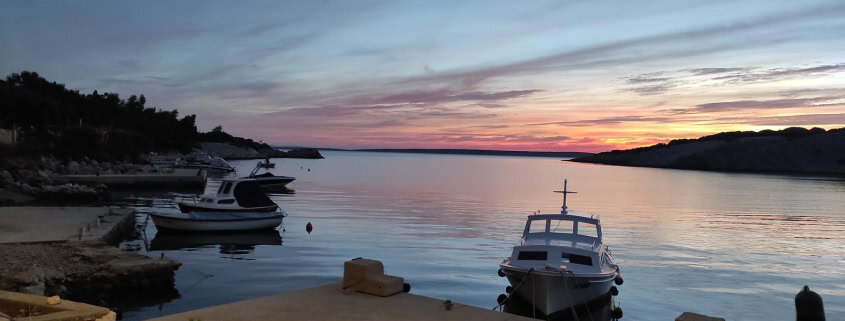
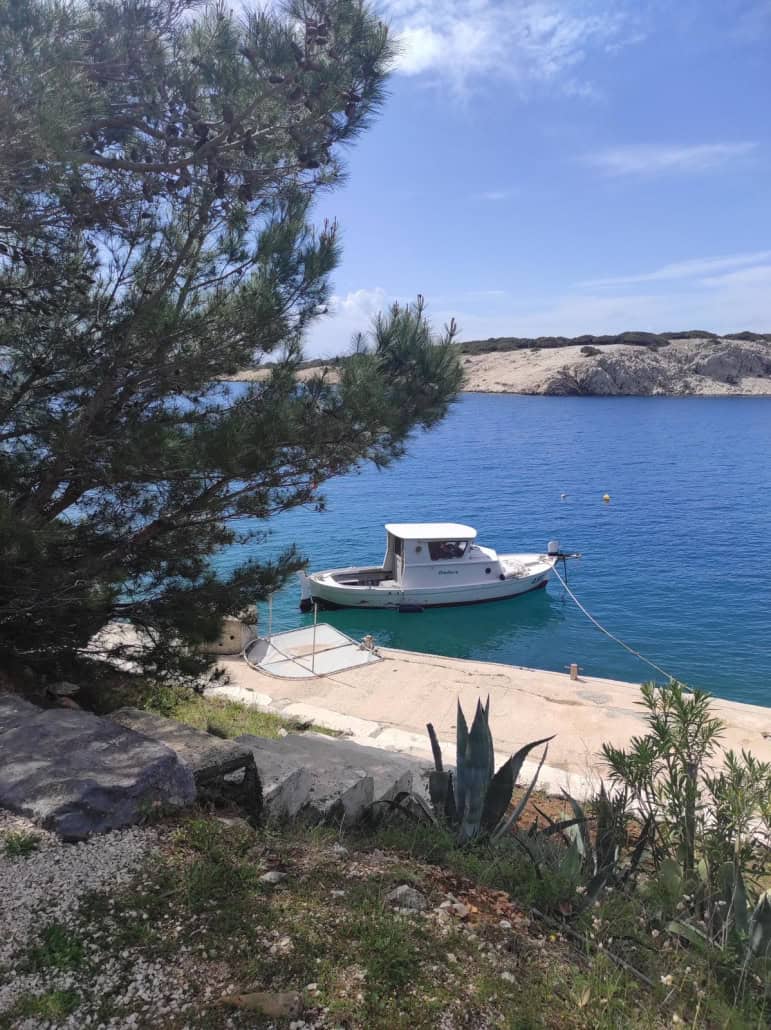
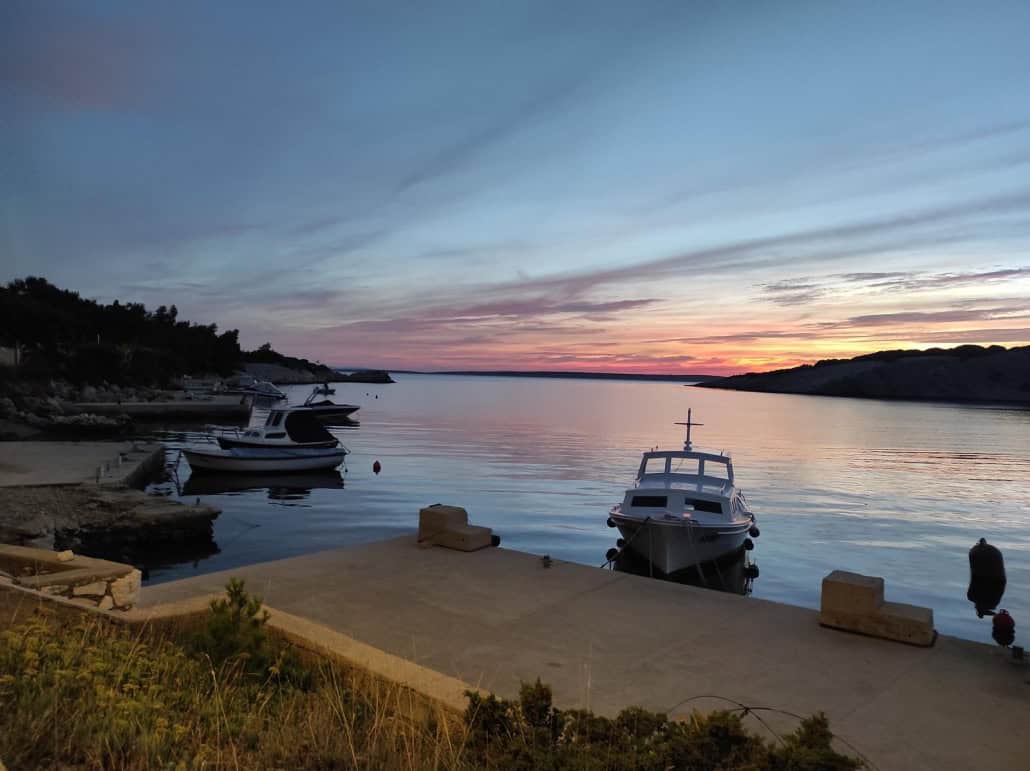
Šimuni Harbour and the relaxed seaside spirit of Pag
If you are planning a visit, here are a few local tips on where to eat, stay and make the most of your time in Šimuni.
Where to Eat
Food is central to life here, shaped by the rich produce of the island. Fresh seafood, island lamb, fragrant olive oil, local wine and the famous Pag cheese (Paška sirana), one of the island’s proudest culinary traditions and an internationally award-winning Croatian cheese, all reflect the distinctive flavours of this part of Croatia.
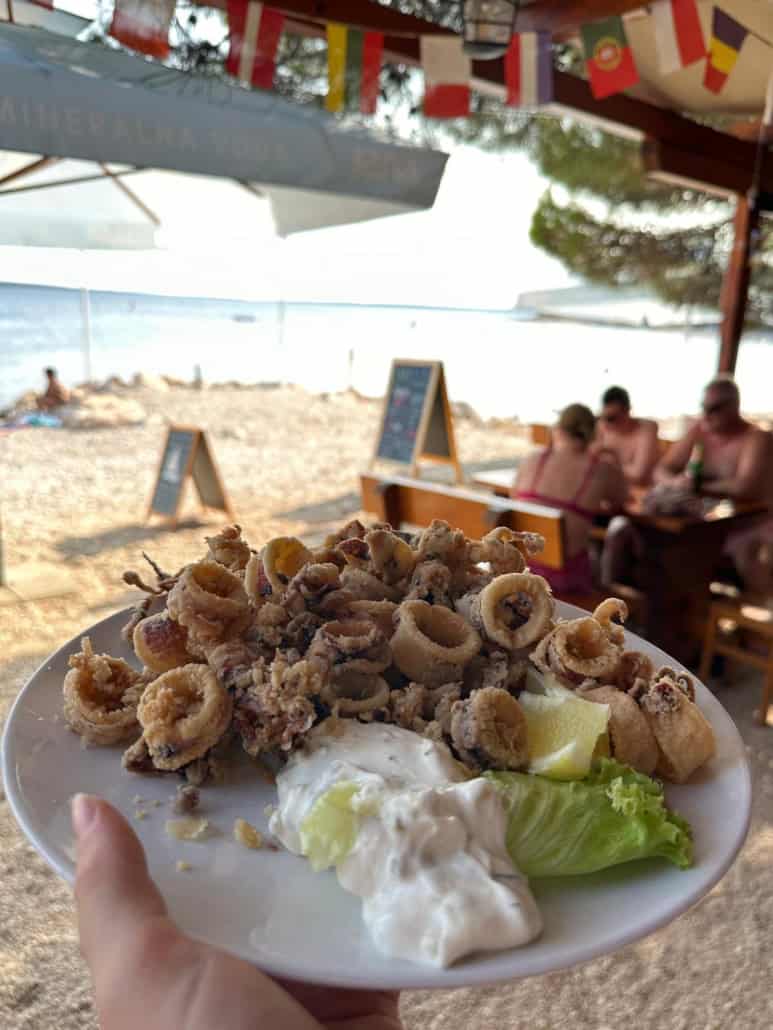
One place to enjoy that local flavour is Leut Beach Restaurant Šimuni, a relaxed waterfront restaurant known for fresh seafood, simple Mediterranean dishes and beautiful sea views.
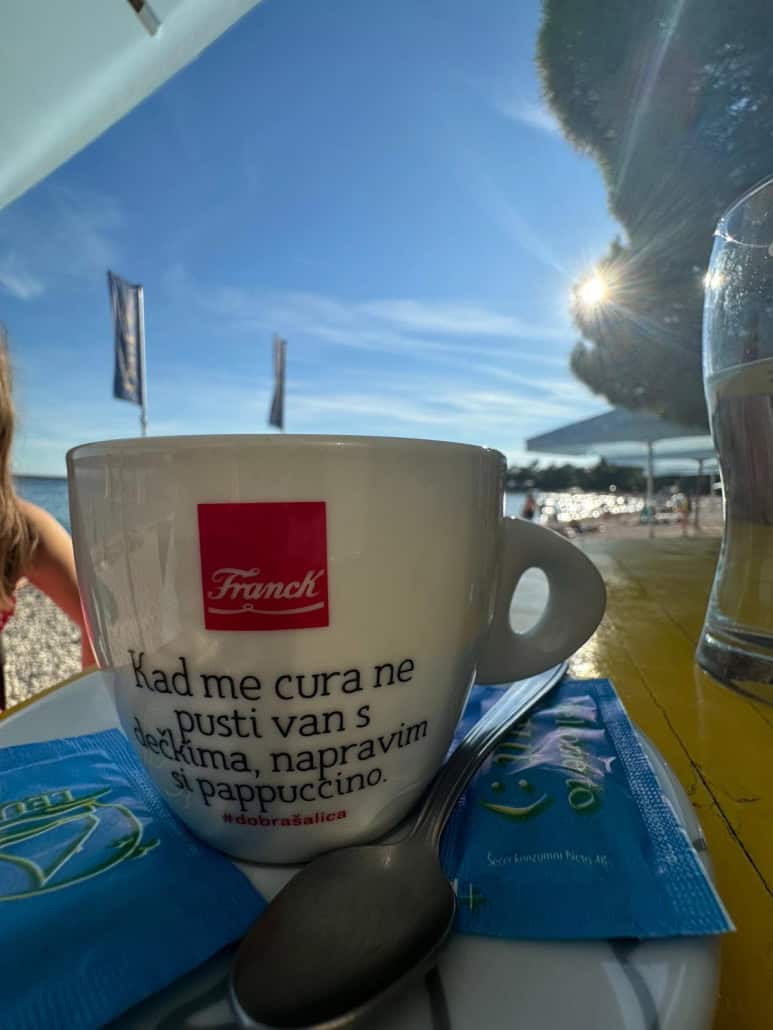
Seaside dining at Leut Beach Restaurant ŠimuniCoffee by the sea – Leut Beach Restaurant Šimuni
Where to Swim and Sunbathe
With crystal-clear waters and a beautiful coastline, the village’s beaches are ideal for families, offering calm sea, plenty of space and welcome shade from pine trees during the warmer months. Whether you are planning a full beach day or a quick morning swim, it offers a relaxed seaside experience away from Croatia’s busier summer crowds.
Crystal-clear waters and family-friendly beaches
Where to Walk
The village is also easy to explore on foot. A walk along the harbour, an evening stroll by the water or a wander through quiet village paths are all part of daily life here. Coastal paths lead through rocky landscapes and pine-covered trails, with beautiful views out to sea.
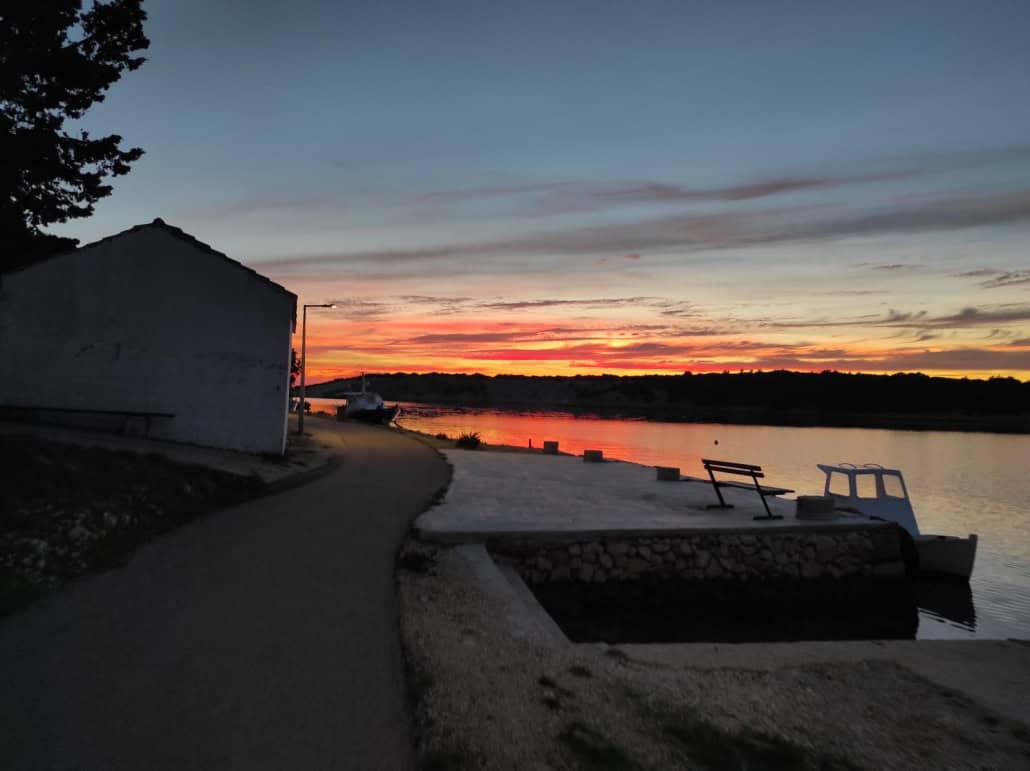
Evening walks along the coast
Where to Stay
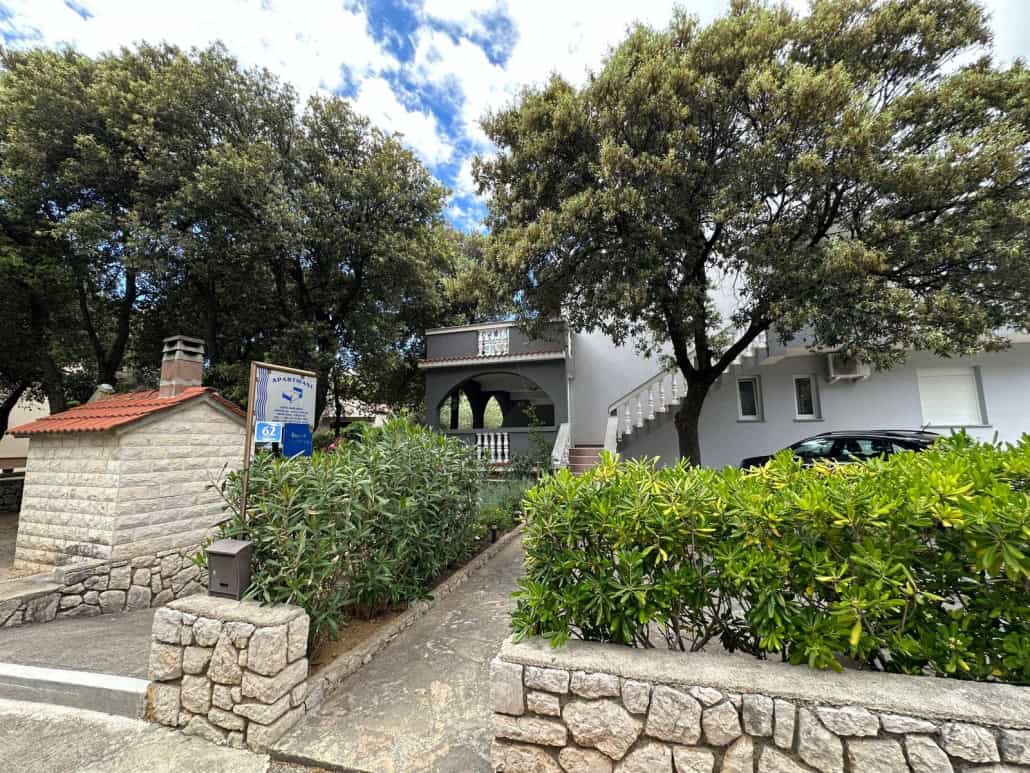
Šimuni is known for its warm, family-run accommodation, from small apartments overlooking the sea to welcoming guesthouses that offer a much more personal feel than larger resort destinations. Places such as Apartmani Brankica reflect that spirit well – simple, comfortable and closely connected to the relaxed local way of life.
Staying here means enjoying sea views, shaded terraces and the kind of local hospitality that makes visitors feel at home.
Family-run accommodation in Šimuni at Apartmani Brankica Šimuni
Taste Local Life
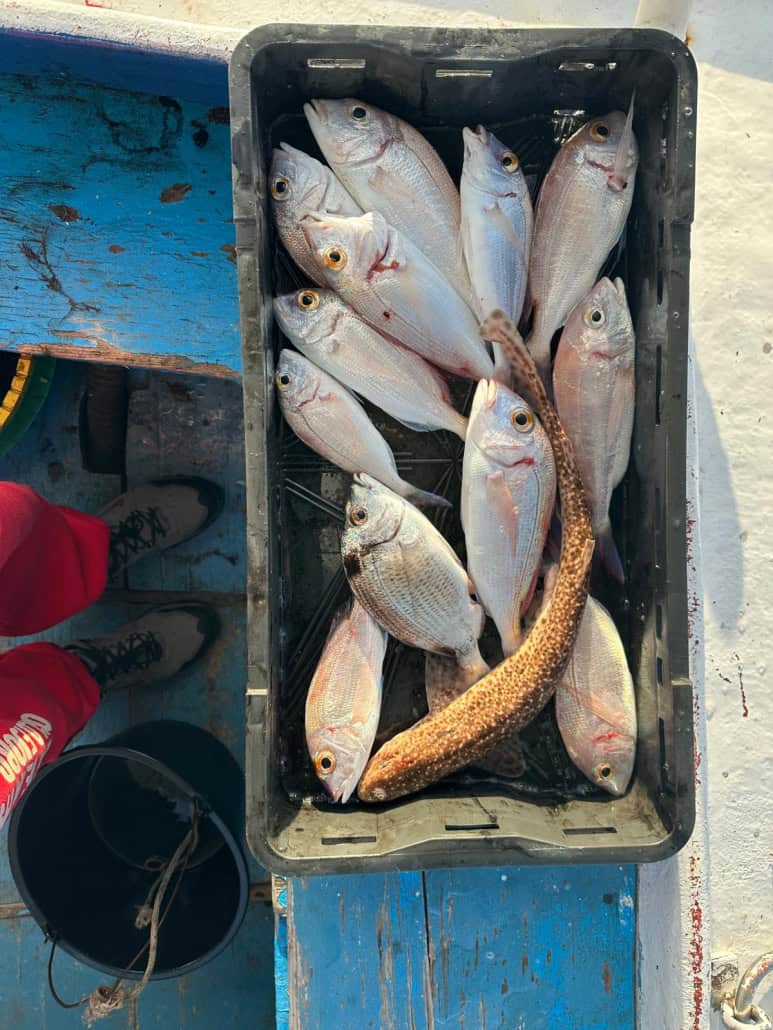
The sea remains at the heart of Šimuni. Small family fishing boats head out each day, returning with fresh catch that soon reaches local kitchens and local fishmongers (Ribara dva), centrally located in the village and, like most places here, only a short five-minute walk from wherever you stay. Fresh seafood remains an important part of everyday life here, reflecting the area’s long connection to the sea.
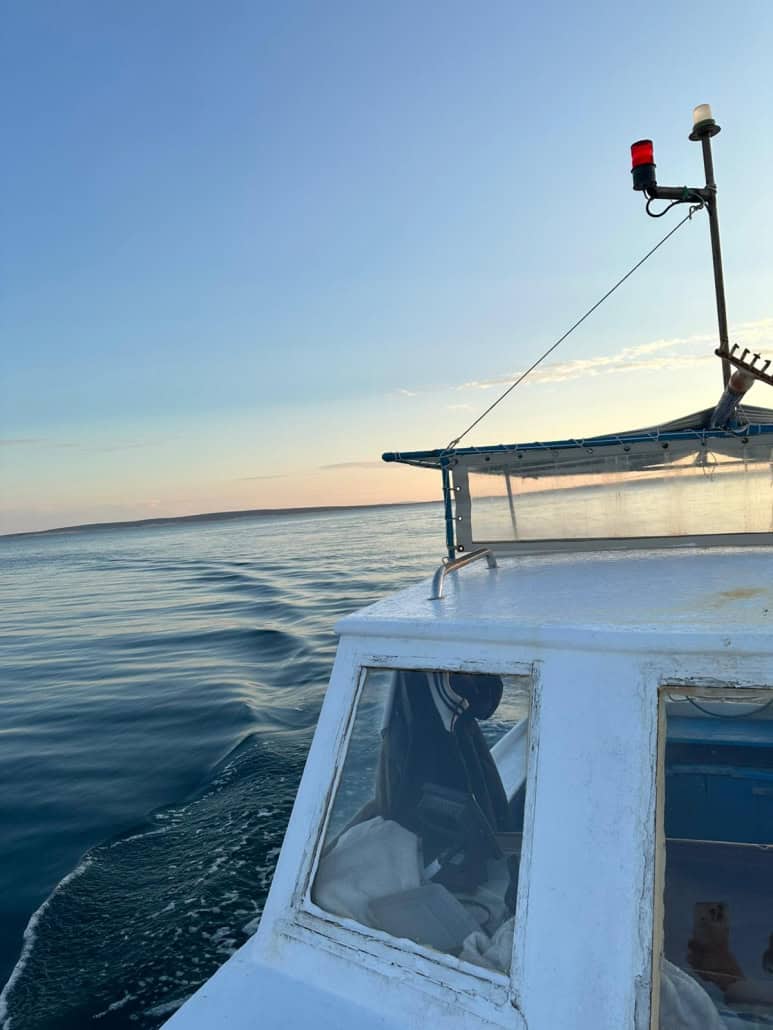
Fresh catch from local watersFishing trips in the local waters
Why Visit Šimuni
Šimuni offers a quieter side of Pag, with calm beaches, fresh local food and a warm village atmosphere. While summer is a wonderful time to visit, April, May, September and October are equally enjoyable, with pleasant weather, quieter beaches and a more relaxed pace. It is a place that has welcomed visitors for many years while keeping its strong family character.
Summer moments by the sea in Šimuni
Thank you for your wonderful write-up on this magical place!
https://www.visit-croatia.co.uk/wp-content/uploads/2026/05/image-3.jpeg11981600annazhttps://www.visit-croatia.co.uk/wp-content/uploads/2017/09/visit-croatia-logo5.jpgannaz2026-05-18 14:50:052026-05-19 13:21:44Discover Šimuni: A Local’s Guide to a Croatian Hidden Gem
With the current political events causing something of a shadow on travel plans and summer holidays this year – mainly down to fuel shortages affecting flights – many travellers are considering altering their travel plans to avoid flights. If you’re travelling from the UK, countries such as France or Spain may seem ideal to visit without taking to the air. But is it possible to reach Croatia through other means? Yes! Although you’ll need to accept a leisurely pace of travel to reach this southern European country. Here, I’ll take you through the different ways of travelling to Croatia without flying.
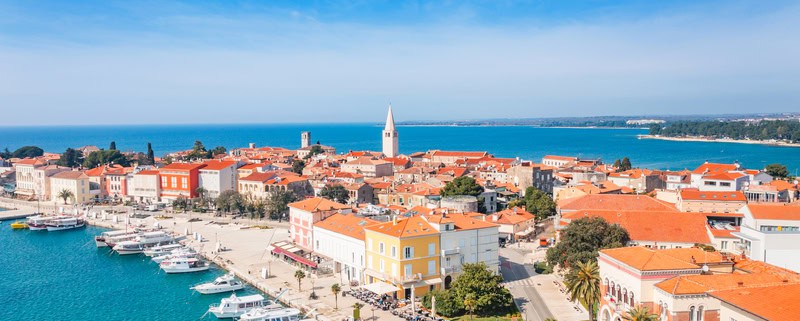
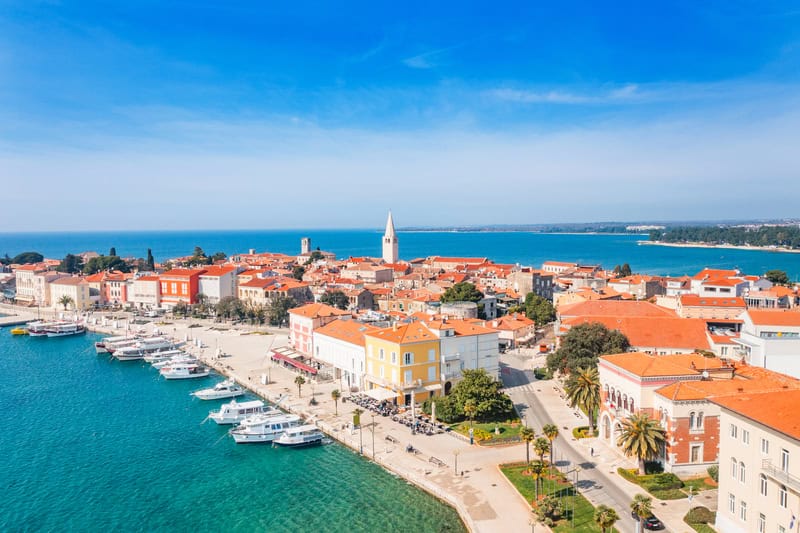
The Istrian town of Porec – you could be here (without boarding a plane)
Travelling to Croatia without flying – By Train
Travelling through Europe by train always has such wonderful connotations, whether it’s young backpackers setting off on an interrailing adventure, or something far more refined and romantic, such as the Orient Express. (Funnily enough, Zagreb was a stop on the original Orient Express route. The super swish and stylish luxury Hotel Esplanade was built in 1925 to accommodate passengers.) If you’ve decided against flying, you may immediately jump to the idea of taking a train instead. And I don’t blame you!
However, if you are travelling to Croatia by train, you will almost certainly need to travel to Zagreb. This city may not be top of your list for a summer holiday destination (although it is a wonderful city to visit), but you will need to make your way to Croatia’s capital city first before travelling on to the coast.
The best idea for travelling to Croatia by train is to make use of the Nightjet services that operate from Stuttgart, Munich and Zurich. These overnight train services depart these cities in the evening (obviously!), which should allow you enough time to get there from the UK, and will also avoid requiring you to spend money on an overnight accommodation stop on your way to Croatia. The Nightjet trains depart Stuttgart 8.30pm, Munich at 11.53pm (this is part of the same route) and at and Zurich at 8.40pm with both trains arriving in Zagreb at 10.30am the next day.
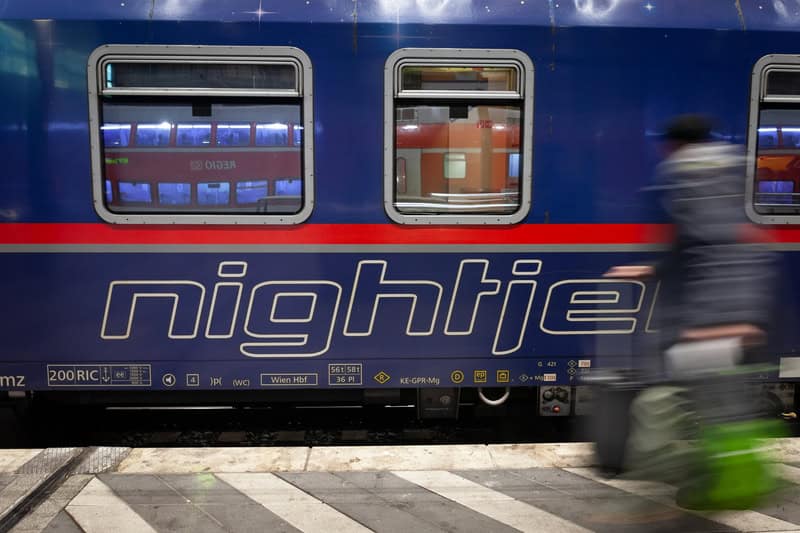
A Nightjet overnight sleeper train
From Stuttgart it’s 14 hours to Zagreb, from Munich it’s 10 hours 37 minutes, and from Zurich it’s 11 hours and 50 minutes. All trains run daily. As these are night train services, beds are available. You can opt for a more budget couchette bed in a compartment that’s shared with others (or a totally private mini-cabin is available) or a bed in a private sleeping car compartment that comes with a private shower and toilet. The most budget option of all is to not opt for any kind of bed, and go for a seat instead! Tickets for these options start from from €59.90 for a seat, from €84.90 for a couchette or from €144.90 for a sleeper cabin.
So, the Nighjet service sounds great (it really does!), but what about getting from the UK to Stuttgart, Zurich or Munich? The small matter of the Channel being in the means you will have to use the Eurostar to get to the continent, there’s no getting around that. Once you’re in Paris, you will definitely need to change trains – possibly even stations – to make the onward journey.
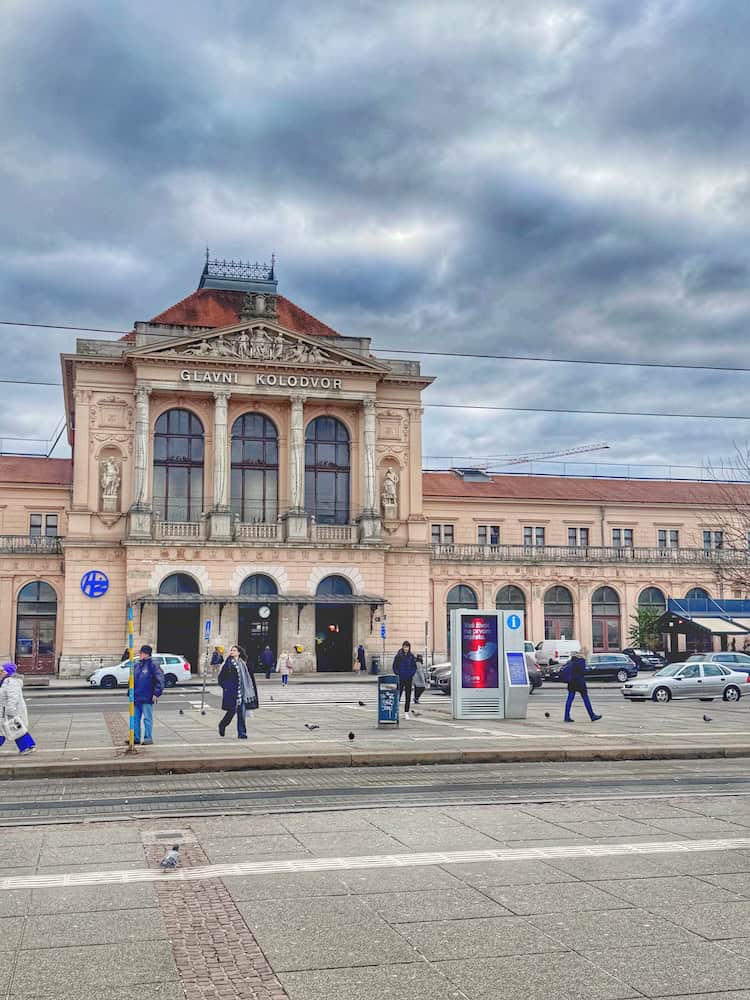
Arrive at Zagreb Glavni Kolodvor, the main train station in the city, with an overnight train
Here’s where booking gets a bit tricky. You could book the whole journey from the UK to Zurich/Stuttgart/Munich on a website such as Trainline, but I don’t believe it offers all the best train options. I would suggest looking up train times on the websites of Eurostar, Die Bahn, TGV Lyria or ÖBB to piece together a journey plan.
Travelling to Croatia without flying – By Bus/Coach
Geography dictates that if you’re travelling to Croatia by bus from the UK, you will (once again) see a route that goes through Germany. The large-scale international bus operator Flixbus is your best option for planning this type of journey – you can even use their website to put in your UK starting point and your end Croatian destination. No faffing about on multiple websites.
Travelling by bus all the way to Croatia is a loooonnng journey, there’s no two ways about it. However, bus travel is considerably cheaper than travelling by train. As with travelling by train, you can utilise overnight buses to avoid having to pay for accommodation along the way.
1980s me would absolutely applaud your decision to travel to Croatia by car, although seeing as I was only a child then and not doing any of the driving, I had it easy! But what could be better than a road trip to Europe to a beautiful destination on the Croatian Adriatic?
I hate to sound like a stuck record, but once again, Germany will be your friend, at least when travelling through Europe. Yes, that big country is “in the way” when it comes to making the journey southeastwards from the UK to Croatia, but the massive plus is the excellent autobahns.
Use a website such as Via Michelin to plan your route and to estimate the costs of driving to Croatia. This non-flying method of travel WILL require a stopover (at least one, two is better) on your way, so do factor this in to your plans and your costs. Plan a stop in Germany and enjoy some bratwurst and bier for your supper.
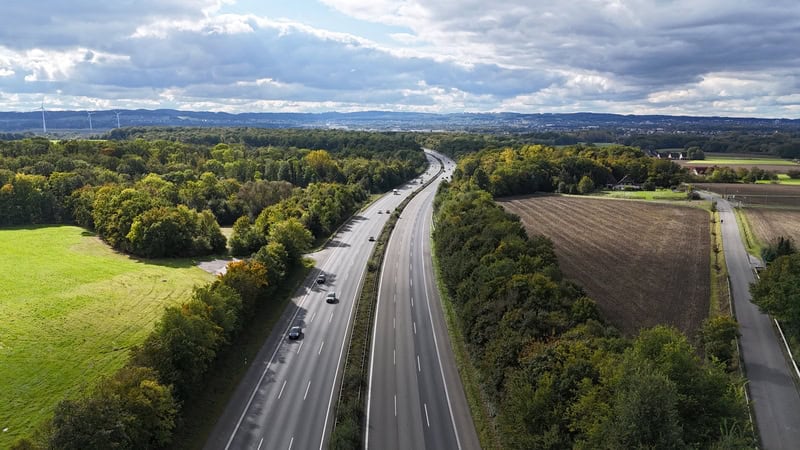
An aerial view of an autobahn in Germany
A long-established driving route from the UK to Croatia:
take a ferry from England’s south coast to France
make the crossing over into Belgium almost immediately and drive in the direction of Brussels and then Germany
into Germany towards Cologne
head in a southeast direction towards Kolblenz – Mainz – Frankfurt – Nuremberg
into Austria near-ish Linz to then head south towards Slovenia and then Croatia
Your route will ultimately be decided by where in Croatia you are trying to reach. A more southerly route in Germany (via Stuttgart and Munich) will lead you towards Salzburg in Austria, allowing you to head south towards Ljubljana in Slovenia and then further south in the direction of the Croatian coast close to Rijeka.
As well as planning your route, the most involved part of this way of travelling is to make sure your car is ready for the cross-Europe journey. Consult a website such as the RAC or the advice from GOV.UK to make sure you have all the necessary paperwork and that your car meets the requirements for driving on the continent.
A massive plus of driving to Croatia is that you can pile your car high with your belongings – seven pairs of shoes per person, it is! – and you can of course make use of your own car when exploring Croatia. Gosh, I’m excited for you just with the idea of driving to Croatia by car!
Other options for travelling to Croatia without flying
Other options than flying? If I don’t mean train, bus or driving, what’s left – hot air balloon? (Although, really, that would also be flying.) Walking? Teleportation?!
No, silly. What I mean is combining a few methods of transport. Mixing together journeys by train and bus would be very doable, but you could also make your way over to the Italian Adriatic coastline and then take a ferry over to Croatia. That would enable you to travel directly to the Croatian coastline, avoiding the need to travel via Zagreb.
Top tips for travelling to Croatia without flying
Let’s face it, not travelling by plane involves a relatively lengthy journey from the UK to Croatia – there’s no getting around that. With the existence of low-cost airlines offering very budget flights, travelling by train, bus, or car can suddenly seem rather costly indeed.
It’s up to you to decide whether you’d like to take on a non-flying European adventure in travelling to Croatia. Realistically, you may wish to expand your holidays and do a multi-site European trip, and take even longer to reach Croatia by making multiple stops along the way.
Imagine a thoroughly enjoyable stay in Paris, Munich, Zurich, Milan, Berlin, Vienna or elsewhere as well as a holiday in Croatia. Wonderful!
https://www.visit-croatia.co.uk/wp-content/uploads/2026/05/getting-to-croatia-without-flying_porec-aerial-view.jpg533800annazhttps://www.visit-croatia.co.uk/wp-content/uploads/2017/09/visit-croatia-logo5.jpgannaz2026-05-15 17:17:112026-05-15 17:17:12The best ways of travelling to Croatia without flying
Now that we’re in May, a number of exceedingly popular ferry and catamaran routes in Croatia have started up for the season, or are about to increase the frequency of operation. It’s an exciting time to be alive! Sorry, no wait – it’s an exciting time to go to Croatia and set sail on the Adriatic using Croatian ferries. So let’s take a look at where Croatia’s ferry and catamaran lines are sailing to at the moment.
TP Line lives in the 21st century
It wasn’t that long ago that pre-booking tickets on Croatia’s ferry and catamaran lines was a pretty archaic system, with online bookings practically non-existent. Thankfully, those days are well in the past, with online bookings readily available. TP Line are taking things even further with all sorts of excellent tech advances that are sure to help all travellers this year.
Not only can you now use Apple Pay or Google Pay to buy your tickets right from your smartphone, you can now also ask the company any questions using their helpful online chatbot. All of this is available on the easy-to-use TP Line Web Shop.
If this wasn’t helpful enough, they offer clear instructions for Boarding Locations on the islands and the mainland – for I know this sometimes confuses travellers – and you can even find out where their catamarans are right now.
This summer, TP Line are the only operator to be running two long-distance Split to Dubrovnik (and return) catamarans.
Their Dubrovnik – Korcula – Hvar – Milna (Brac) – Split catamaran started operating daily from 1st April, and will do so until 31st October. This one sails from Dubrovnik at 8am, arriving in Split at 1.25pm. The return journey departs Split at 3.10pm, arriving back into Dubrovnik at 8.20pm.
On 8th May (next week), their second catamaran operating the same route cranks up its engines to set sail. This second sailing will also operate daily (until 18th October), departing Split in the morning at 9am and arriving in Dubrovnik at 2.15pm. The return journey departs Dubrovnik at 2.55pm and arrive in Split at 8pm.
Yesterday, 30th April, saw the launch of their Split – Hvar sailings which will run three times a day until 31st October. From 15th June to 20th September, one sailing a day will run from Split to Hvar and then on to Korcula as well.
The above summer-only routes join TP Line’s other year-round ones which include Dubrovnik – Korcula – Lastovo, Split – Hvar – Lastovo, Zadar – Olib, and Dubrovnik – Sipan – Sobra (- Polace – Korcula, Lastovo).
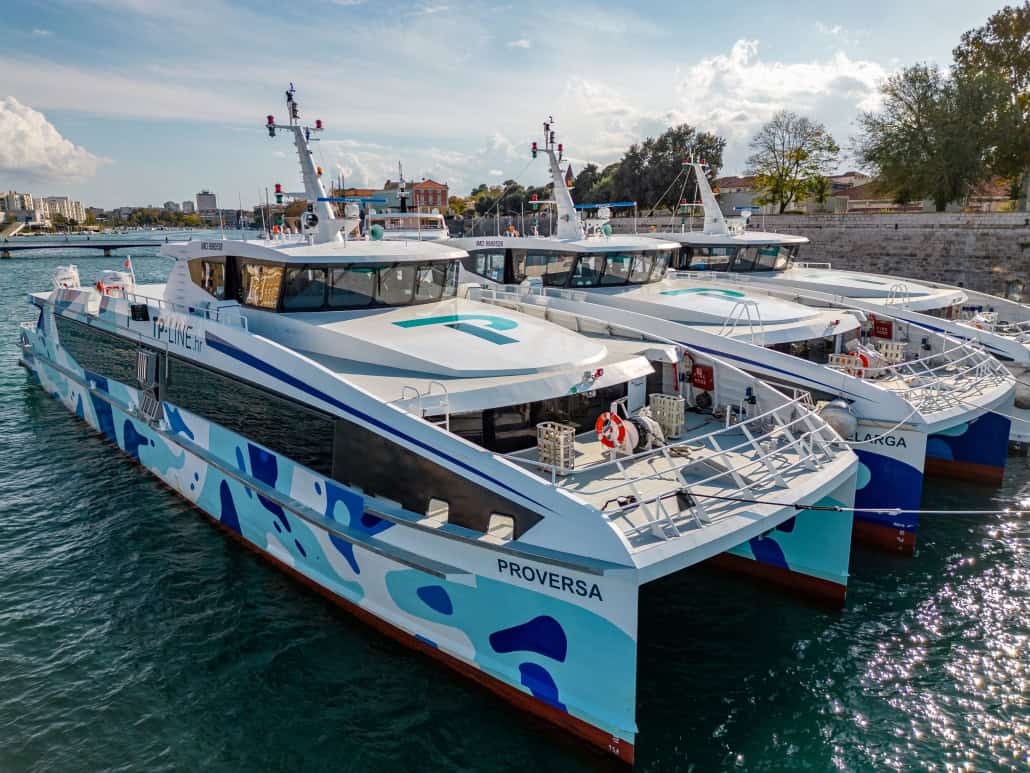
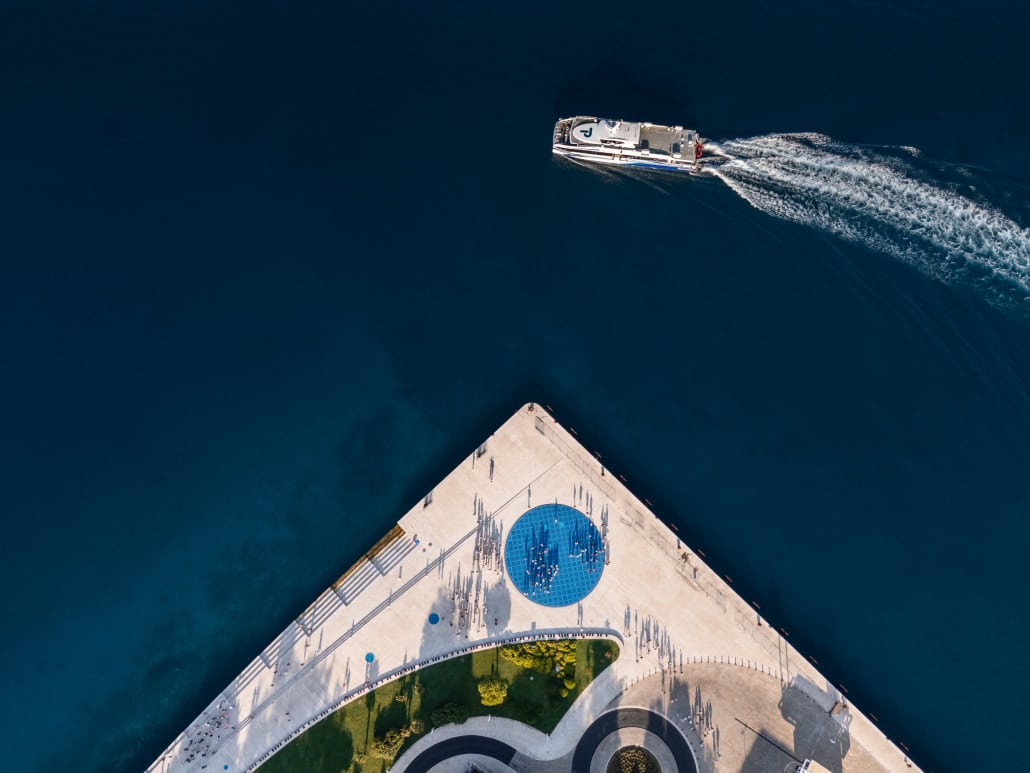
A TP Line catamaran sails past Zadar
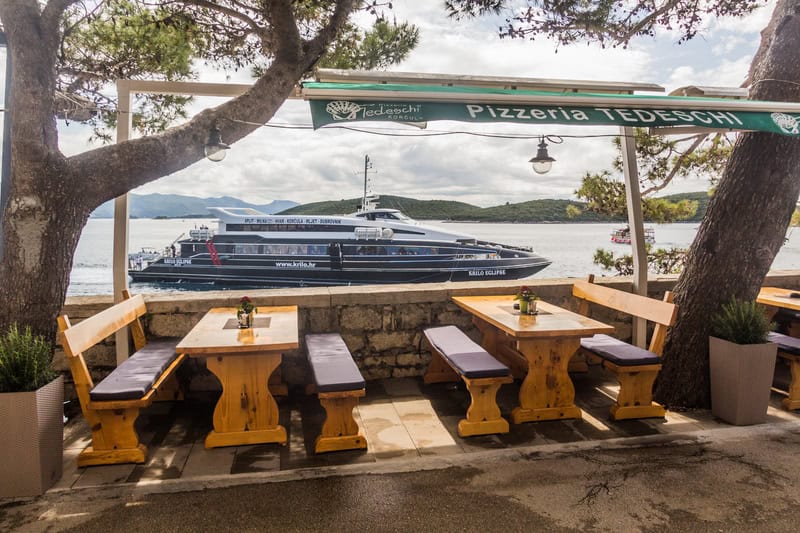
Do you know about Krilo Shipping Company?
No? Well, you should. Krilo Shipping Company have been (excuse the pun) ferrying passengers to some of Croatia’s islands since 2016, mainly from Split to peaceful Solta. This year, they will be operating a route that’s new to them – from Dubrovnik to Pomena on Mljet to Korcula. This route cranks into action on 15th May, running until 15th October. You could technically use this catamaran for a (short) day trip for either Mljet or Korcula, given the timings.
I also commend Krilo Shipping Company on their updated website this year!
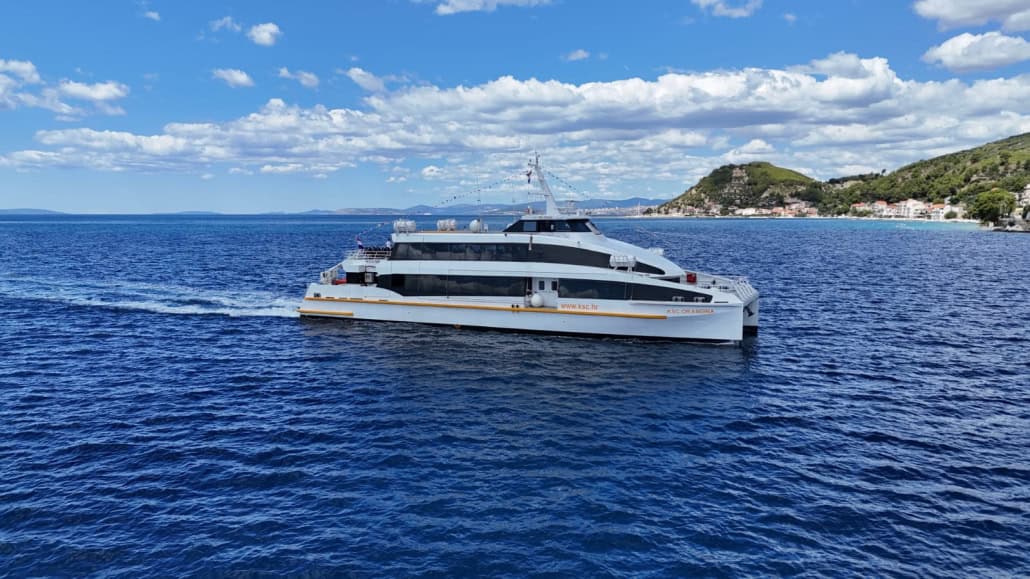
Krilo Shipping Company’s Orangina vessel (what a great name!)
Kapetan Luka brings out all the hits
(By hits, I mean popular routes.)
Kapetan Luka continues to operate one of its long-distance Dalmatian catamarans this summer, running from Split to Milna (Brac), Hvar, Korcula, Pomena (Mljet) to Dubrovnik. This route already started operations on 1st April, and will continue to serve travellers until 31st October 2026. This catamaran sails from Split in the morning, reaching Dubrovnik at 12.30pm. The return journey is made at 5.30pm, arriving in Split at 8pm.
I’ve already written about Kapetan Luka’s new Split to Supetar catamaran that sails several times a day, year-round. As of today, 1st May, it will take to the Adriatic no less than seven times from Split to Supetar, and six times from Supetar to Split.
Edit: Since writing this post, Kapetan Luka has also launched a smart new website. Well done to them!
Jadrolinija moves into high season schedules
But not quite yet. Jadrolinija traditionally operates on low-season and high-season schedules for many of its year-round routes, and the high-season versions kick into action later this month on 29th May. Generally, that’s when frequencies on certain routes increase…and when high season prices come into effect!
I can tell you that as of today, 1st May, Jadrolinija are increasing the frequency on their Bari to Dubrovnik sailing which will now cross the Adriatic twice a week.
International Routes
Further north in the Adriatic, Adriatic Lines‘ sailings from both Porec and Rovinj in Istria to Venice have set sail today! This month, you will be able to make the journey three times a week from Rovinj and four time a week from Porec. These frequencies will increase the further we get into summer, and from 1st June you will also be able to sail from Pula, and from Umag on 1st July.
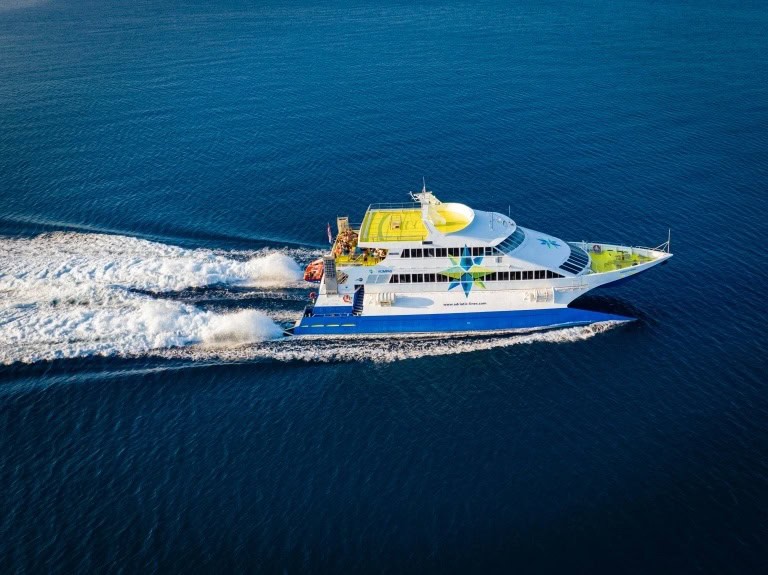
Adriatic Lines’ Prince of Venice vessel
The same company also operates a fast catamaran from Dubrovnik to Kotor and Budva in Montenegro (either can be used for a day trip), but these start operating in June.
More info on Croatia’s ferry and catamaran lines
Take a look at our Ferries in Croatia guide to all the operators and lines that exist in the country. You may be surprised at how many there are! (Or not, given the number of Croatian islands!)
Our Croatia Ferries Map will also help you plan your sea travels by showing you the longer distance routes that exist up and down the Croatian coastline.
Happy sailing on Croatia’s ferry and catamaran lines!
https://www.visit-croatia.co.uk/wp-content/uploads/2026/05/TP-Line-2025-58-scaled.jpg19202560annazhttps://www.visit-croatia.co.uk/wp-content/uploads/2017/09/visit-croatia-logo5.jpgannaz2026-05-01 11:49:262026-05-06 12:57:15Croatia’s ferry and catamaran lines ready for the season
We’re almost at the end of April, which can only mean one thing – it’s May in a few days’ time, which in turn means two bank holidays for all of those in the UK (yay) and which also means there’s another half term coming along (gulp). But, good news! The end of May is perhaps one of the best times of the year to visit Croatia, so May half term is so well placed for you to enjoy a holiday with your family in the country. But let me help you plan your trip to Croatia for May half term with this post!
Sibenik
Why go to Croatia for May half term?
I mean, why not, but if you really need me to twist your arm:
Flight time from the UK is roughly two or two and a bit hours, which is very doable with little ones, as that’s about 17 episodes of Bluey (remember, screen time isn’t a concern when you’re on holiday)
The weather will be great
The Adriatic will just about be warm enough for swimming in
But should you find it too cold, practically every family resort will have its own pool – maybe even an indoor one too
As it’s early season, holidays will be cheaper than during the summer holiday months of July and August
The crowds will not have descended yet, so you will have more pool-space, beach-space, sightseeing-space, national park-space and all other kinds of space to yourselves
The ice cream
Delicious ice cream
I’m not constrained by school holidays, should I go to Croatia for May half term
I mean, no. Why would you do that to yourself? Go the week before or the week after.
If you’re already booked your holiday for that last week in May, then – oh yay, well done, never mind.
Seriously, don’t worry, Croatia isn’t exactly a peak half term holiday destination.
Are you sure the weather will be good enough?
Yes. All along the coastline, the weather will be very fine indeed. Temperatures are likely to be in the mid-20s Celsius (at least), and days will be very sunny. Rain isn’t likely, but if you do encounter any rainfall, it won’t be for long.
On that note, do bring your summer clothes to enjoy the most of the weather, but pack some cover-ups (cardigans, light jackets) for evening time. Late May doesn’t bring the same kind of sweltering heat as summer does, so evenings will be a little fresher but not cold.
Fine, I’m sold. Where should I go in Croatia for May half term?
There are plenty of family resorts up and down the Croatian coastline, which of course means plenty of choice for you!
I have two hotels in particular to recommend to you in Croatia for May half term, both in the gorgeous region of north Dalmatia. First off, the Falkensteiner Funimation Hotel Borik in Zadar has multiple outdoor pools and is right on the beach, but also has a decent-sized indoor pool should the weather not play ball. If swimming gets boring, there’s a great indoor soft play (yes, really!), kids’ clubs with activities for different ages, indoor games and best of all, it’s all-inclusive! Zadar Old Town is a short journey away (book an Uber or Bolt, it will be less than €10) to enjoy everything that lovely town has to offer.
The exterior of the Falkensteiner Funimation Hotel Borik, as seen from the garden/pool area – at sunset!
My other personal favourite is the Amadria Park Hotel Jakov, which offers smart, trendy yet fun accommodation (bunk beds for the kids!) with very relaxing vibes throughout. Again, there are several pools here, including a nicely sized baby pool, a kids’ club, and a bear mascot that likes to turn up at random times. The whole Amadria Park resort is interconnected, so you can stroll along the seaside promenade to enjoy the multiple restaurants and areas. There’s even a mini golf here. Hotel Jakov’s neighbour, the Hotel Andrija, is also suitable for a holiday with kids, who may shriek with delight when they see the giant octopus on the outside. (Don’t worry, he’s not real.) And if all of this isn’t enough, the Aquapark Dalmatia is just steps away. The outdoor portion of this opens in June, but there’s an indoor section that is open year-round!
Those of you who are travelling with teens may want something more than just a family hotel with a pool to jump into about 97 times a day. If so, consider renting an apartment that has access to a pool and is a short walk to a beach, but also is well placed for trips to a larger town or city for sightseeing and excursion opportunities. Here are some ideas:
Trogir is a short distance from Split and very easy to reach from Split Airport. This small island town itself is exceptionally charming, but for more traditional holiday vibes, stay on the connected island of Ciovo, which offers plenty of apartments (and some hotels) and beaches. You can reach Split very easily by bus or boat (or car, of course).
A small resort in southern Dalmatia, such as Cavtat, Slano, Zaton or Mlini, so you can have a relaxing day-to-day existence, but make the journey into Dubrovnik by bus or boat
Enjoy a city and nature break combo by flying into Zagreb and spending half your holiday there (so many sightseeing and cultural opportunities!), and then taking a bus down to the Plitvice region and taking several walks/hikes in the Park on subsequent days
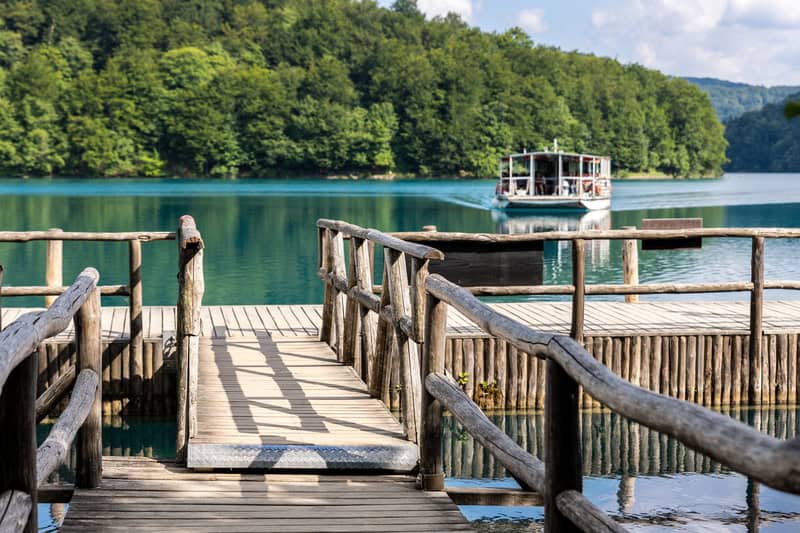
A boat crossing a lake in the Plitvice Lakes National Park
Activities in Croatia for May half term
A holiday in Croatia isn’t a holiday in Croatia without an excursion of some sort. And if you only do one trip, make sure it’s getting out onto the Adriatic on a boat. Everyone will love it, trust me! Boat trips can be booked almost all along the coast – mainland or on the islands. When you’re in Croatia, enquire at your hotel or at any of the little stands you’ll see dotted around the town you’re staying in.
For a preview, take a look at some of the options below:
Late May would be an ideal time to see the magical Blue Cave before the peak summer crowds, and combining it with a trip to where Mamma Mia 2 was filmed (yes, really) – what could be better? Or dolphin watching in Istria, how amazing is that?
Day trips can absolutely include a little bit of adventure, from quad biking to fun and games on the Cetina River (which is practically adventure central in Croatia):
Take a look at what holiday packages operators such as Jet2 Holidays (one of my favourites), TUI, Easyjet Holidays or British Airways Holidays have to offer. You may well be able to snap up a half term deal, and tweak your holiday depending on your requirements.
Or put your holiday together yourself! (Go on, be brave!) Take a look at what flights can be booked for the end of May (the answer is plenty, but use our Flights to Croatia from the UK & Ireland page as your guide) and then snap up the accommodation in Croatia of your dreams.
And…relax…
Lucky you! You’re going on holiday to Croatia very soon!
https://www.visit-croatia.co.uk/wp-content/uploads/2026/04/croatia-may-half-term-2026_sibenik.jpg450800annazhttps://www.visit-croatia.co.uk/wp-content/uploads/2017/09/visit-croatia-logo5.jpgannaz2026-04-28 23:09:062026-04-28 23:09:07Plan Croatia for May Half Term 2026
The Easter break is fast approaching, with less than a couple of weeks left of the school Spring term! (Sorry to surprise you if you weren’t already aware.) Whilst I’m sure many of you will have already booked your holidays, some travellers may be seeking alternative arrangements to planned breaks or perhaps booking last-minute deals. And be thinking…is Croatia suitable for an Easter holiday? Well, you’re on the right page to find out! Here’s how you can spend the Easter Holidays in Croatia.
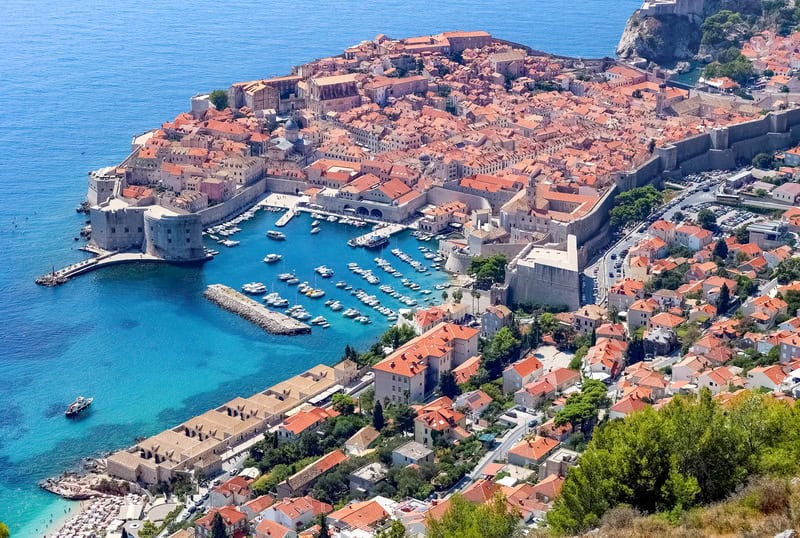
Dubrovnik would be an ideal location for an Easter Holidy break!
Wait a minute, when’s Easter again?
Easter Sunday is fairly early this year, on 5th April. Do be aware that Easter Monday is also a public holiday in Croatia, but the Friday before is not – but will still be commemorated as part of the Easter weekend. As a Catholic country, Easter is understandably a rather religious affair for many here. In fact, Easter is probably the most religious of all the holidays during the year. Mass on Easter Sunday is a very well-attended affair at churches all over Croatia.
Because of its status as a religious holiday, most establishments will be shut on both the Sunday and Monday. That includes shops, cafes, restaurants, many attractions (but not all) and similar, so do be aware of this.
If you would like to witness a traditional religious Easter procession, you may like to head to the island of Hvar. The 500-year-old Easter tradition, Za Krizen, sees six parishes follow a cross on an overnight journey all around the island. This journey begins on the Thursday before Easter (Maundy Thursday) into Good Friday.
Of course, the Easter Holidays – as far as schools and similar institutions go – are always a two-week-long holiday. If you are concerned that spending Easter in Croatia will disrupt your enjoyment (I mean, it shouldn’t, but for some it might), consider holidaying in the second week.
But what about the weather?
Okay, this is bound to be a big consideration for many travellers if you’re thinking about spending the Easter Holidays in Croatia. It’s too early in the year to have summer weather, that’s for sure – you definitely won’t get temperatures in the high 20s Celsius (high 70s/low 80s Fahrenheit) and endless stretches of very hot sun. Sunbathing on a beach is unlikely and swimming in the Adriatic is a no-go…unless you’re very brave.
Having said that, it is too early to be looking at weather forecasts to see what the weather will actually be like for the first two weeks of April. Generally, however, you can expect coastal areas to be sunny and hopefully reaching around 20ºC (or perhaps a few degrees higher). The further south along the coast you are, understandably, the better/warmer the weather should be. So opt for Dubrovnik and the surrounding area to try and get the best of the weather if you really, really need to have the best weather possible.
Once we get closer to April, take a look at the forecasts on the Croatian Meteorological Service, or a weather app of your choosing to find out what will actually be forecast.
Flights to Croatia for the Easter Holidays
The end of March is a time when many airlines start their “seasonal” services, and that’s certainly the case for flights to Croatia. Whilst not every single route starts operating at this time of year, you can certainly make use of an incredibly high number of flights from the UK and Ireland to Croatia during the Easter Holidays. Such as:
I’ll be honest with you, before I started writing out this list, I didn’t expect it to be quite so long! That’s 28 (28!) routes you can make use of if you’re heading to Croatia during the Easter Holidays.
Get a deal on a package holiday to Croatia during Easter
If I’ve managed to persuade you to spend your Easter holidays in Croatia, why not consider a package break? At this time of year, you’ll very likely enjoy some very good deals indeed because it’s quite early in the season. Seeing as Jet2 have commenced their flights to Dubrovnik, let’s take a look at some of Jet2Holidays‘ packages to this city.
For example, you can take advantage of 7 nights (departing Sunday 5th April) at the very comfortable 4-star Grand Hotel Park for £1,380 for two people. Close to restaurants and a bus journey away from the Old Town, this hotel has an indoor pool, so you can enjoy some swim time whatever the weather.
For luxury at a relative steal, 7 nights at the 5-star Royal Blue Lapad for the same dates costs £1,744 for two people. Or you could opt for 7 nights at the 5-star Hotel Croatia in genteel Cavtat for £1,408 for two people.
For something super upscale, you could enjoy 7 nights at the 5-star Hotel Excelsior – one of Dubrovnik’s most famous hotels – departing London Stansted on Sunday 5th April for £2,660 for two people. Pricey, yes, but I found the same package offered for over £5,000 for two people for dates in June.
Other types of holidays in Croatia
City breaks galore
Okay, so given it’s not exactly beach weather in Croatia during early April, how about considering another type of holiday? A city break to Zagreb would really be ideal for this time of year. Springtime in Croatia’s capital city is wonderful, with the pleasant weather providing a cheerful air and the perfect setting for days spent in cafes (although, really, the Zagrepčani have no problem doing that all year round) with gentle strolls through the Upper and Lower Towns, taking in many of the museums and sights.
Springtime in Zagreb
Or, what about a coastal city for a city break? Glorious springtime offers much for visitors in cities such as Pula, Zadar or Split.
Who doesn’t love a road trip?
April may be the perfect month to undertake a road trip in Croatia. The roads won’t be busy with summer “commuters”, and you won’t have to suffer through sweltering temperatures as you slog down the coastal road. (Scratch that – the coastal road is anything but a slog, whatever the outside temperature.)
That very coastal road, with its spectacular views, would be the top choice for a road trip. Get the full experience of Dalmatia by starting in Zadar (to where you can fly) and then making the drive all the way down to Dubrovnik. Or, if you have more time, start in Pula in Istria! And of course, doing the reverse of either of these is possible.
For a mix of inland treasures and coastal delights, start in Zagreb and then head down to the Plitvice Lakes to enjoy a couple of days here in the spring sunshine. Then head down in the direction of Zadar and further down the coast, as above.
Island life
Croatia’s islands are waking up in springtime, but are still relatively quiet locations when it comes to holidaying at this time of year. But that’s what you might be looking for! Even the larger and most popular of Croatia’s islands – Hvar and Brac, for example – still have low numbers. Not all accommodation may be fully available to you, but for a peaceful and relaxing stay, consider some time on an island during the Easter Holidays.
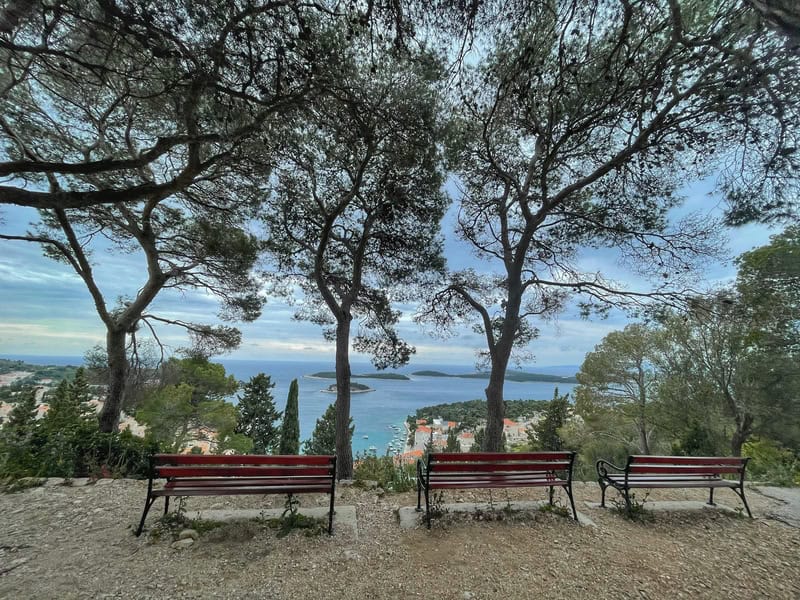
A peaceful Spring moment on the island of Hvar
What’s on in Croatia during the Easter Holidays?
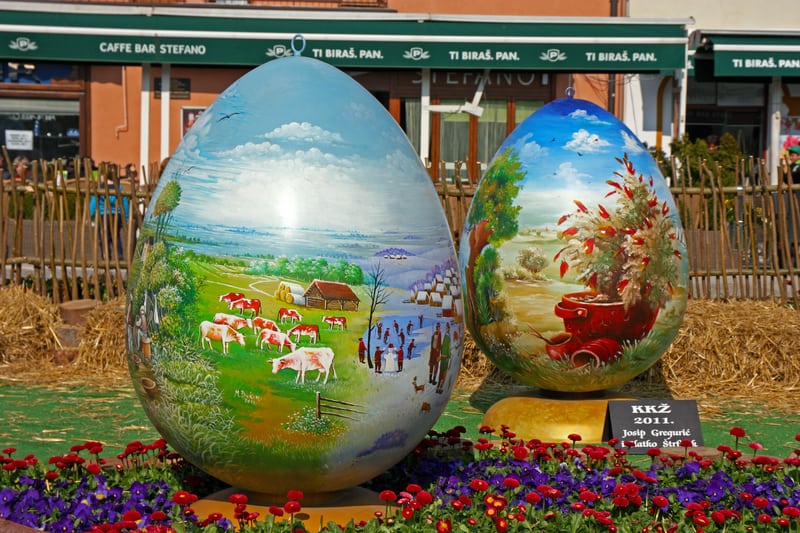
Look out for Easter-related events wherever you are, often involving child-focused happenings. (Such as Easter egg hunts, for example.) One of the best Easter-related events is the display of giant Easter eggs in the northern Croatian town of Koprivnica. These eggs – labelled Easter Eggs from the Heart – are hand-painted in naive art style, typical for the region.
Non-Easter events
Around 3,000 competitors are expected for the Istria 100 (9th – 12th April), which actually covers five different race distances, the longest being 100 miles in length…hence the name. The competition is sold out, but you can certainly watch the racers whizz by in Central Istria.
If you’re more into cars and less into…er, people…the Croatia Rally takes place on the exact same dates (9th – 12th April). This official FIA World Championship event is held on roads in Istria, Gorski Kotar, Lika and Karlovac counties this year.
The first concert of Dubrovnik Musical Spring, a wonderful classical music event featuring the Dubrovnik Symphony Orchestra, will take place at Revelin Fortress on 10th April.
April is asparagus month, and if you’re a fan of this woody vegetable, you must head to Lovran in Istria! The whole month celebrates the Asparagus Festival, with local restaurants offering special menus. The highlight of the festival takes place on 11th April when a giant fritaja (similar to an omelette) is made with 1,000 eggs and 30 kilograms of asparagus and bacon. That’ll be quite some party!
The UCI Gran Fondo cycling race will be taking to the roads in and around Umag on 11th April.
On the evening of 11th April, the Zadar Night Run will see competitors race on routes (5km, 10km or 21km) at night. Most of the routes run right by the sea. A super sweet kids’ night run takes place the day before at 6pm, with kids running down Siroka ulica in the centre of the Old Town.
On Fridays in April (10th, 17th and 24th), head to Kvaternik Square from 6pm to enjoy the street food event Place. With good vibes and great music too, you can enjoy a tasty dish from a street food stall.
All in all, there’s lots to enjoy if you’re spending the Easter Holidays in Croatia!
https://www.visit-croatia.co.uk/wp-content/uploads/2026/03/easter-holidays_aerial-view-dubrovnik-old-town.jpg538800annazhttps://www.visit-croatia.co.uk/wp-content/uploads/2017/09/visit-croatia-logo5.jpgannaz2026-03-19 14:08:342026-03-20 09:56:04How to spend the Easter Holidays in Croatia
Plitvice Lakes National Park is one of the top sights to visit in Croatia. With its stunning interconnected lakes and waterfalls, gorgeous nature and animal inhabitants (although the larger ones are rarely seen by people), it’s a wonderful place to spend a day – or hopefully longer. The inland location, in the Lika region of Croatia, is also somewhere that many visitors wouldn’t otherwise experience, preferring the coast or Zagreb. Visiting the park provides a wonderful opportunity to experience another slice of Croatia. My latest visit to the National Park was last month, at the start of the coldest season of the year. So what was it like visiting the Plitvice Lakes in winter? Is it worth it? Find out what I thought!
Early arrival
To make the most of my day, I decided to take the first bus from Zagreb to the lakes. That meant getting up before 6am (normally, waaaay too early for me) to make the 6.45am bus. The bus, run by Prijevoz Knezevic, ended up being a little mini-bus to my surprise, but no matter. The comfy seats and decent leg room were just the thing for a snooze all the way to the lakes. (The mini-bus was half full, and one small group also disembarked at the lakes.)
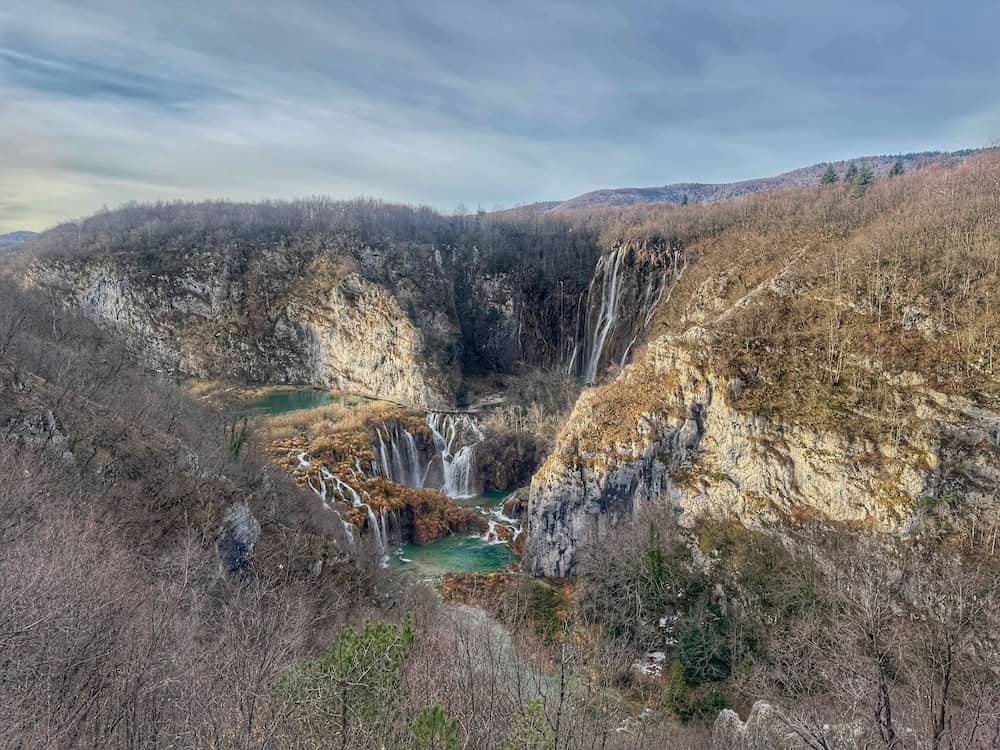
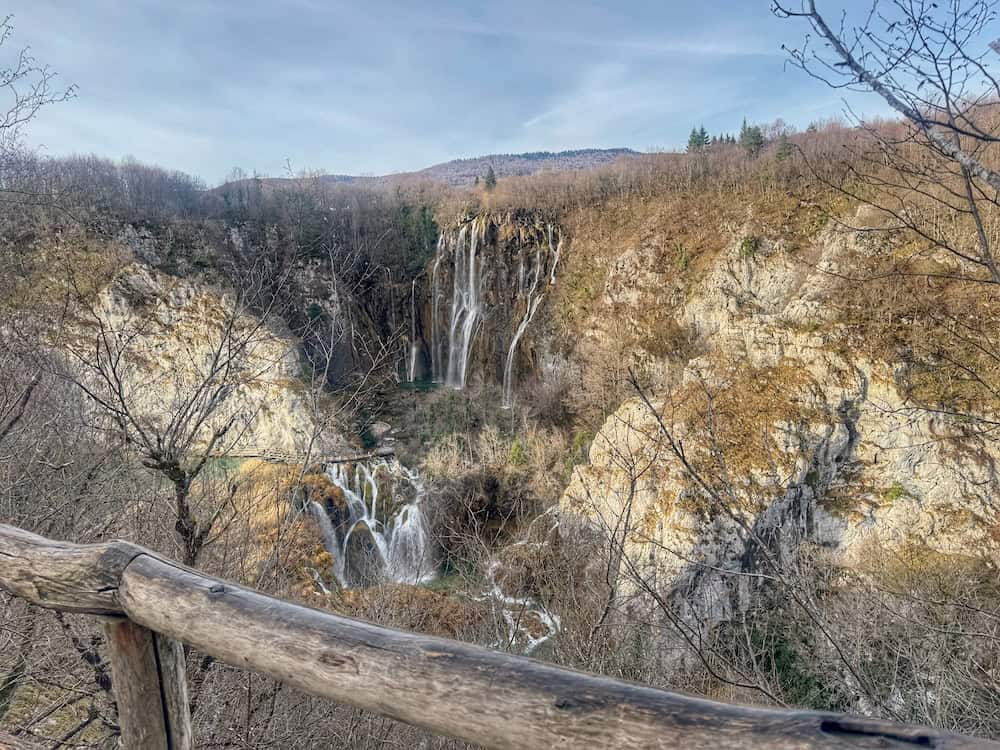
The bus stopped right by Entrance 1, from where it’s possible to visit the Lower Lakes – which are the ones that are accessible in winter. It is also this entrance you need to visit Veliki Slap (Big Waterfall – the clue’s in the name, as it’s the tallest waterfall around these parts). Funnily enough, although you’re visiting the Lower Lakes, you enter the Park from up on high and first experience one of the most beautiful and most famous views of the National Park.
A first view of the lower lakesLooking down toward Veliki Slap
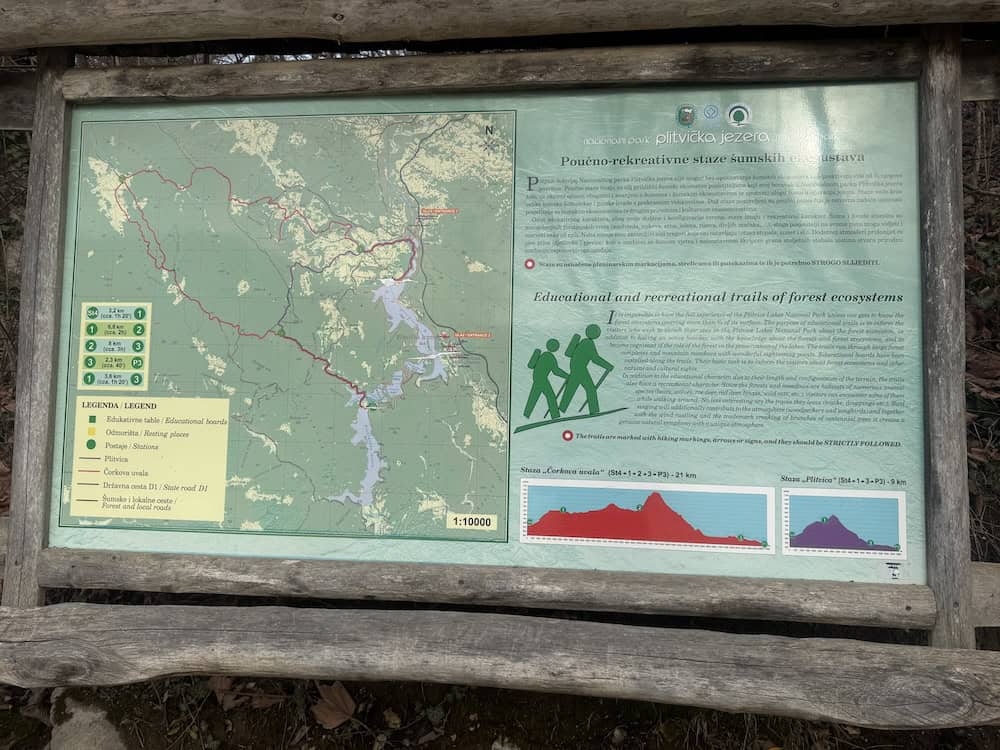
I headed to the ticket booth to snap up my €10 ticket (which would be €40 in the peak summer months!) and then talked to the helpful guy in the adjacent booth who explained what paths and trails were open and would be possible to visit. In this case, he told me Trails A and B would be able to be followed. I decided to opt for the longer Trail B (which they say takes 3 to 4 hours, and 4,000 metres in length).
And then, reader, my adventure began.
Oh, wow!
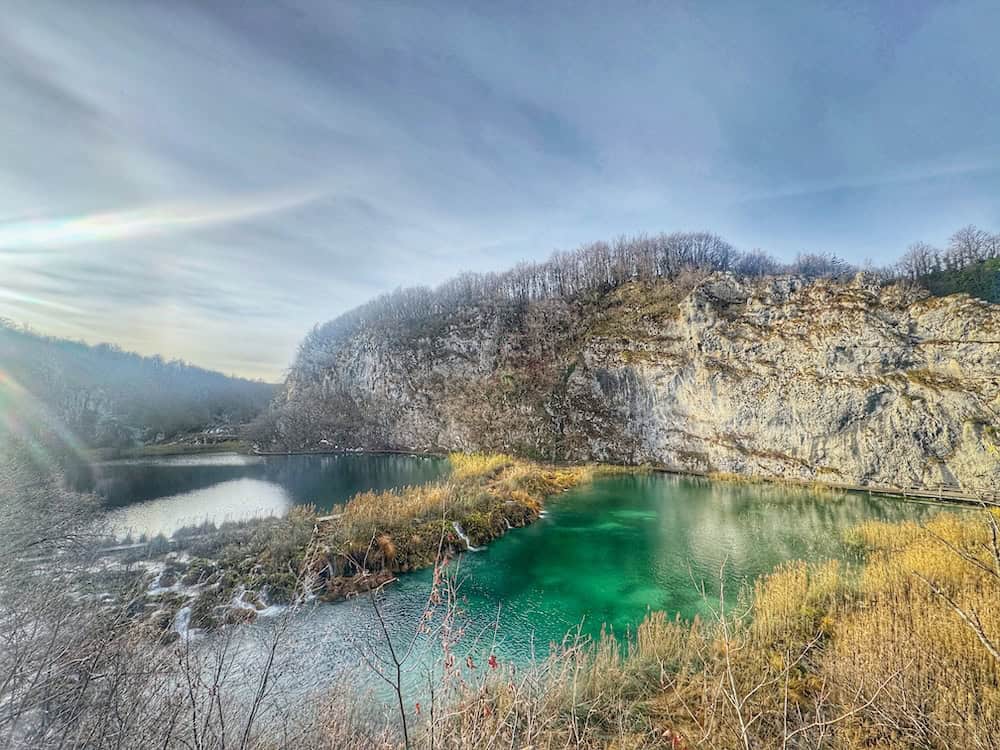
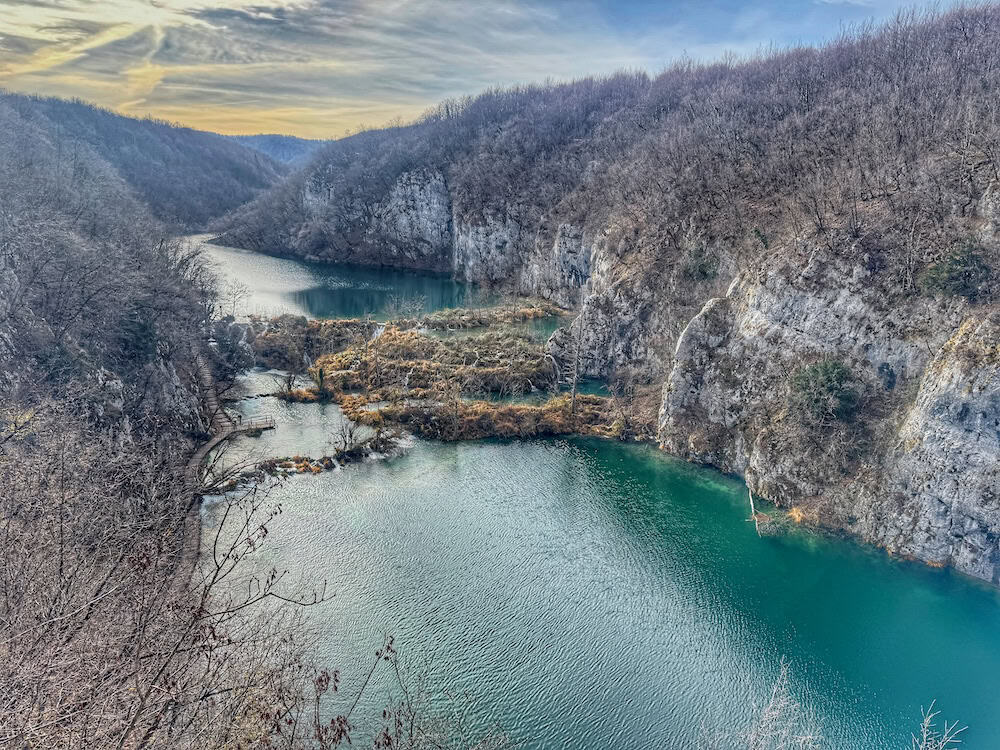
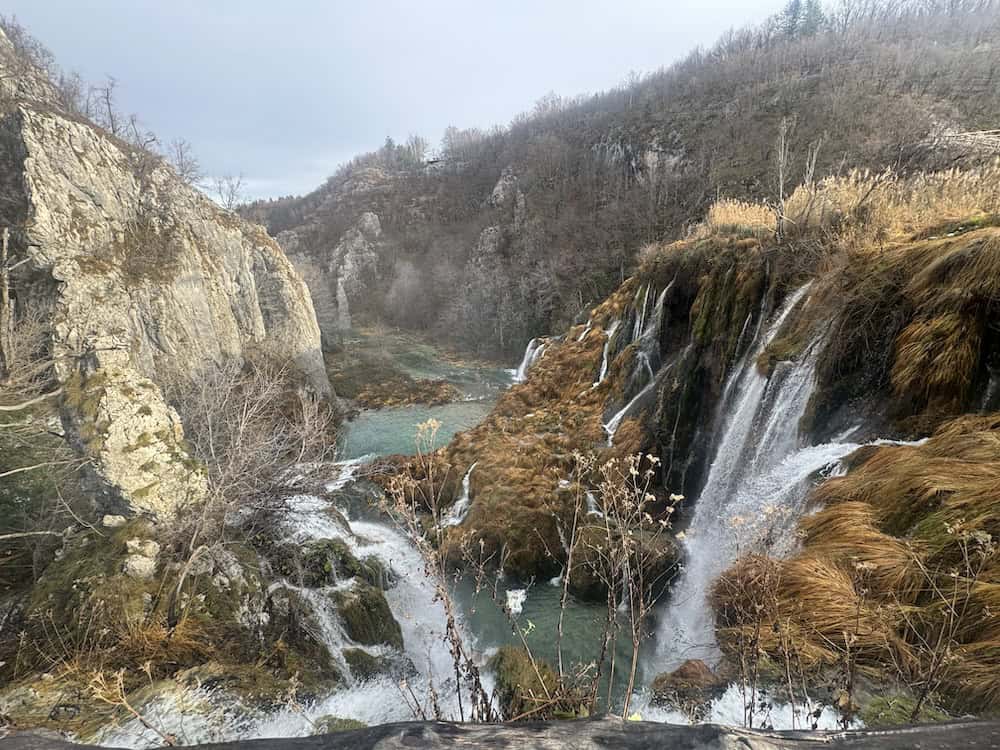
As I’ve already hinted, just a few steps beyond Entance 1 is one of the most the unbelieveable sights of the Plitvice Lakes, looking down onto three interconnected lakes (Milanovac, Gavanovac, and Kaludjerovac) and the waterfalls inbetween them. You might even stand yourself here, take in the amazing sight, snap a photo or three, and then head home. But you wouldn’t, because you’re not crazy, are you?
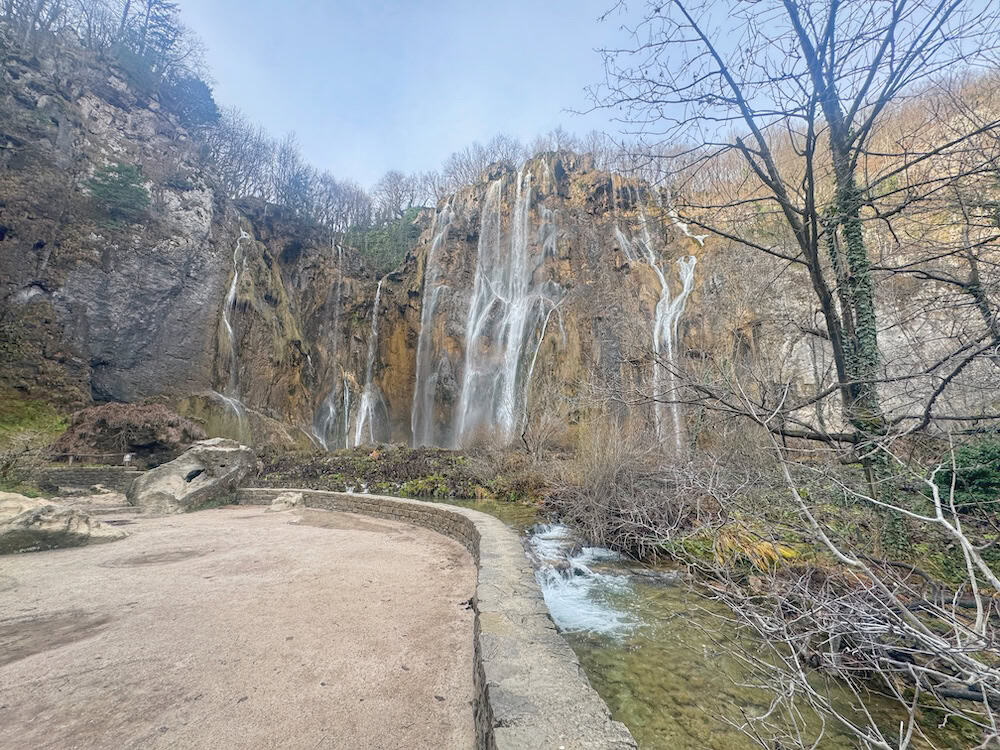
From here, I descended down the path in the direction of Veliki Slap. This waterfall is actually in the wrong direction from the trails, essentially down a dead end, but if he’s the biggest guy in town, you need to pay him a visit – right?
Veliki Slap
Two things quickly became apparent to me. The first was that it was literally freezing (I do mean literally), so I had to dress myself in all additional items of clothing I wasn’t yet wearing.
The second I realised was that by arriving at the Plitvice Lakes just before 9am in winter, I had totally won in life. As I descended down to the Lower Lakes, I didn’t pass a single other person. On my way to Veliki Slap and back, I passed two people – Plitvice Lakes maintenance workers. Heading further around the paths, heading in the direction of Lake Kozjak, I passed only a handful of people – maybe 10 at most? Having the Lakes essentially “to myself” was really such a magical experience that I can barely put into words. It was probably one of the best days of my life!
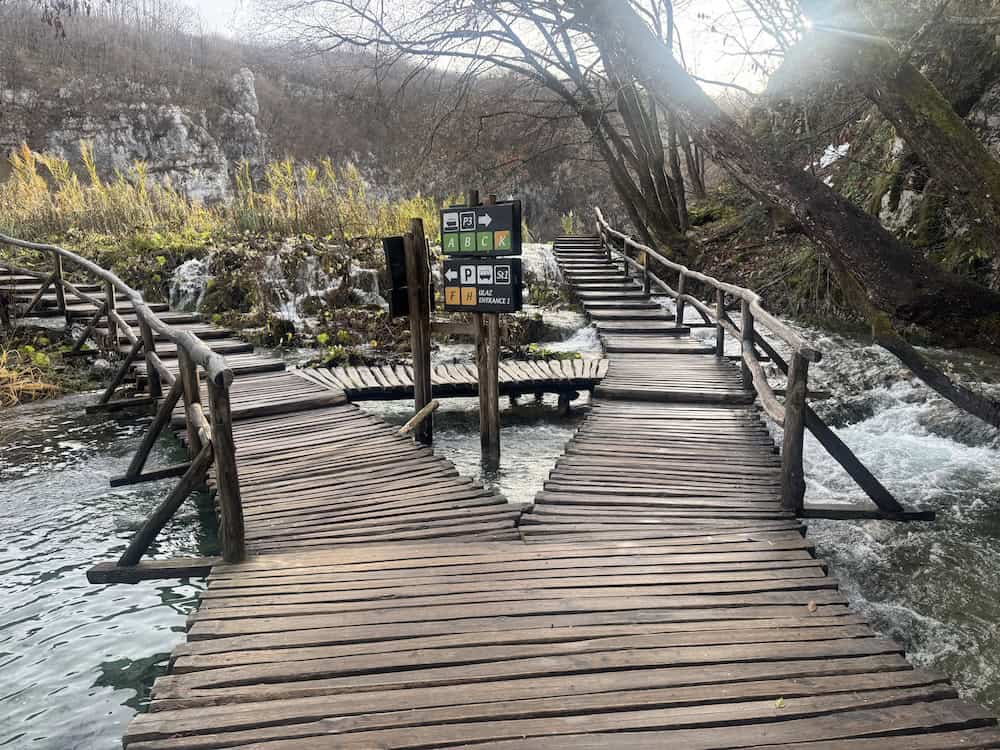
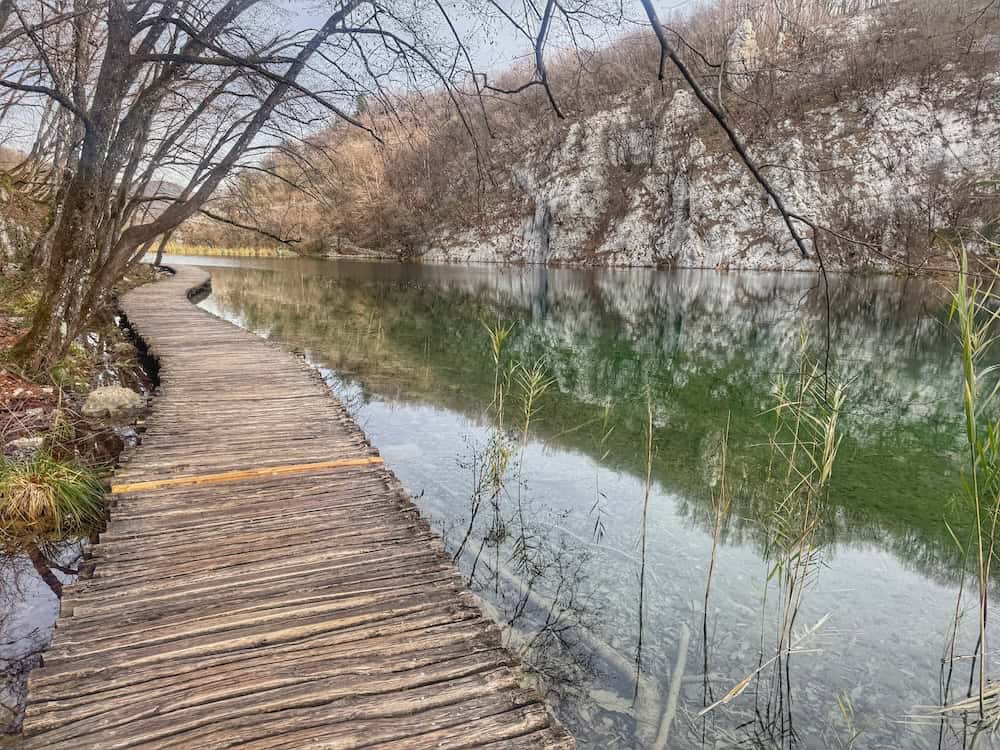
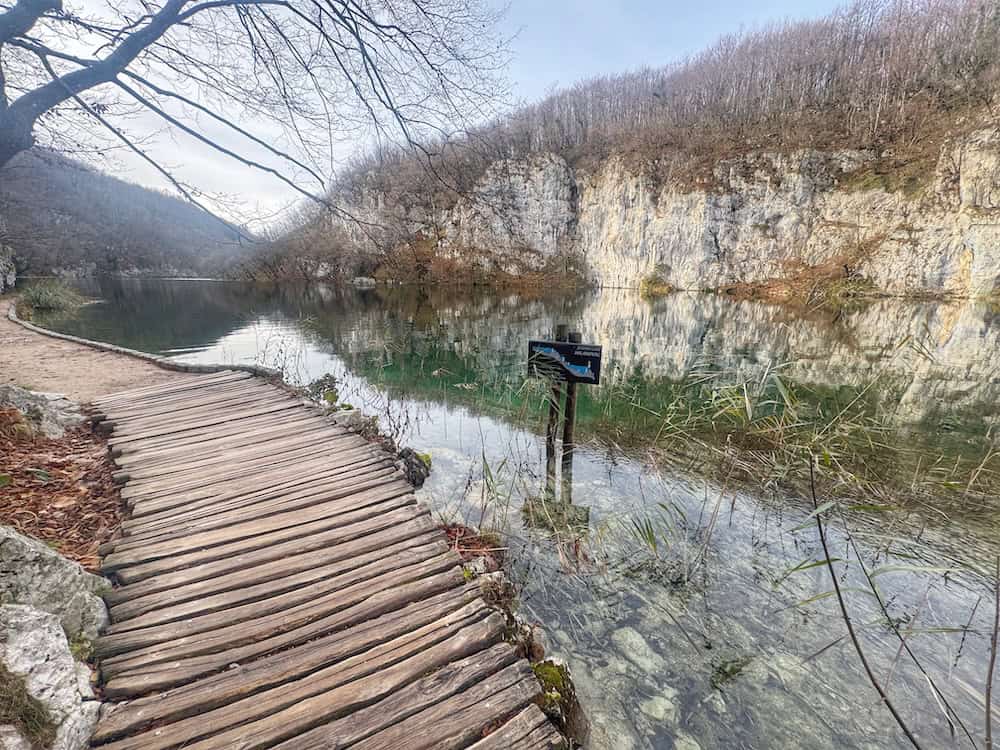
The Lower Lakes in Plitvice on a winter morningThe lovely wooden paths in Plitvice
Heading round the wooden paths and admiring all the lakes and waterfalls, the lack of other visitors meant I could really go at my own pace. This also meant I could take in all the particular signs and points of interest I came across without being hurried along.
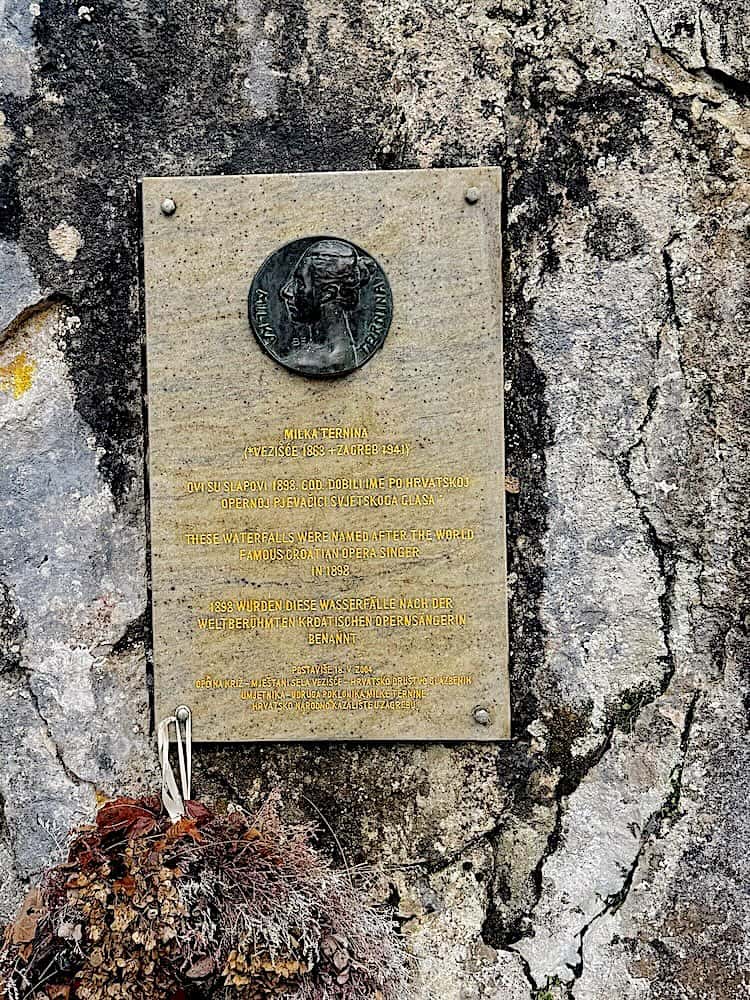
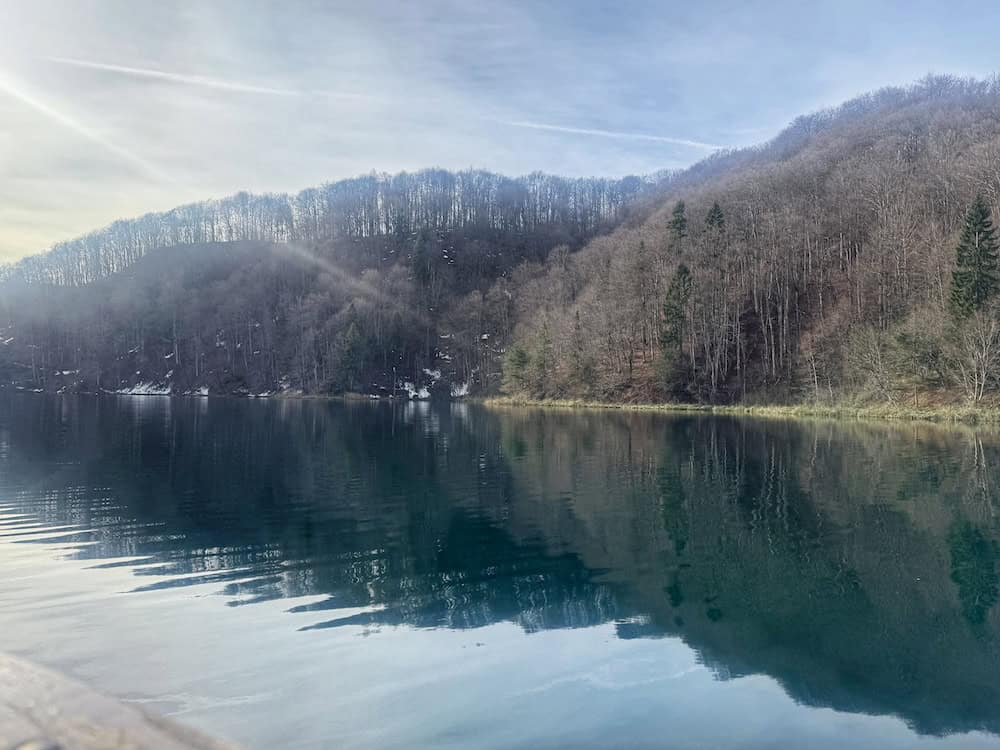
A plaque explaining how a set of falls are named after opera singer Milka TerninaA wonderfully still lakeMilanovac Lake
Time for a pit stop
On reaching Lake Kozak, I discovered a small souvenir shop and a small cafe. Of course, I made good use of both – I couldn’t leave without getting something for my fridge’s magnet collection. The cafe was relatively basic, but very warm and just the thing for a recharge, for both myself and my phone. It had a reasonable selection of hot drinks and offered things like sandwiches, burgers and chips and a few sweet treats. (Also, a fairly impressive range of Croatian spirits…I’m sure a shot would have been warming, but I didn’t go for it!) I would highly recommend a warming coffee and a slice of cheese strudel (savijača). Delicious.
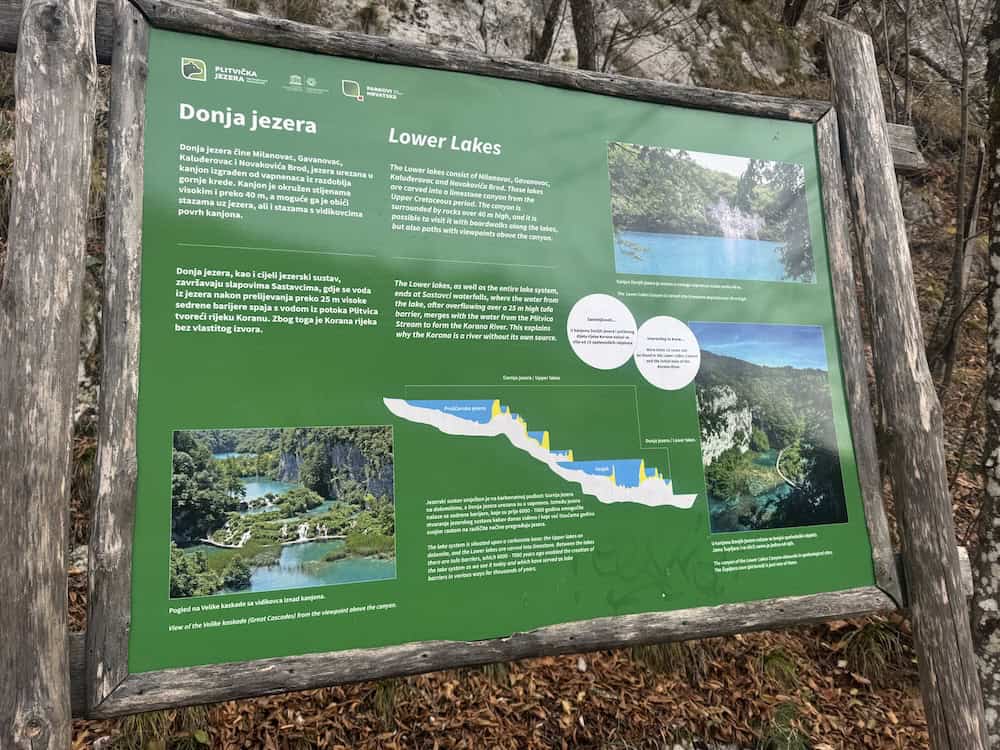
Just the thing for a cold December morningInformation signs in PlitviceInformation signs in Plitvice
On I go
The cafe and shop are right by the shore of Lake Kozak, which has an electric boat running across it. This in itself is another awesome experience – the boat glides softly and quietly over the lake as you take in the nature on both sides.
The boat was actually the largest number of people I saw at any one time during my Plitvice winter adventure, with about 15-20 people on board. A few seemed to be part of small tour groups, who I assumed to be undertaking private tours of the Park. (I certainly saw one couple clearly being guided around the lakes.)
Lake Kozjak
I disembarked on the other side of the lake – past a sad, understandably closed ice-cream stall – to continue my journey on Trail B. Most of my fellow boatgoers seemed to disappear at this point (don’t worry, I don’t mean in a sinister way), so I assume they were heading up to Entrance 2, to be taken elsewhere.
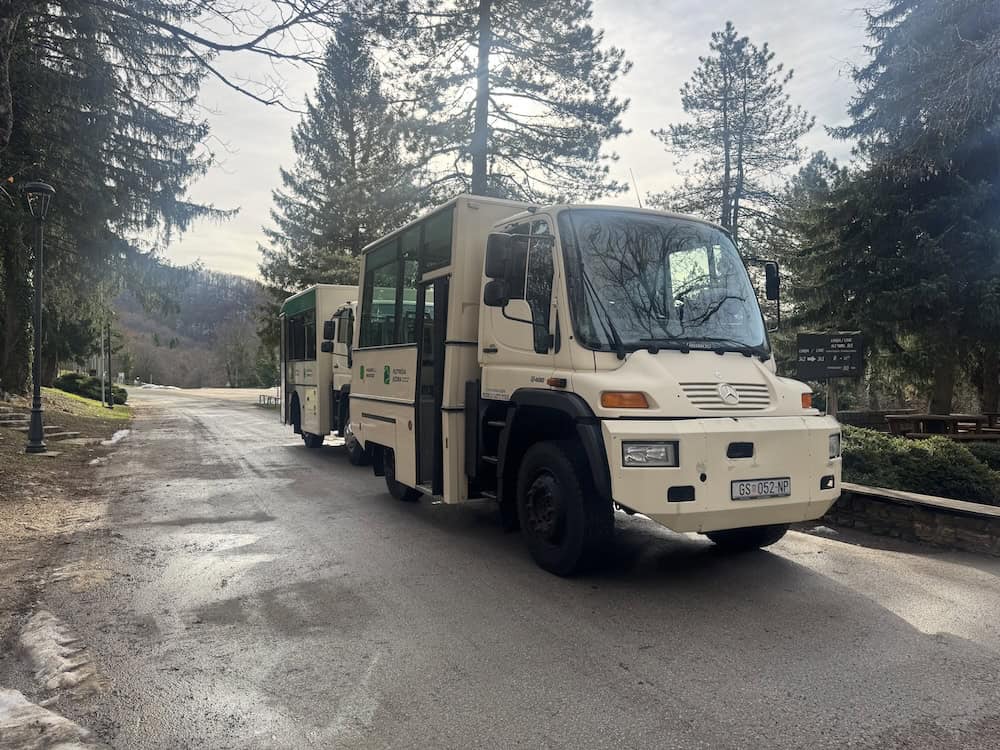
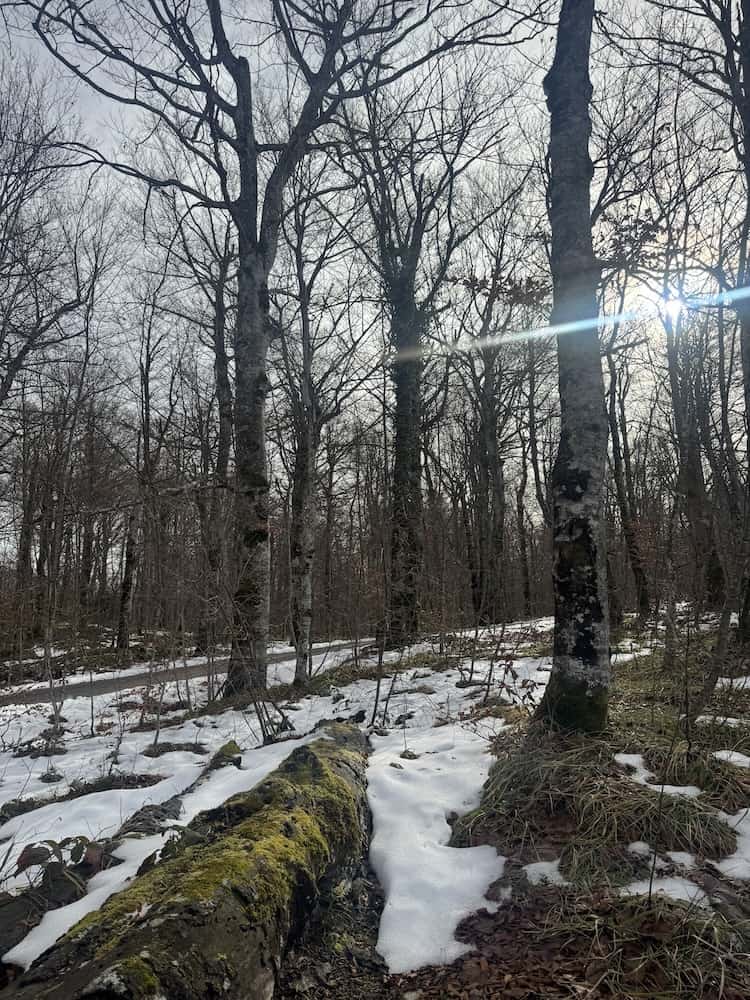
Heading up the hill here, I encountered what’s called the “panoramic vehicle”, essentially a small coach with comically sized windows. (Comically big not small, although the latter would be more comical.) By this time, I was alone again, and the bus took me on a short journey to continue Trail B. Excitingly, this part of the Park had snow! Real snow, on the ground! Okay, only on the parts where no one walked, but as I had hoped to encounter Plitvice in snow (but delayed my visit for a few days to get better weather), it was a teensy bit exciting.
Panoramic vehicles in the Plitvice LakesSnow in the Plitvice Lakes
The bus dropped me off to continue my walk along the top of the canyon, towards Entrance 1, and I again encountered the lakes of Milanovac, Gavanovac, and Kaludjerovac from up high. By this time, the sun had properly emerged, and the temperature had gone up a few degrees, so the gorgeous lakes and waterfalls could be their best twinkly self.
And again on the paths back to Entrance 1, I only encountered one or two people at a time. Solo but not lonely at all. And no “fights” for the best photo viewpoint!
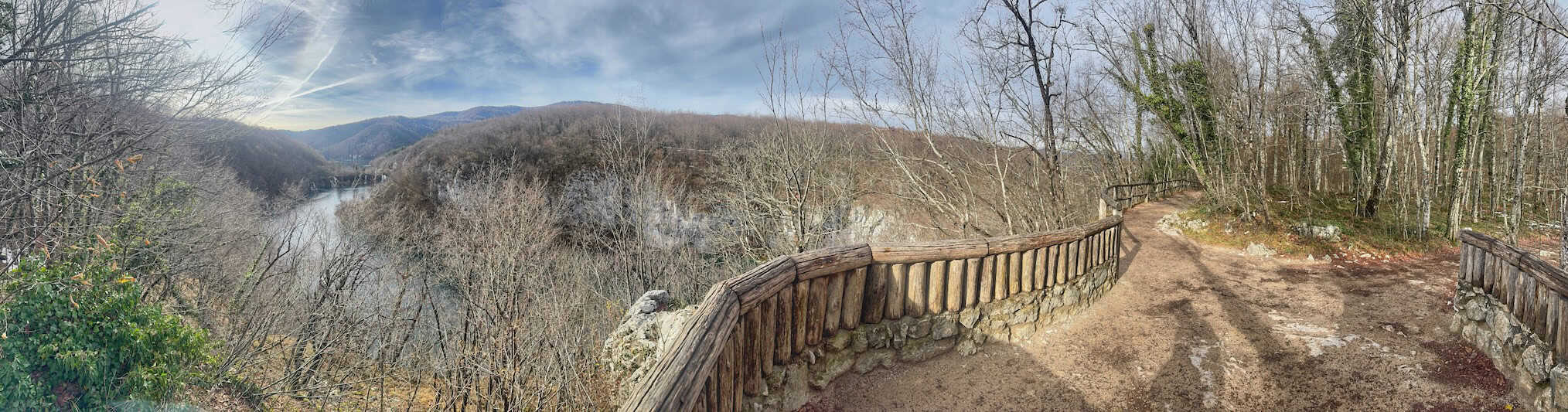
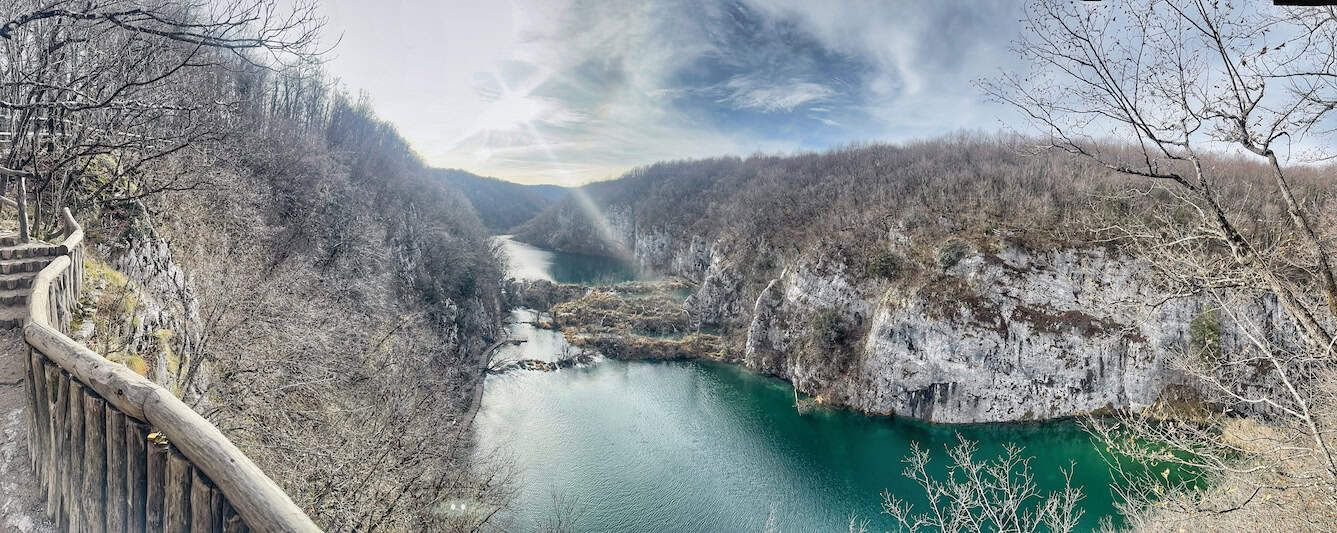
A panoramic view of the Plitvice LakesAnd a second panoramic view of the Plitvice Lakes!
Conclusion – was visiting Plitvice Lakes in winter worth it?
Oh my goodness, yes. A million times yes.
Visiting the Plitvice Lakes is worth it any time of year, but in peak season, you’ll encounter so many crowds of people that it will be practically like a traffic jam to get around. Nevertheless, Plitvice in peak summer is still a sight to behold.
The different seasons give visitors a different Plitvice experience. Sure, winter means hardly any fellow visitors, but also shorter opening times and quite strict logistics in terms of where you can travel from and at what times. You also have to pay closer attention to the weather. I would have loved to have visited in proper snowfall (tempted as I was by social media posts!), but I’m aware that that could have meant a more treacherous journey around the Park. I don’t regret waiting a few days for a cold but eventually beautifully sunny, dry day!
So yes, please do visit the Plitvice Lakes in winter. It is absolutely worth it.
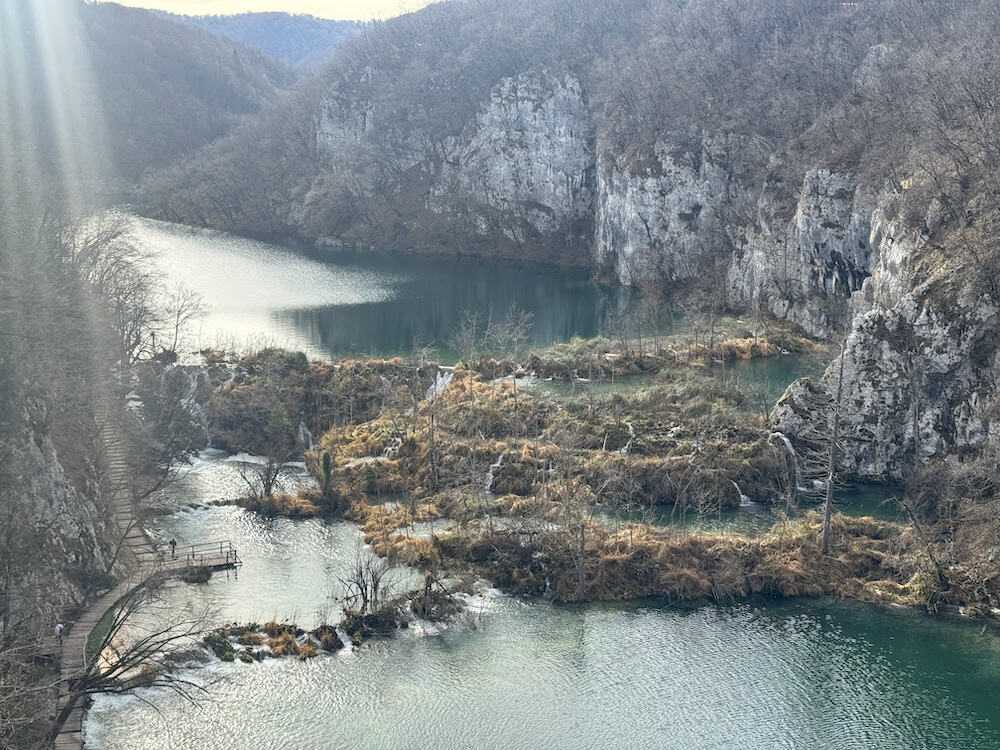
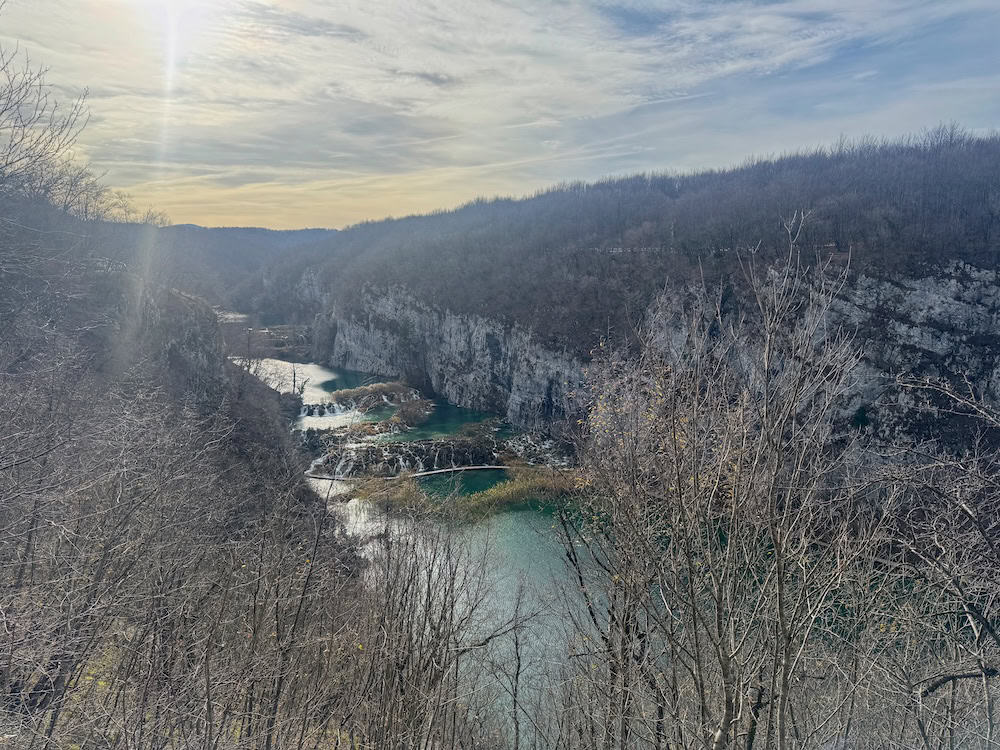
A close-up of the interconnected Lakes in PlitviceThe view from Entrance 1, now almost four hours later
Getting to the Plitvice Lakes in winter
If travelling by public transport, it is easiest to reach the Plitvice Lakes in winter from Zagreb. With a journey time of around just two hours, and the fact that there are a number of buses per day, makes a day-trip very doable. Take a look at the Zagreb Bus Terminal website to look up bus schedules and to buy your tickets. Do also make your life easier and buy your return ticket before travel as well – you don’t have to use the same bus operator. Tickets are mostly electronic these days, and can be presented on your phone upon boarding.
You can also hire a car to make the relatively easy journey to the Lakes. Parking in the Lakes car park is free in winter (in December, January and February).
Alternatively, you may prefer an organised tour. Take a look at some of the possibilities below:
The park is open from 8am to 3pm, with both Entrance 1 and 2 generally open unless conditions prove otherwise. Ticket sales are only available until 1pm.
The electric boat over Lake Kozjak operates from 8am to 2.30pm/3pm (end time depends on the direction) in winter.
Good to Know
What to wear
Dress appropriately! And warmly! Winter at the park can be very cold indeed, so make sure you have appropriate winter clothing – which means many layers, and a proper winter jacket. A waterproof coat/jacket in addition wouldn’t be a bad idea, or at least take along a waterproof top layer that you can put on if you need.
Gloves are an absolute must, as are hiking shoes or boots or footwear that has a good grip when you’re walking. The paths can be wet and/or icy.
I personally didn’t have any hand warmers, but I saw a few other visitors with them. They seem like a good idea!
Eating, Drinking and Shopping
Right by entrance 1 is a small snack bar (think sandwiches, burgers, hot and cold drinks) for refreshment and a souvenir shop with Plitvice Lakes branding. Although the products comprised a mix of regular souvenir takeaways (t-shirts, baseball caps) and more pleasing items (carved wood ornaments, kids’ books on Plitvice), I found it to be rather expensive! I wanted to buy a book (in English) for my children, but baulked at the price of €15 for a very slim book!
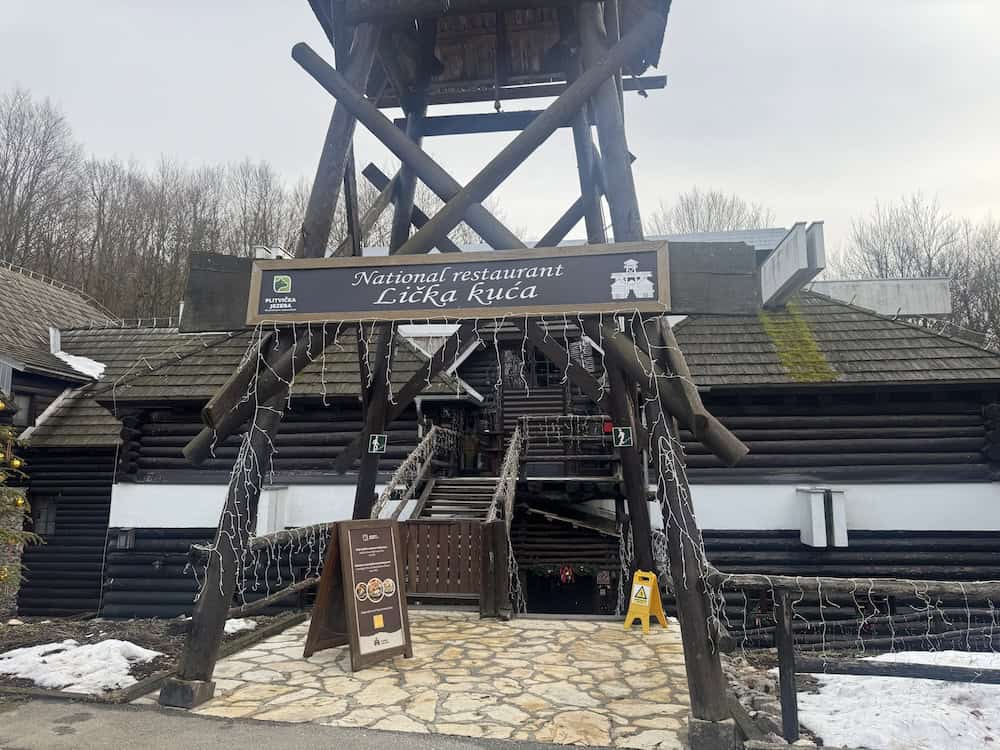
I’ve mentioned the shop and cafe by Lake Kozjak for another pit stop. However, for a proper, hearty and very filling lunch, I would return to Entrance 1 and head over the footbridge to Licka Kuca (Lika House in English) Restaurant. Absolutely delicious food, typical of the Lika region, with very friendly service and a warm ambience. Recommended!
Getting there
If you’re using public transport – i.e. bus – you really do want to get to the lakes as early as possible. Although you’ll curse an impossibly early start, you’ll thank yourself when you get to the lakes and experience them!
Return buses might run a little late – they don’t start from Plitvice, but are travelling from further afield. Wait by the little wooden huts (make sure you’re at the hut that’s going in the right direction) and be patient!
Tickets
You can buy tickets for the National Park in advance online on the Plitvice Lakes National Park – Tickets webpage. But I wouldn’t bother, they are very, very unlikely to sell out in wintertime!
One thing to note is that you can buy a 2-day ticket for €15 in winter. If you’re driving yourself to the Lakes and staying locally, a two-day visit would be lovely.
More info
You can find out all the latest information on visiting the Park, including current conditions of trails and what can be visited, on the Plitvice Lakes National Park website.
I’ve recently been in communication with a lovely lady – M – who needed a little bit of assistance with planning her trip around Croatia. M was lucky enough to be travelling around Croatia for four weeks (yes, four!) and visited an incredible nine towns/cities and nine islands! Read on below for some very helpful travel tips and M’s itinerary:
Travel Tips
Having just returned from backpacking around the beautiful country of Croatia for 4 and a half weeks – visiting 9 towns/cities and the main towns on 9 islands – we thought we would share some of the knowledge we gained about travel and our itinerary.
We found Rome2rio.com very helpful as it gave us the travel options available to get from one place to another and the names of the companies that we needed to use. Many of these companies have their own app.
The main ferry companies are TP Line, Krilo and Jadrolinija. We booked through directferries.com, which was easy as it gave us all the times and prices for all the ferries on our chosen dates.
The bus companies we used were mainly Arriva and FlixBus. For many of the buses, you have to pay for your luggage that goes into the hold. This costs about €1.30 per bag.
Travelling from Split airport to Split can be done in a few ways. The airport shuttle (from right outside the airport) takes passengers down to the ferry port, whereas the local bus number 37 (from across the road) takes you to the bus station at the top of the town. This then goes to Trogir.
I hope the above information helps you with planning your itinerary.
Ferries and catamarans in the port of Split
The Four-Week Itinerary
Our itinerary was as follows:
Split – we did a day trip to Trogir, taking the 37 bus there and returning on the water taxi with Bura Line
Bus from Split to Zadar – used the local bus from the Autobusni Kolodvor to visit Plitvice Lakes
Ferry from Rab toPag – the ferry arrives in Novalja on the north of the island. The local bus station is a 25-minute walk away from the port if you want to get to Pag Town
Bus from Pag to Split (we had to change buses at Zadar) and then a ferry to Vis
I contacted Visit Croatia a couple of times for additional information, and they were very helpful.
Thank you so much, M, for sharing your amazing itinerary with us, and also for your travel tips. Thank you also for your kind words about Visit Croatia!
https://www.visit-croatia.co.uk/wp-content/uploads/2025/10/krk-town.jpg533800annazhttps://www.visit-croatia.co.uk/wp-content/uploads/2017/09/visit-croatia-logo5.jpgannaz2025-10-08 14:03:302025-10-23 17:45:06Reader’s Trip Report: A Four Week Itinerary for Croatia
As of 12th October 2025, the EU’s new Entry/Exit System will start being rolled out in Croatia and other EU countries. This has been in the works for some time now (it was due to be implemented about a year ago – I wrote about it in The new Entry/Exit System and Croatia), but it is now finally going live. Find out what it means for you when travelling to Croatia and the rest of the EU, and what you actually have to do about it.
When will the new Entry/Exit System start?
The Entry/Exit System will finally start being rolled out at Croatian borders and other EU borders from 12th October 2025. This will be a gradual rollout, with full implementation across the Schengen Zone expected by 10th April 2026.
Who is the Entry/Exit System for?
The Entry/Exit System will only apply for visa-exempt travellers to Croatia and the EU – such as those of you travelling from the U.S., the UK, Australia, New Zealand and similar – OR for those of you who hold short-stay Schengen visas.
EU travellers will not need to take part in EES, and can continue to travel to Croatia as before. You can still travel using just your country’s ID card, if you wish!
What does the Entry/Exit System involve? Do I have to do something ahead of time when travelling?
You do not have to do anything ahead of time for the EES.
The above-mentioned travellers to Croatia and the rest of the EU will now need to have their fingerprints and their photo taken at the border when entering the Schengen Zone, as well as providing their passport details. Of course, you only need to provide this information the first time you enter the Schengen Zone after 12th October. On subsequent visits, your details will be checked against the information you first provided.
As you can imagine, this will likely cause longer queues at each border into the Schengen Zone. Be prepared for this – I expect uproar against this EU measure in certain British newspapers!
So what does this mean when I travel to Croatia?
The next time you visit Croatia – after 12th October 2025 – you will likely need to provide the above information when entering the country.
Is this the same thing as ETIAS?
No, the EES is NOT the same thing as ETIAS.
Once the EES is up and running in full across the Schengen Zone, ETIAS will be rolled out in the near future. ETIAS is something that you have to be aware of and obtain before travelling. This is essentially the EU’s visa waiver programme – much like the ESTA that exists for the United States. This pre-screening service will require you to submit your personal details and travel information online before travelling, as well as requiring you to pay a fee.
ETIAS is not yet being introduced, but is expected to come into effect at the end of 2026.
As I mentioned, I also wrote about the new system quite extensively about a year ago – do read The new Entry/Exit System and Croatia as there is a fair amount of useful information there, such as why EES is being introduced.
Happy travelling!
https://www.visit-croatia.co.uk/wp-content/uploads/2025/09/ees-oct25_eu-border.jpg600800annazhttps://www.visit-croatia.co.uk/wp-content/uploads/2017/09/visit-croatia-logo5.jpgannaz2025-09-29 21:20:292025-09-29 21:20:31The new Entry/Exit System (EES) and Croatia from October 2025
We all know that Croatia has many, many delights, all along its stunning coastline. You can therefore imagine that one of the best ways of experiencing the country and everything it has to offer is by sailing the Adriatic. What could be better than gliding over the twinkly sea on a luxury vessel, exploring islands big and small, swimming in private coves before enjoying a hearty lunch on board and then moving on to some relaxing sunbathing or snooze time.
Yacht rentals have become one of the fastest-growing luxury travel segments, and it is no surprise to discover that the Adriatic and Croatia are among the most popular destinations for such holidays. Croatia, in fact, accounts for 40% of global yacht charters according to data from the Croatian Ministry of Tourism.
And this figure is indeed growing, according to the latest figures! Between January and July 2025, Croatia welcomed 72 foreign cruise vessels making 377 journeys and carrying over 516,000 passengers, representing a 10.8% increase in vessel arrivals and a 9.2% increase in overnight stays compared to the same period in 2024. (Source: Croatian Bureau of Statistics, Sept 2025.)
Why is nautical tourism in Croatia so popular?
Darijo Saric of VIP Holiday Booker explains why Croatia has become a leader in nautical tourism and yacht holidays.
High-profile visitors have played a part in raising Croatia’s profile. Just a few months ago Jeff Bezos and Lauren Sánchez were photographed celebrating with foam parties on a yacht ahead of their wedding. Beyonce and Jay-Z have been spotted touring multiple islands on a private yacht. The Beckhams, Jon Bon Jovi, and many others have also been spotted sailing the Dalmatian coast.
Celebrities do bring more attention. Whether it is one of their holiday selfies being shared on social media or simply journalists covering celebrities in news outlets, it has inadvertently promoted Croatia as a yachting destination with global reach.
But it’s not just celebrities showcasing Croatia’s appeal. Events such as Yacht Week, a week-long sailing festival that brings together thousands of young travelers for island-hopping, beach parties, and live music has become increasingly popular since it first started in 2006.
It presents the vibrant, social side of yacht holidays.
At the same time, yacht holidays in Croatia can be the opposite of high-energy partying. Yachts can be slow, authentic and deeply relaxing.
Many of our villa guests are increasingly requesting yachts as a part of their holiday packages. For them, it’s not only about accommodation, but about enjoying the full experience. They want to wake up in a beachfront villa and then set off on a yacht to explore hidden bays and remote islands.
This reflects how Croatia has been cleverly marketed to appeal to both adventurous younger travelers and a more refined segment seeking privacy, comfort, and curated experiences.
About VIP Holiday Booker
VIP Holiday Booker is a holiday letting agency that is primarily focused on Croatian villas, offering visitors to the country a wide range of luxury accommodation. The company prides itself on providing a truly personalised service, arranging extras such as private chefs, transfers and much more to ensure a premium holiday experience.
https://www.visit-croatia.co.uk/wp-content/uploads/2025/09/Speedboat_Jeanneau_Leader_8_5.jpg6661000annazhttps://www.visit-croatia.co.uk/wp-content/uploads/2017/09/visit-croatia-logo5.jpgannaz2025-09-23 15:17:052025-09-23 15:17:07The growth of nautical tourism in Croatia
Every so often, I sit down and write one of these guides on one of the most travelled routes in Croatia. Many thousands of travellers make the journey from Dubrovnik to Split (or the return journey, from Split to Dubrovnik…or both!) during their stay in Croatia, so it makes sense that I write a guide to it. And about time for an update, for this guide is the first since the Peljesac Bridge was opened in 2022. So here’s the updated guide for 2025 for travelling from Dubrovnik to Split. (Or the reverse!)
Travelling from Dubrovnik to Split by Catamaran (but not ferry)
Let’s first get this out of the way – I say “…but not ferry” for there are no large ferry boats operating on the Dubrovnik to Split or Split to Dubrovnik route. Many years ago, Jadrolinija used to operate a long-distance ferry from Rijeka via Split to Dubrovnik, which was a much-loved sailing option. But this option is long gone, and there are no car ferries operating today.
So, what sailing options can you make use of? These days, three companies offer a catamaran that sails from Dubrovnik to Split – Jadrolinija, Kapetan Luka and TP Line. Jadrolinija has one boat sailing this route, whilst Kapetan Luka and TP Line have two boats each. All operators make stops at islands (and the mainland, in the case of one of Kapetan Luka’s routes) along the way. Whilst all operators and sailings are much of a muchness, it is important to note that some routes operate from Dubrovnik to Split in the morning, whilst some run in the afternoon. I would suggest which one you go for depends on what time you want to arrive in Split.
Jadrolinija’s Dubrovnik to Split catamaran
The following catamaran is operated by Jadrolinija. You can buy tickets for the sailing on their website.
Timetable
Daily
Operates from 6.6.25 to 21.9.25
Daily
7.45am
↓
Dubrovnik
↑
9.25pm
9.25am 9.40am
Korcula
7.25pm 7.10pm
10.50am 11.10am
Hvar
5.55pm 5.35pm
11.55am 12.10pm
Bol (Brac)
4.45pm 4.30pm
1.05pm
Split
3.30pm
Note: no sailing from Dubrovnik to Split on 6th June, and no sailing from Split to Dubrovnik on 21st September
Ticket Prices
Route
Price
Dubrovnik – Korcula/Korcula – Dubrovnik
€25
Dubrovnik – Hvar/Hvar – Dubrovnik
€48
Dubrovnik – Bol/Bol – Dubrovnik
€48
Dubrovnik – Split/Split – Dubrovnik
€48
Korcula – Hvar/Hvar – Korcula
€23
Korcula – Bol/Bol – Korcula
€27
Korcula – Split/Split – Korcula
€27
Hvar – Bol/Bol – Hvar
€25
Hvar – Split/Split – Hvar
€25
Bol – Split/Split – Bol
€23
TP Lines Dubrovnik to Split Catamaran Option 1
The following catamaran is operated by TP Line. Tickets can be purchased on their website.
Timetable
Daily
Operates from 14.4.25 to 26.10.25
Daily
8.05am
↓
Dubrovnik
↑
8.20pm
10.00am 10.10am
Korcula
6.20pm 6.10pm
11.40am 12.00pm
Hvar
4.45pm 4.30pm
12.45pm 12.50pm
Milna (Brac)
3.50pm 3.45pm
1.25pm
Split
3.10pm
Note: no sailing from Dubrovnik to Split on 14th April, and no sailing from Split to Dubrovnik on 26th October
Ticket Prices
Route
Price
Dubrovnik – Korcula/Korcula – Dubrovnik
€25
Dubrovnik – Hvar/Hvar – Dubrovnik
€48
Dubrovnik – Milna/Milna – Dubrovnik
€48
Dubrovnik – Split/Split – Dubrovnik
€48
Korcula – Hvar/Hvar – Korcula
€25
Korcula – Milna/Milna – Korcula
€25
Korcula – Split/Split – Korcula
€25
Hvar – Milna/Milna – Hvar
€15
Hvar – Split/Split – Hvar
€25
Milna – Split/Split – Milna
€10
A TP Line catamaran near Dubrovnik
TP Lines Dubrovnik to Split Catamaran Option 2
Timetable
Daily
9.5.25 – 12.10.25
Daily
2.55pm
↓
Dubrovnik
↑
2.20pm
4.50pm 5.00pm
Korcula
12.20pm 12.05pm
6.25pm 6.40pm
Hvar
10.40am 10.20am
7.20pm 7.25pm
Milna (Brac)
9.35am 9.30am
8.00pm
Split
9.00am
Ticket Prices
Route
Price
Dubrovnik – Korcula/Korcula – Dubrovnik
€25
Dubrovnik – Hvar/Hvar – Dubrovnik
€48
Dubrovnik – Milna/Milna – Dubrovnik
€48
Dubrovnik – Split/Split – Dubrovnik
€48
Korcula – Hvar/Hvar – Korcula
€25
Korcula – Milna/Milna – Korcula
€25
Korcula – Split/Split – Korcula
€25
Hvar – Milna/Milna – Hvar
€15
Hvar – Split/Split – Hvar
€25
Milna – Split/Split – Milna
€10
Kapetan Luka Dubrovnik to Split Catamaran Option 1
The following catamaran is operated by Kapetan Luka. Tickets can be bought on their website.
Timetable
Daily
Operates from 1.4.25 to 31.10.25
Daily
3.30pm
↓
Dubrovnik
↑
12.30pm
4.50pm 4.55pm
Pomena (Mljet)
11.10am 11.05am
5.30pm 5.40pm
Korcula
10.30am 10.20am
6.50pm 7.00pm
Hvar
9.10am 9.00am
7.30pm 7.35pm
Milna (Brac)
8.30am 8.25am
8.00pm
Split
8.00am
Ticket Prices
Route
Price
Dubrovnik – Pomena/Pomena – Dubrovnik
€20
Dubrovnik – Korcula/Korcula – Dubrovnik
€25
Dubrovnik – Hvar/Hvar – Dubrovnik
€50
Dubrovnik – Milna/Milna – Dubrovnik
€50
Dubrovnik – Split/Split – Dubrovnik
€50
Pomena – Korcula/Korcula – Pomena
€20
Pomena – Hvar/Hvar – Pomena
€25
Pomena – Milna/Milna – Pomena
€25
Pomena – Split/Split – Pomena
€30
Korcula – Hvar/Hvar – Korcula
€25
Korcula – Milna/Milna – Korcula
€25
Korcula – Split/Split – Korcula
€30
Hvar – Milna/Milna – Hvar
€15
Hvar – Split/Split – Hvar
€25
Milna – Split/Split – Milna
€10
Kapetan Luka Dubrovnik to Split Catamaran Option 2
The following catamaran is operated by Kapetan Luka. Tickets can be bought on their website.
Timetable
Daily
Operates from 1.6.25 to 25.09.25
Daily
2.45pm
↓
Dubrovnik
↑
1.30pm
4.25pm 4.30pm
Pomena (Mljet)
11.55am 11.50am
5.10pm 5.20pm
Korcula
11.20am 11.10am
6.05pm 6.10pm
Sucuraj (Hvar)
10.25am 10.20am
6.40pm 6.50pm
Makarska
9.50am 9.40am
7.20pm 7.30pm
Bol (Brac)
9.05am 8.55am
8.25pm
Split
8.00am
Ticket Prices
Route
Price
Dubrovnik – Pomena/Pomena – Dubrovnik
€20
Dubrovnik – Korcula/Korcula – Dubrovnik
€25
Dubrovnik – Sucuraj/Sucuraj – Dubrovnik
€25
Dubrovnik – Makarska/Makarska – Dubrovnik
€45
Dubrovnik – Bol/Bol – Dubrovnik
€50
Dubrovnik – Split/Split – Dubrovnik
€50
Pomena – Korcula/Korcula – Pomena
€20
Pomena – Sucuraj/Sucuraj – Pomena
€20
Pomena – Makarska/Makarska – Pomena
€25
Pomena – Bol/Bol – Pomena
€25
Pomena – Split/Split – Pomena
€30
Korcula – Sucuraj/Sucuraj – Korcula
€25
Korcula – Makarska/Makarska – Korcula
€25
Korcula – Bol/Bol – Korcula
€25
Korcula – Split/Split – Korcula
€30
Sucuraj – Makarska/Makarska – Sucuraj
€25
Sucuraj – Bol/Sucuraj – Hvar
€20
Sucuraj – Split/Split – Sucuraj
€20
Makarska – Bol/Bol – Makarska
€20
Makarska – Split/Split – Makarska
€20
Bol – Split/Split – Bol
€20
For any of the above sailings, I would suggest you always pre-book tickets – at least a few days in advance if you can’t do so earlier – as the Dubrovnik to Split (or Split to Dubrovnik) catamaran is a popular route.
Travelling from Dubrovnik to Split by Bus
Travelling by bus from Dubrovnik to Split is a very easy, reliable and cheap option – and there are numerous buses operating on this route, year-round.
Journey time between the two takes around 4 to 4.5 hours. Although buses no longer go through that small slice of Bosnia, some buses make numerous stops along the way, which means a longer journey time. In the summer months, the coastal road can also be congested with holiday traffic, making the journey longer than expected. If you are travelling during the peak summer months, consider taking an early morning or later evening bus.
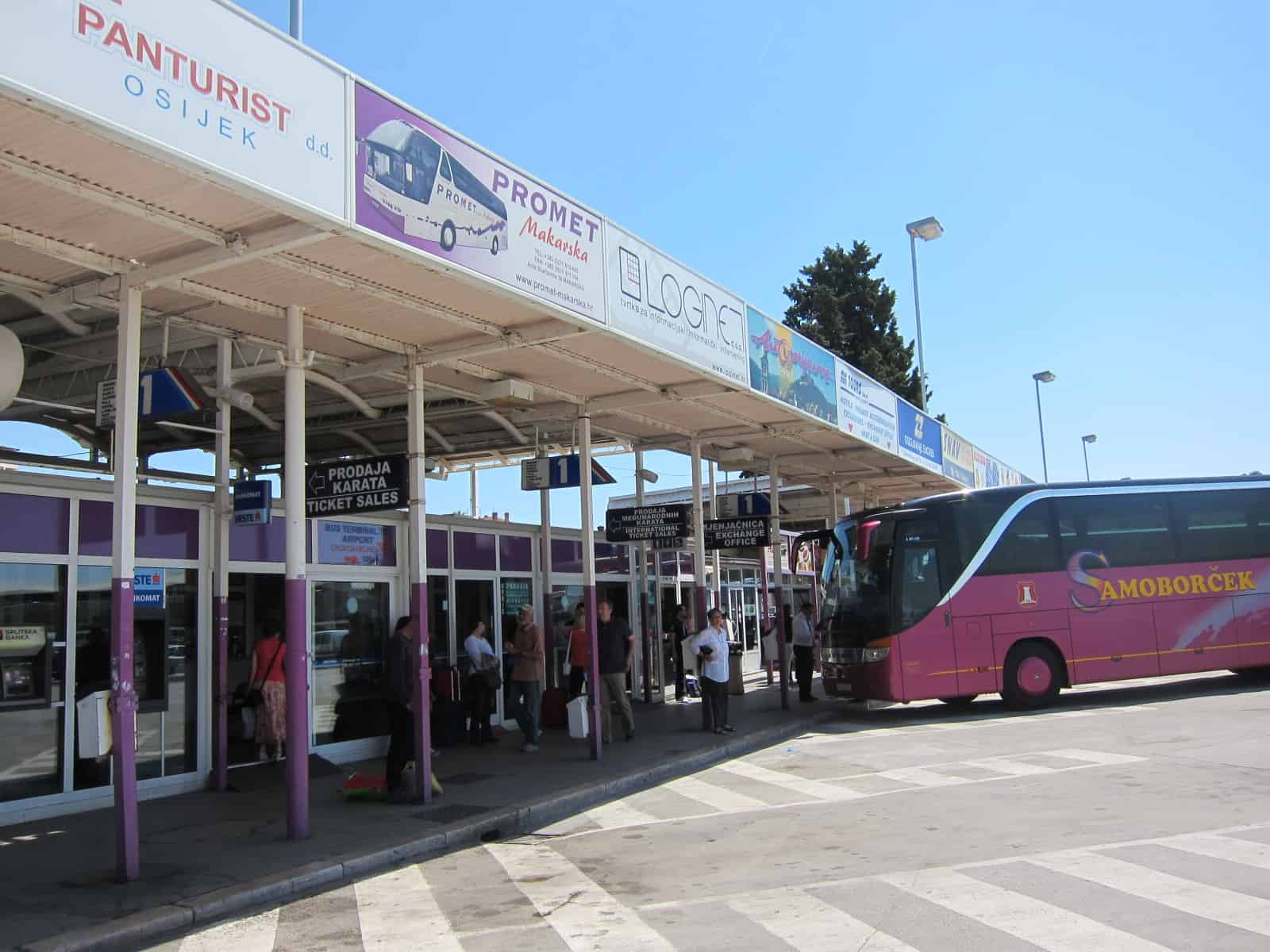
Dubrovnik Bus Station
If a shorter journey time is important to you, take a bus that hardly makes any stops and uses the motorway (where it starts, near Ploce) instead!
A one-way bus ticket from Dubrovnik to Split in 2025 costs €20-€25.
Good to know: Sit on the left-hand side of the bus (on the same side as the driver) to be closest to the amazing view!
Driving from Dubrovnik to Split
If you’re renting a car during travels in Croatia, making the drive from Dubrovnik to Split is relatively straightforward. As with travelling by bus, the fastest option is to take the A1 motorway (from where it starts, near Ploce) and zoom all the way up to Split! On the way to the motorway, you’ll drive part of the coastal road up and through the Peljesac Peninsula and across the Peljesac Bridge, so you’ll experience this charming part of south Dalmatia. Why not stop for a coffee? Perhaps in Ston, and you can then visit those town walls!
Or if you’re after something a bit more slower paced – and utterly beautiful – take the D8 coastal road all the way from Dubrovnik to Split. You’ll be rewarded with utterly gorgeous views all the way, and you’ll have plenty of opportunity to stop for coffee, lunch, some photos at a viewpoint and more along the way.
Part of the coastal road
The motorway option takes around 3 hours, whilst the coastal road would take you 4 hours to drive, but that assumes no stops at all. During summer, the coastal road option can be slower (as we’ve mentioned for the bus option above) because of holiday traffic. Simply take it in your stride!
Do also be aware that if you use the motorway, you will need to pay a toll. Take a ticket just before entering the motorway and then pay at the toll on exit. For a regular-sized car, the motorway toll in 2025 will cost €7.30 from Dubrovnik to Split (entering at Karamatici and exiting at Dugopolje for Split). You can see prices for other vehicles on the Toll Rates section of the Croatian Motorways website.
If you want to make the journey from Dubrovnik to Split very, very quickly, travelling by plane is, of course, the best bet.
Trade Air operate flights year-round twice a week, on Tuesdays and Thursdays. Flight time from Dubrovnik to Split is 55 minutes. A one-way ticket costs around €75 for a non-refundable ticket.]
Dubrovnik Airport
Travelling from Dubrovnik to Split by Train
Impossible!
Let me elaborate – Dubrovnik has no train station, so there’s no way you can travel from Dubrovnik to Split by train! Use one of the options above instead.
Dubrovnik to Split by Private Transfer
If you fancy taking all the organisation of travelling from Dubrovnik to Split out of your hands, a private transfer may be the best choice for you. These are generally rather pricey – you are making a journey of over 200 kilometres, after all – but if there’s a small group of you plus luggage, you may find it easiest to opt for a transfer. Take a look at some of the private transfers available below:
So what’s the best way of travelling from Dubrovnik to Split?
Oh yes, I did promise to tell you that, didn’t I? If I said, “there’s no best way”, would you be really cross with me?
Well, if you have your own rental car, then you’ll be driving, of course, and this option gives you the most flexibility and possibility of exploring.
Flying is only possible twice a week, and I would only recommend this if you’re really pushed for time and perhaps are only travelling with a small amount of luggage. But it’s undoubtedly the fastest option.
Travelling by catamaran is a great way of experiencing sailing on the Adriatic, but it is a long journey from Dubrovnik to Split by sea. I would personally choose a catamaran if making overnight stops on one (or more) of the islands along the way.
So, call me old-fashioned, but I love the bus option! Sit back and relax, put some music on your headphones (or listen to the gorgeous Croatian music the bus driver has chosen) and watch the gorgeous view as you’re driven by. And this is the cheapest option!
Whatever way you choose for travelling from Dubrovnik to Split, enjoy your journey!
https://www.visit-croatia.co.uk/wp-content/uploads/2025/05/The-best-ways-of-travelling-from-Dubrovnik-to-Split-blank.jpg500800annazhttps://www.visit-croatia.co.uk/wp-content/uploads/2017/09/visit-croatia-logo5.jpgannaz2025-05-28 12:37:542025-06-03 21:19:33The best ways of travelling from Dubrovnik to Split in 2025