If you’ve visited Zadar, you will have marvelled at the town’s many wonderful sights. It’s gorgeous, compact Old Town is home to a number of wonderful points of interest, old and new. Not least the area heading away from the Forum – which was built in the 3rd century by the Romans, but is now mostly ruins – leading to the sea. As well as the remains of what would have been a bustling marketplace in Roman times, you have a view of the iconic Church of St Donatus and the bell tower of the Cathedral of St Anastasia. But head down right to the seafront and there are two fascinating modern sights – the Greeting to the Sun and the magical Sea Organ. And today, we’ll take a look at the latter!
A close-up of the openings from which the sounds are heard, with people sitting and enjoying what they hear
About The Sea Organ
Known as morske orgulje in Croatian, the Sea Organ was designed by Croatian architect Nikola Basic, who was also the genius behind the Greeting to the Sun. Taking up about 70 metres of Zadar’s sea front, under the marble stone floor, thirty-five pipes of different lengths, sizes and slopes have been laid. When the sea waves hit these pipes, beautiful notes are carried through the holes up to the ears of those sitting above. Although the notes produced are completely random, of course, they do sound rather harmonious. It really does sound as if the sea is playing an organ!
The Sea Organ was opened in April 2005.
Getting There
Simply head down to the main seafront promenade in Zadar’s Old Town, known as the Riva. Next to the Greeting to the Sun light installation, you will hear the gentle notes of the Sea Organ and see the holes and cutouts located in the stone floor from which the music escapes. And that’s it – you’ve made it there!
A large part of Zadar’s Old Town is pedestrianised so it’s easy to reach the Sea Organ by foot. But you could also drive (or be driven to) Ulica Zadarskog Mira.
The holes laid in the stone work on the seafront in Zadar
Experiencing The Sea Organ
There’s honestly something so special about Zadar’s seaside promenade; you really must experience it for yourself. (And many do!)
To get the most of your “money” – I’m simply borrowing an expression here, as all of this is free – head to the Riva just before sunset and sit yourself down on the marble steps. You may like to bring along a small drink of something refreshing or relaxing, or even a coffee, to fully elevate what you’re about to experience.
You’ll almost instantly be hearing the gentle sounds of the Sea Organ, as the waves lap against the underfloor pipes. Generally, this is a popular time of day to come and hear the Sea Organ, so the notes will be intermingled with the delicate chatter of other people all around you.
As it’s approaching sunset, the Sea Organ’s sounds will soon be joined by glorious shades of orange and pink and the sun sets in front of you. It’s not for nothing that Zadar is proclaimed to have one of the most beautiful sunsets in the world.
Once the sun has fully set – or almost has – pick yourself and walk the few steps towards the Greeting to the Sun installation to dance around the colourful, twinkling lights here. Read more about that sight in our guide to it: Spotlight On: The Greeting to the Sun, Zadar.
Experience a preview of the Sea Organ in the comfort of your own home with the video below:
Opening Hours and Price
The Sea Organ is “open” to be enjoyed any time of day or night – and it’s totally free! Better still, you can hear its gorgeous music whenever you want; there is no better time to visit it than any other. (Unlike the Greeting to the Sun, which obviously works best at dusk or nighttime.)
https://www.visit-croatia.co.uk/wp-content/uploads/2025/11/spotlight_zadar-sea-organ.jpg533800annazhttps://www.visit-croatia.co.uk/wp-content/uploads/2017/09/visit-croatia-logo5.jpgannaz2025-11-17 14:14:052025-11-18 14:23:09Spotlight on: The Sea Organ, Zadar
Large swathes of Croatia are home to absolutely beautiful nature – you may well have been lucky enough to have visited one of the eight national parks or one of the many nature parks. The country’s nature parks are perhaps less known than the national parks, especially those such as Plitvice and Krka, but let me tell you – they are no less gorgeous, or any less dedicated to absolutely stunning nature. One such place is Papuk Nature Park, located in Slavonia in Eastern Croatia which has also been designated a Geopark – Croatia’s first. It is an area that offers so much for all ages – nature, yes, but also adventure and activities, and the opportunity to learn more about the amazing geological history at the local info centres.
If you’re visiting Croatia this autumn, consider a trip to Papuk Nature Park – it’s one of the best times of year to visit!
About Papuk Nature Park
Papuk Nature Park is centred around Papuk Mountain, the largest mountain in Slavonia, although at “only” 953 metres high, it pales in comparison to some of its coastal cousins! However, the mountain area extends over more than 300 square kilometres of incredible diversity, from dense beech and oak forests to steep cliffs to peaceful valleys and streams.
The mountain has an amazing geological history, for it was once an island in the Pannonian Sea many millions of years ago. Fossils found in the nature park’s rocks attest to the life that once flourished here.
Papuk was designated a nature park in Croatia in 1999; this status means that the park’s activities are dedicated to protecting and preserving the nature that is located here.
In 2007, Papuk Nature Park was awarded the status of a Geopark, part of the European Geoparks Network and part of the UNESCO Global Geoparks Network. A geopark is an area of significant geological heritage that promotes sustainable economic development and preserves its heritage for the benefit of the local community.
Start your visit at the Geo Info Centre
Start your exploration of the park at the Geo Info Centre, located in Vocin – one of the main entrances to the park. This modern multimedia space tells the full story of the Geopark from geological, biological and historical viewpoints. It is here that you can learn more about the fascinating history of Papuk as an island in the Pannonian Sea, and how rocks, mountain ranges and entire ecosystems were formed so long ago. You will be able to fully immerse yourself in a time when dinosaurs roamed the land, when the ice age was prevalent or when the first human communities started populating the area.
The Geo Info Centre includes numerous fully interactive displays and experiences, not least the 6D Cinema Hall. You will really feel like you’ve gone back in time!
The 6D Cinema Hall at the Geo Info Centre
Those with an archaeological interest will be fascinated by the displays showing numerous different periods of the Papuk region. Find out how people lived in this part of the world from the Iron Age through to the Middle Ages.
There are also numerous exhibits on the flora and fauna of the park, and young kids will delight in the Geo Capsule corner where they can explore to their heart’s content.
The Geo Info Centre is open Tuesday to Friday from 8am to 5pm, and on weekends and public holidays from 9am to 5pm.
Tickets are priced at €8 for adults, €7 for concessions and €6.50 for children aged 4 to 18 years.
Visiting Papuk Nature Park
What could be better than surrounding yourself with the stunning nature of the park? Papuk really does lend itself to a multitude of walks or hikes throughout its area. Whilst exploring, you may come across Jankovac Forest Park and its lakes or Skakavac waterfall. Maybe you’ll spot an Ivanjski rovaš whilst you’re roaming? That’s the smallest lizard in Croatia!
If you want to extend your knowledge of the nature park, consider signing up for one of the educational programmes that are available.
Activities in Papuk Nature Park
If you’re interested in something beyond “just” enjoying the stunning nature here, there are many adventurous activities for you to take part in.
Adrenaline Park Duboka offers an aerial assault course for kids and adults, whilst another adrenaline park is being built in Slatinski Drenovac that will offer ziplining, climbing and more.
Do also look at the Nature Park’s Outdoor Programmes for details on activities such as canoeing, mountaineering, climbing, geocaching and even horse riding.
Getting here
The Nature Park is roughly 200 kilometres southeast of Zagreb, and about 100 kilometres west of Osijek. Really, the Nature Park is best visited by car and would be an ideal stop if you’re exploring this part of continental Croatia.
There are four entrances to the park – the aforementioned entrance at Vocin (where the Geo Info Centre is located), two more northern entrances at Slatinski Drenovac and Orahovica and a southern entrance at Velika.
For a longer stay, there’s a small campground – Camp Duboka – which can accommodate 11 campervans, and which also has an area for tents.
More info
You can learn plenty more about the lush nature of Papuk Nature Park on the official website www.pp-papuk.hr or on Vrata Papuka.
https://www.visit-croatia.co.uk/wp-content/uploads/2025/10/PP-Papuk2.jpg8001200annazhttps://www.visit-croatia.co.uk/wp-content/uploads/2017/09/visit-croatia-logo5.jpgannaz2025-10-02 14:00:152025-10-03 15:22:31Spotlight on: Papuk Nature Park
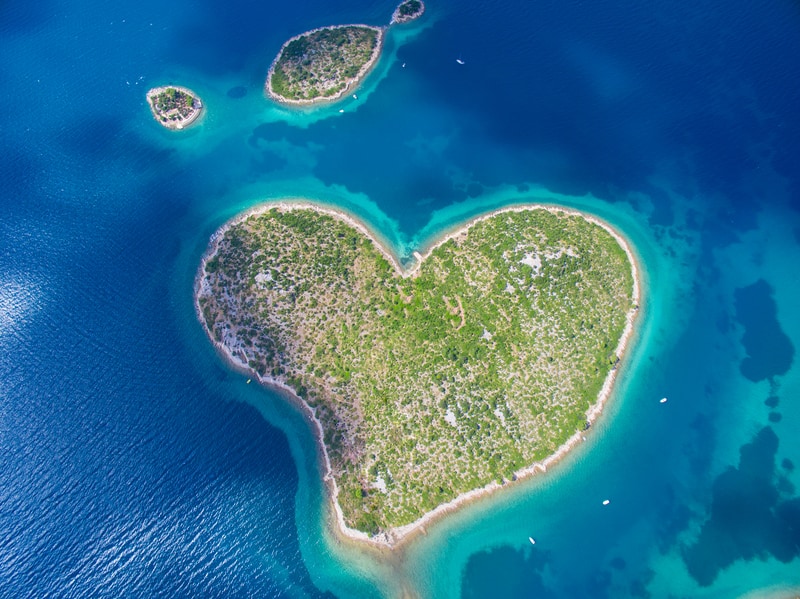
What could be better for Valentine’s Day than an actual island in the shape of a heart? I mean, imagine gifting that to someone! Technically you could, for a heart-shaped island exists in Croatia – the island of Galesnjak. And what’s even more impressive is that this island is naturally heart-shaped – no man-made interference here. Let’s learn more about Galesnjak, where it is and whether it’s possible to visit it.
Aerial view of the heart shaped Galesnjak island
The island has of course existed for a long, long time – but it was in 2008 when it became famous, “discovered” as it was by Google Earth and subsequently quite a bit of fanfare in the global press. And fair enough – it’s a good looking island, and what could be more charming than one in the shape of a heart?
About Galesnjak
Also referred to as the Island of Love or Lover’s Island, Galesnjak is actually located very close to the mainland in North Dalmatia. It lies in the Pasman channel, only 600 metres away from the mainland, in front of Pasman island and slightly north of the popular holiday town Biograd na moru. It has a total size of 132,000 square metres.
It is a privately-owned island and there is, essentially, nothing on the island by way of visitor facilities, amenities or similar. The island is largely covered by shrubs which gives it its appearance. A few years ago, part of the plant life was raised with the aim of beautiful olive trees being planted to improve the general romantic nature of Galesnjak.
The island has of course existed for a long, long time, and there is even evidence of life having existed on the island many centuries ago. It was first recorded on maps in the 19th century; however, it was in 2008 when it became famous, “discovered” as it was by Google Earth and subsequently quite a bit of fanfare in the global press. And fair enough – it’s a good looking island, and what could be more charming than one in the shape of a heart?
Here is what Galesnjak looks like on Google Earth now:
g
Visiting Galesnjak
As a privately-owned island, Galesnjak is closed to visitors generally…unless you are able to organise a private (in other words, rather expensive) trip of some sort. There have been rumours that celebrities such as Beyonce and Jeff Bezos have visited and held parties on Galesnjak because…well, if you have that level wealth, why wouldn’t you?
You are of course permitted to sail near to the island to view it – although, again, you would need to do so on a private tour which would also see you visiting other small islands and nearby locations. Take a look at some of the following private boat tours from Zadar that are available:
Part of Galesnjak was up for sale a few years ago. You could have bought 40,000 square metres of the island for a cool €13 million. Understandably, it’s unknown whether the sale went through or not.
A view of Galesnjak (you can see where parts of the island have been razed) and its location close to the mainland
More info
You can discover more about Croatia’s heart-shaped island on the website of Pasman Tourist Board
https://www.visit-croatia.co.uk/wp-content/uploads/2023/06/galesnjak.jpg599800annazhttps://www.visit-croatia.co.uk/wp-content/uploads/2017/09/visit-croatia-logo5.jpgannaz2025-02-14 10:13:182025-02-14 10:13:20Spotlight on: Galesnjak, Croatia’s heart-shaped island
If you’re visiting the central part of Dalmatia – in and around its main city of Split – you may have come across the possibility of visiting somewhere called the Blue Lagoon. While this sounds rather spectacular, it’s not the only Blue Lagoon in the world – you may have heard (or visited) that amazing geothermal spa that’s located just outside Reykjavik in Iceland. (I have and that place is magical! But I digress…) Let me first tell you that the Blue Lagoon in Croatia is nothing like the Icelandic version and secondly, it still is magical in a slightly different way! Here’s a guide to why you should visit the Blue Lagoon and what you can see and enjoy when doing so.
Ariel view of popular Blue Lagoon – Krknjasi near town Trogir, in the Adriatic sea, Croatia
About The Blue Lagoon and its features
Croatia’s Blue Lagoon is located just off the tiny island of Drvenik Veli, a sister island to Drvenik Mali. (Veli and mali meaning big and small!) The lagoon is located in Krknjasi Bay on the eastern side of the island. It is referred to as the Blue Lagoon because of its stunningly clear blue and turquoise waters atop a sandy seabed and next to a white pebble beach.
The sea area here is remarkably still and shallow – helping to produce this gorgeous blue effect – protected as it is by two further islets, Krknjas Veli and Krknjas Mali. (There goes those veli and mali names again. Now you know what they mean!)
This whole experience is one of paradise, with some even calling it akin to the Caribbean. Whilst I have no personal experience, let’s just stick to admiring this slice of heaven in the Mediterranean, shall we?!
This is certainly one of these places where words can’t fully do it justice, and photos can only go so far. Why not experience it for yourself when you next visit this part of Croatia?
In almost all cases, it would be easiest to join an organised tour if wanting to visit the Blue Lagoon. Tours from local towns and cities exist, such as from Split and Trogir. These tours generally include visiting the Blue Lagoon as just part of the day – often, you will also get to visit other small islands in the region, or historic gems such as Trogir. In all cases, you will have at least an hour or two to enjoy in the Blue Lagoon itself for swimming and snorkelling. (Snorkelling equipment is normally always provided by the excursion company.)
Take a look at some of the options for tours from Split…
Local Trogir agency Bura Line also offers a 10-hour tour from Split that includes stops in Trogir, the island of Ciovo and the island of Solta as well as the Blue Lagoon.
By ferry
You can otherwise opt to take a public ferry from Trogir to Drvenik Veli. Jadrolinija operates this route, sailing three times a day, year-round. (The boat in fact then also sails on to Drvenik Mali.) Should you utilise this boat, it would give you a full day on the island as the latest return boat departs 7 and a half hours after you’re first dropped off. (Do check timetables carefully so you’re not stranded by missing the return boat!)
The boat docks at Drvenik Veliki, the main settlement on Drvenik Veli. This is around a 45-minute walk away from the Blue Lagoon bay.
Should you wish for more time on the island and to enjoy the Blue Lagoon, there is a small handful of accommodation in Drvenik Veliki. You can search and book using the map below:
Opening Hours and Price
Well, seeing as it’s a natural bay in the sea, it’s open all the time! But you are of course restricted to the hours that you can reach the area by boat.
As for the price – the lagoon itself is free, but you are again dependent on the cost of the excursion or ferry!
When is Best to Go to the Blue Lagoon
As you can perhaps imagine, the Blue Lagoon can be a popular place to visit – sometimes too popular. Obviously summer is the best time to come here to get the full effect of sunshine and warm Adriatic waters, but you’ll be joined by a good number of other day trippers.
Consider visiting outside of the peak summer period – let’s say early June or mid to late September – when you’ll still be able to enjoy swimming here but alongside fewer visitors.
What to See and Do
Relax! Enjoy the gorgeous blue waters and the tranquil surroundings of where you are. If you visiting from somewhere as bustling as Split, it will be quite a contrast.
If you have access to snorkelling equipment, absolutely give it a go. You’ll be able to view the marine life in the calm waters, and snorkelling itself is such a calming activity.
More info
Unfortunately, Drvenik Veli appears not oto have a tourist board website, so online information is somewhat limited. There’s a small slice of info on the Visit Trogir website.
https://www.visit-croatia.co.uk/wp-content/uploads/2025/02/blue-lagoon-3.jpg7491000annazhttps://www.visit-croatia.co.uk/wp-content/uploads/2017/09/visit-croatia-logo5.jpgannaz2025-02-10 15:18:052025-02-10 15:18:33Spotlight on: Blue Lagoon, Dalmatia
You may have heard whisperings about a Croatian connection to fashion item that is the tie. It’s just one of the many fascinating items to emerge from this small country. But how exactly did Croats come to invent the tie? Read on below to find out more – and to learn more about the famous Croatian tie brand Croata.
The (Croatian) origin of the tie – the cravat
As with all good stories, this revolves around love.
From way back when to the present day, Croatian ladies have traditionally tried a scarf around their fiancés’ necks as a sign of mutual love and fidelity. Not only would this be a sign of commitment to each other, it was also a way of making their love known to others. This simple act was even more important during times of war, signifying that the ladies were willing to wait for their beloveds, sometimes for many, many years. The tied scarves would also provide comfort and encouragement to the men when they were on the battlefields.
The French Connection
Croatian light cavalry soldiers – known for their exceptional military skills and courage – went to serve the French king during the Thirty Years’ Way in the 17th century. One detail of their uniform was immediately noticed by the fashion-conscious French people – the red neckerchiefs tied around the necks of the Croatian soldiers. These Croatian neckerchiefs were simple, colourful, flowing and tied in a distinctive knot – all elements different from the high, stiff collars worn by French men at the time.
The court of Louis XIV enthusiastically accepted this bold clothing item, deeming it to be a sign of dignity and civility, distinction and formality. It came to dominate the urban fashion of the time.
A name emerges – the Cravat
You’ve surely heard of the word cravat and not particularly thought it to be connected to ‘Croat’…despite being very similar. In fact, it absolutely is connected!
The new fashion trend of a knotted scarf that was said to be tied “à la manière Croate” (“in the Croatian way”) in the French language.
In other languages, the cravat is known as krawatte (German), corbata (Spanish) and cravatta (Italian).
And cravat is of course still used in English, but for a special type of tie. The expression “to tie a cravat” has also produced the words “tie” and “necktie“.
The necktie is the only clothing product that does not have a protective function for the wearer. It nevertheless has a strong symbolism, of dignity and freedom but also responsibility and formality. Wearers tie their important moments with the knot of a tie, conveying a message about their feelings.
About Croata
Croata is an independent, family-owned Croatian luxury brand that was founded in 1990 and which today employs over 100 people. Known for its heritage, craftsmanship and exclusivity, the artisanal fashion house creates beautiful and unique items. Each item produced by Croata combines excellent quality raw materials with top attention to detail, handmade in Croatia by highly skilled artisans that are experts in working with different materials and in an assortment of tailoring techniques.
Croata is committed to using a responsible and sustainable approach in its gorgeous products.
About Croata’s production process
Croata’s beautiful items evolve during a two-stage production process to produce a beautiful finished product.
Firstly, the cravat or tie is born on paper at the Croata design studio…or perhaps even earlier, in the minds of a Croata designer!
Many of Croata’s products contain celebrated motifs from Croatian and world cultural and natural heritage. Some of the most popular Croatian motifs that are used include pleter braiding, Glagolithic script or folk embroidery. Braiding is a common decoration on old Croatian stone monuments, first seen in the early Middle Ages. Glagolitic script – which you may have also seen on Croatia Euro cent coins – is an old Croatian alphabet that was in use from the 11th century. Folk embroidery, meanwhile, is referred to as a “letter of the heart” that is created by Croatian women and girls from all over the country.
It takes a special kind of art to transfer these motifs – once seen on stone – into the gentle silk weave of a cravat, requiring exception knowledge of the techniques of weaving and sewing neckties.
After designs have been created on paper, they are transferred onto silk samples to discern the fullness and richness of each design – a very important stage in the development.
The second part of the process involves the cutting. Cravats are cut in three parts, at a 45-degree angle, with particular attention paid to the tip which must be tailored precisely and sewn meticulously. The design of the cravat must fit the point perfectly, just as the designers envisioned it. This is one indicator of a very high-quality necktie.
Each cravat has a cotton insert to give it a specific volume and which also affects the size of the knot. All three parts of the cravat, including the inner and outer layers, are precisely stitched by hand. At the end, the brand label and the passantino – the tab into which the narrower part of the cravat is inserted – are attached.
Croata’s very fine cravat is now ready for the customer!
Croata’s tips for checking the quality of the tie
A perfectly cut and sewn tie – when stretched out – will be perfectly straight along its whole length with no twists.
The thread loop at the narrower part of the tie provides it with elasticity and longevity as well as indicating that the tie is handmade. For these reasons, you should never cut off this thread!
More about Croata
Do take a look at Croata’s stunning creations in the images of this post.
You can also learn more about the company and its very fine products on www.croata.com, where you can also buy Croata’s neckties, shawls, scarves, shirts and more with items for both men and women. They offer worldwide delivery!
When in Croatia, be sure to seek out a Croata shop. They have four shops in Zagreb, as well as shops in prime locations in Dubrovnik, Split, Zadar, Varazdin and Osijek.
The interior of the Croata shop in Zadar
All images are credited to Croata.
https://www.visit-croatia.co.uk/wp-content/uploads/2024/12/Colorful-ties-that-tell-the-same-story-of-style.jpg7201080annazhttps://www.visit-croatia.co.uk/wp-content/uploads/2017/09/visit-croatia-logo5.jpgannaz2024-12-16 12:22:542024-12-18 10:47:19Spotlight on: the Croatian tie connection and the Croata brand
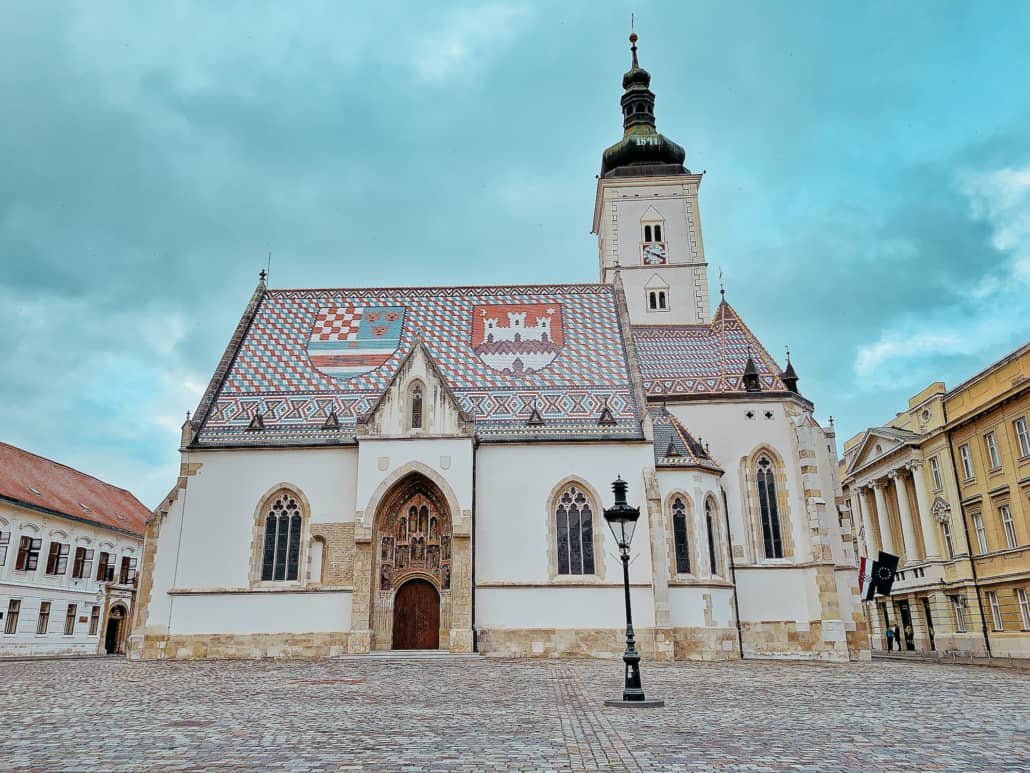
One of the most famous sights in Croatia is St Mark’s Church in Zagreb. It’s one of “those kinds of sights” that is often featured in tourist advertising for the country along with Zlatni Rat Beach, Plitvice Lakes National Park and Dubrovnik’s Old Town Walls and similar. And – like all those aforementioned beauties – it’s definitely the kind of thing you need to see in real life, not just on screen.
With its stunning tiled roof featuring two historic shields of Croatia, it’s an absolute must-see when visiting Croatia’s capital city. It’s easily done so on a walking tour of Zagreb’s sight-filled Upper Town, and when you turn the corner onto St Mark’s Square (Trg svetog Marka) you’ll be rewarded with a stunning view of this iconic sight.
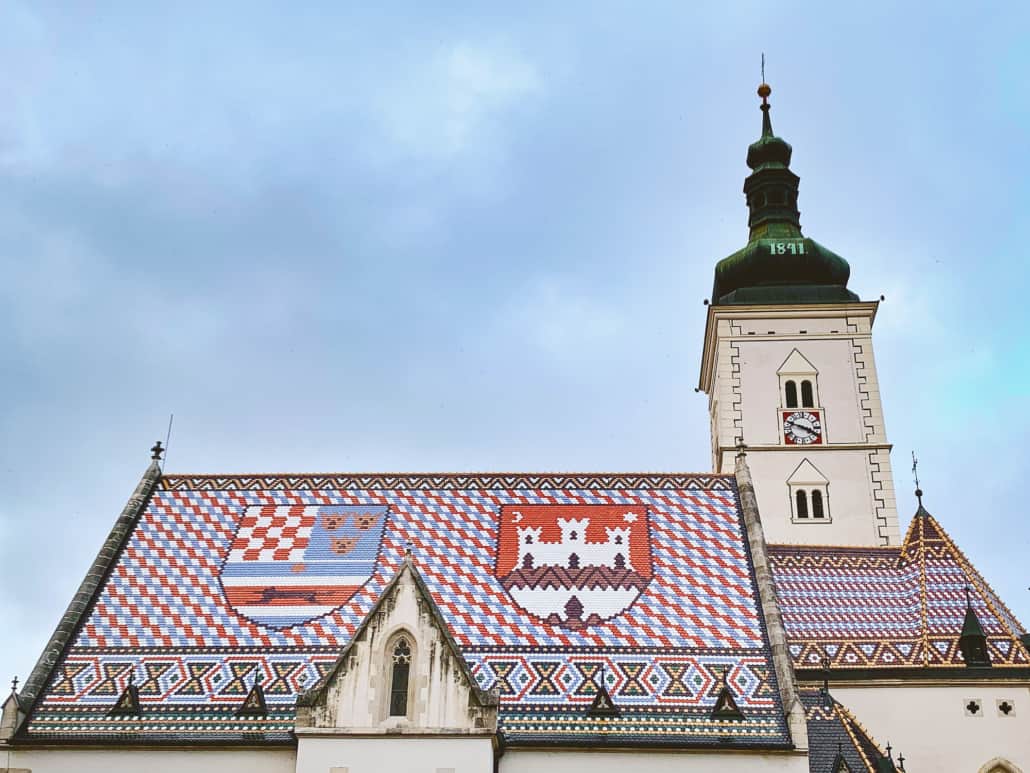
St Mark’s Church, with its famous tiled roofA close-up of the tiled roof – it shows the coat of arms of the Kingdom of Croatia, Slavonia and Dalmatia (left) and the coat of arms of the City of Zagreb (right)
History of the St Mark’s Church, Zagreb
The original church that stood here is understood to be from the 13th century, officially making it one of the oldest buildings in Zagreb. However, it is just one Romanesque window on the southern wall that still exists today. Much of the main structure and layout of the church is from the 14th century, including beautiful sculpture work in its Gothic southern portal.
The church was extensively renovated and reconstructed in the 19th century (especially due to the devastating 1880 earthquake), with designs by Viennese architect Friedrich von Schmidt, and Hermann Bolle who was heavily involved with Zagreb’s city plans and other grand buildings at that time. Works then included the lowering of the floor, the burying of tombs underground and the removal of the church’s Baroque altars with the installation of three stone altars instead. It was during this renovation that the Church received its beautiful tiled roof.
Further renovations took place in the early part of the 20th century, with works by famed Croatian sculptor Ivan Mestrovic installed during this time.
In March 2020, another earthquake caused structural damage to the Church. After repairs, the Church was reopened to Mass in December 2023.
Features
Have I mentioned the beautiful tiled roof?! The colourful glazed tiles depict two coats of arms. On the left, you will see the coat of arms of the Kingdom of Croatia, Dalmatia and Slavonia, an autonomous kingdom within Austro-Hungary that existed from 1868 to 1918. Within this latter coat of arms, you can see elements of the Kingdom of Croatia (the red and white checkered part), of Slavonia (the bottom blue – white – red – white – blue part which features a pine marten) and of Dalmatia (the upper right portion with three lions).
A closeup of the Coat of Arms of Croatia, Dalmatia and Slavonia
A close-up of the Coat of Arms of Zagreb
The right-hand coat of arms is that of Zagreb – or, in fact, Gradec which is the historic town (largely located where today’s Upper Town stands) from which Zagreb hails. Zagreb’s coat of arms is actually a castle on a blue background, whilst Gradec’s is of the castle on a red background – as shown on the church’s roof.
St Mark’s Church, with the parliament building – Sabor – on the right
The impressive Gothic portal on its southern wall features sculpture work from the 14th century with fifteen figures including Joseph, Mary and Jesus. This work is thought to be done by the Parler workshop from Prague.
On the outside of the northwestern wall you can find the oldest coat of arms of Zagreb, which is from 1499.
Getting There
As I’ve mentioned, the Church is located in the middle of the cobbled St Mark’s Square in the Upper Town part of Zagreb. It is a short walk from many of the city’s other most famous sights, such as the Stone Gate, Lotrscak Tower and the Funicular. Also located on St Mark’s Square is the the Croatian Parliament Building, the Sabor and Banski Dvori which houses the Croatian government.
If travelling from elsewhere in Zagreb, the best idea is to take a tram to the main square – Ban Jelacic Square – first. From here, it is then a 10-minute walk to St Mark’s Church; walk up Ulica Pavla Radica until you get to the statue of St George, then go round it and through the Stone Gate and then straight ahead until you get to St Mark’s Church.
Alternatively, from the main square, walk along Ilica until you get to the Funicular. Ride it to its Upper Station and then walk north, past Lotrscak Tower, in a northern direction for a few minutes to once again hit St Mark’s Square.
Visiting St Mark’s Church, Zagreb
It used to be possible to get right up close to the Church and do a full circular walk around the exterior. Unfortunately, railings have been positioned around St Mark’s Church for a few years now due to security issues – thanks to the two political buildings on this same square. This means that it’s not possible to get particularly close to the Church.
Nevertheless, you can still take a photo or two or three hundred from the edge of the square itself. You are there, of course, to see the wonderful tiled roof so point your camera(phone) upwards and start clicking away!
It is not possible to visit the interior of the church unless you attend a Holy Mass. These are held at 6pm on working days and at 11am and 6pm on Sundays and religious holidays.
St Mark’s Church in Markov trg (St Mark’s Square); the roof tiles show the coat of arms of Zagreb (right) and the coat of arms of the Kingdom of Croatia, Dalmatia and Slavonia (left)
Take a look at some of the walking tours of Zagreb below that include St Mark’s Church as one of the sights you see:
The official website of the Church is zupa-svmarkaev.hr although this website is in the Croatian language only.
https://www.visit-croatia.co.uk/wp-content/uploads/2024/10/st-marks-church-closeup-2.jpg7501000annazhttps://www.visit-croatia.co.uk/wp-content/uploads/2017/09/visit-croatia-logo5.jpgannaz2024-10-14 23:35:402024-10-15 11:36:44Spotlight on: St Mark’s Church, Zagreb
In the next instalment of our Spotlight on… series, we now move to the charming north Dalmatian town of Sibenik and its impressive Cathedral of St James. The Cathedral is one of the most important sights in Sibenik and in fact in the whole of Croatia too – it’s a highly recognisable structure.
The Cathedral is also one of Croatia’s UNESCO World Heritage sites, added to the list in 2000. It is one of two UNESCO sites in Sibenik – the other being St Nicholas Fort which is listed as a Venetian Work of Defence from the 16th & 17th Centuries.
Use this page to find out more about the Cathedral and how to visit it.
The Cathedral of St. James
Getting There
The Cathedral of St James is located right in the centre of Sibenik, in the old part of the town. If you’re walking down the seaside promenade known as the Riva, you will be able to see it – it’s a quick walk up a set of stone steps to read the Cathedral itself.
Reaching Sibenik to get to the Cathedral is easy as there are good bus connections from elsewhere in Croatia. The bus station in the city is also a short walk from the Cathedral.
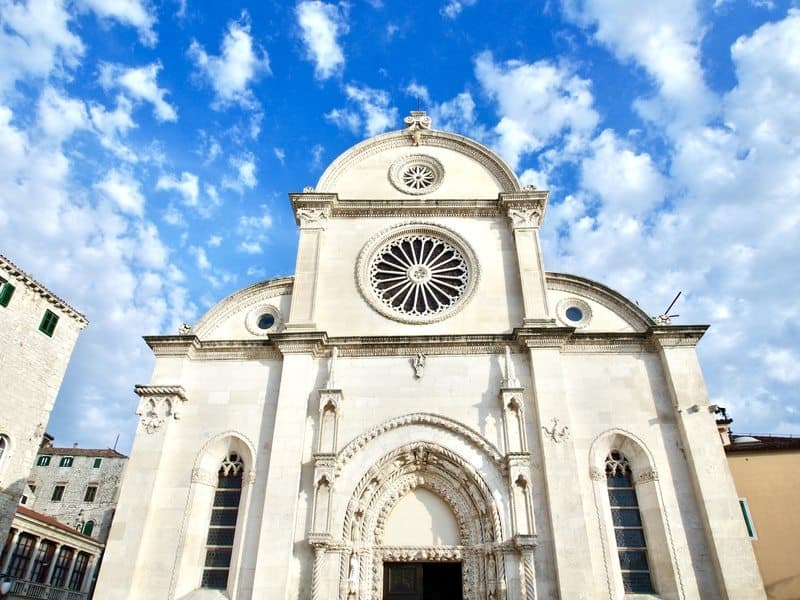
Entrance of the CathedralAnother look at the front of St James’s Cathedral
About The Cathedral of St James
The Cathedral was constructed between 1431 and 1536, with several different Italian and Dalmatian architects responsible for the look of the structure over this time. The main architects involved in the construction were Francesco di Giacomo, Georgius Mathei Dalmaticus (also known as Juraj Dalmatinac) and Niccolo di Giovanni Fiorentino. Juraj Dalmatinac directed construction work between 1444 and 1473; a famous Croatian sculptor, you can find a statue placed opposite the entrance to the Cathedral as a memorial to him.
First intended to be built as a rather straightforward church, plans of the building changed significantly to include side naves, apses, its dome and a baptistery. Almost all of this work came under the plans of Juraj Dalmatinac, and for this reason, he is so closely linked to the Cathedral.
Although there were largely three different phases to its construction, the Cathedral appears to take the form of one unified build and there is little to identify separate plans by different architects.
The relatively long construction period means the Cathedral features both Gothic and Renaissance design styles because of the transition from one to the other at the time.
Features of The Cathedral of St James
The main features of the Cathedral include its 32-metre-high dome, which sits atop 4 columns, its three naves and three apses (domed recesses) and 74 faces (or portraits) with assorted expressions on the exterior of locals of the time.
The front of the Cathedral features the Lion Gate which depicts Adam and Eve on columns supported by lions.
The interior of the Cathedral is highly detailed and features the baptistery where three angels support the baptismal font, the crypt of Bishop Sizgoric and the crypt of Bishop Stafilic.
The interior of the cathedral – look at the amazing height of the altar
Rather impressively, the Cathedral was constructed entirely from stone (limestone and marble from the nearby island of Brac) without brick or wooden supports.
Cathedral of St James external “portraits”
Opening Hours and Price
The Cathedral can and should be enjoyed from its exterior first – do spend some time enjoying its impressive facade and walking around the three sides to admire all the detail on the outside.
Once you’ve soaked up all of the ornate external decoration, you can pay a visit to the inside of the Cathedral of St James. The Cathedral is open year-round (only by appointment from the 1st December to Easter) from 8.30am to 7.30pm or 8.30pm depending on the month. Entry fee is €3.
Do be aware that as a working Cathedral, mass takes place daily (and three times on Sundays) so you may prefer to visit at other times.
Other Ways of Seeing and Enjoying The Cathedral
You may like to join a guided walking tour of Sibenik which will include some time looking at the Cathedral. See below for some ideas of walking tours:
https://www.visit-croatia.co.uk/wp-content/uploads/2024/06/cathedral-of-st-james-sibenik-aerial.jpg533800annazhttps://www.visit-croatia.co.uk/wp-content/uploads/2017/09/visit-croatia-logo5.jpgannaz2024-06-18 15:26:172024-06-21 15:17:31Spotlight on: Cathedral of St James, Sibenik
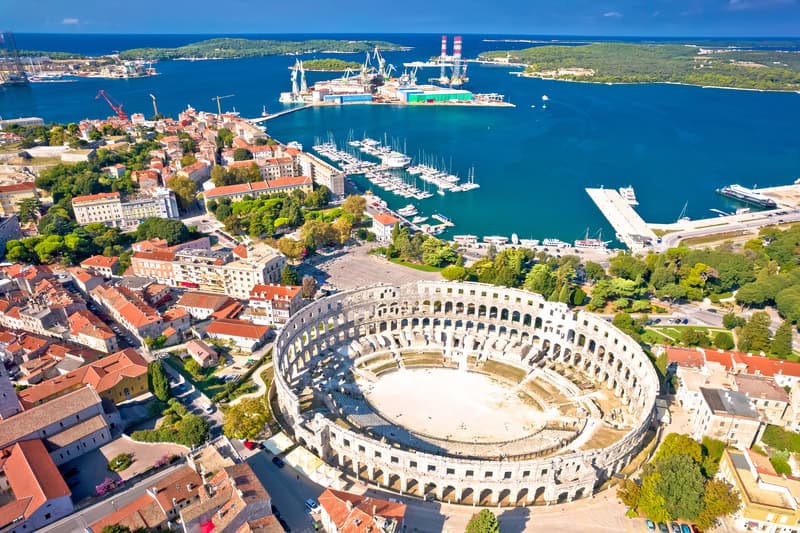
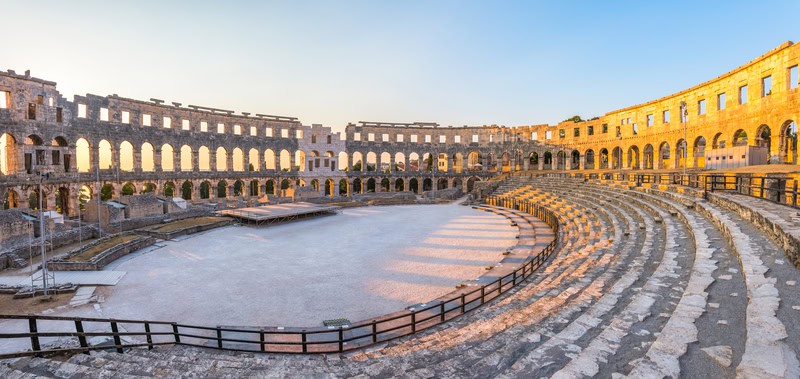
The stunning Arena in Pula is one of the most magical sights in all of Croatia. This three-story (on its largest side) Roman amphitheatre is the sixth-largest amphitheatre in the world but – with all four sides intact – it is the best-preserved amphitheatre. Imagine that! Read on for more details about this ancient gem in Pula, how to visit it and what to see there.
Getting There
The Arena is located in the northeastern part of Pula, a short distance from the sea. Take a look at our Getting to Istria page for details of flights to Pula Airport, and then out Getting to and from Pula Airport for how to get to the city itself.
The Arena is actually a short walk (no more than 15 minutes) from the bus station and a similar distance from the train station. It is also very close to the port in Pula, should you be making your way to the city by boat.
You can also take a local city bus to the Arena – buses 4, 5a, 8, 9 and 71 go past this wonderful building.
An aerial shot
About The Arena and Its History
The Arena was built in several stages or iterations during the rule of several different Roman Emperors between 27 BC and 68 AD. The foundations of the first amphitheatre were built during the time of Emperor Augustus. This was extended during the reign of Emperor Claudius and completed under the reign of Emperor Vespasian. At the time of its construction, Pula – then called Pietas Iulia – was the centre of Roman rule in this part of the Empire; the Arena was built just outside the Town Walls.
The Arena is named after the Latin word for sand (harena) which is what the floor of the central part would have been covered in. Its external walls are made from limestone.
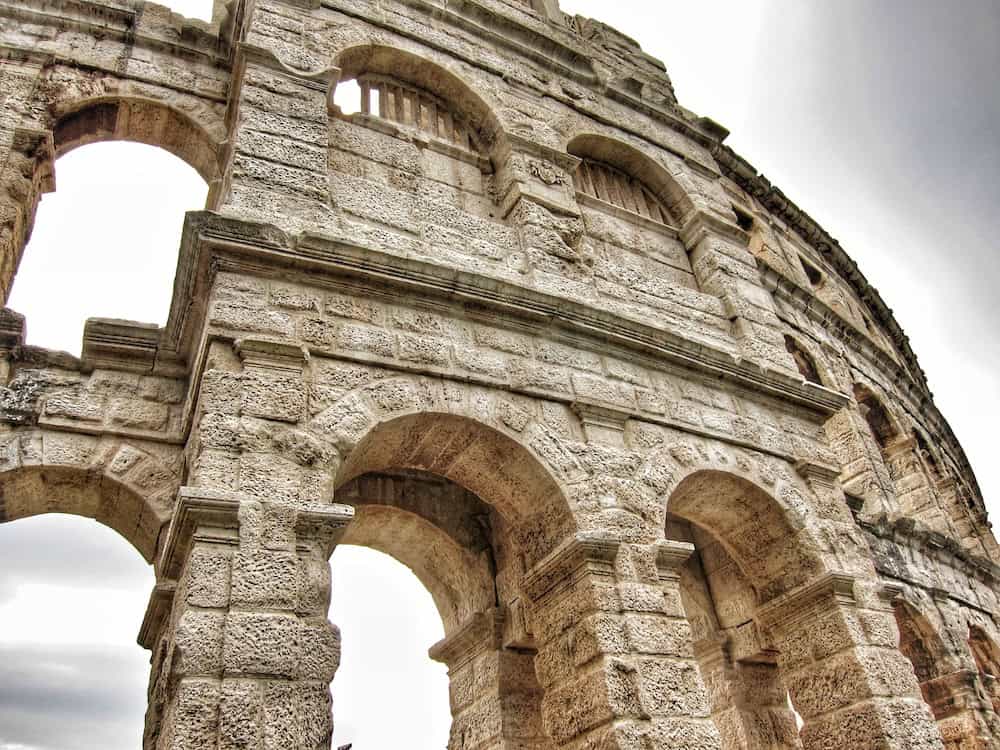
A close-up of the exterior wall of the Arena
During its use in Roman times, it would have held up to 23,000 spectators. These days, about 5,000 people usually attend events held here. Back in those Roman times, the amphitheatre was used for what you can expect – gladiatorial fights and other entertainment occasions, as well as being a place for social meetings.
Gladiatorial fights were banned in the 5th century and the Arena subsequently became used for a cattle market. In that same century, parts of the stone of the structure began to be used as a source of building materials for the local area although this practice was stopped in the 13th century.
In the 16th century, the Venetian Senate proposed to dismantle the amphitheatre in its entirety and rebuild it in Venice although this was (thankfully!) prevented by Sentator Gabriele Emo. A plaque in tribute to him was placed on the northwestern tower.
The restoration of the Arena began in the 19th century.
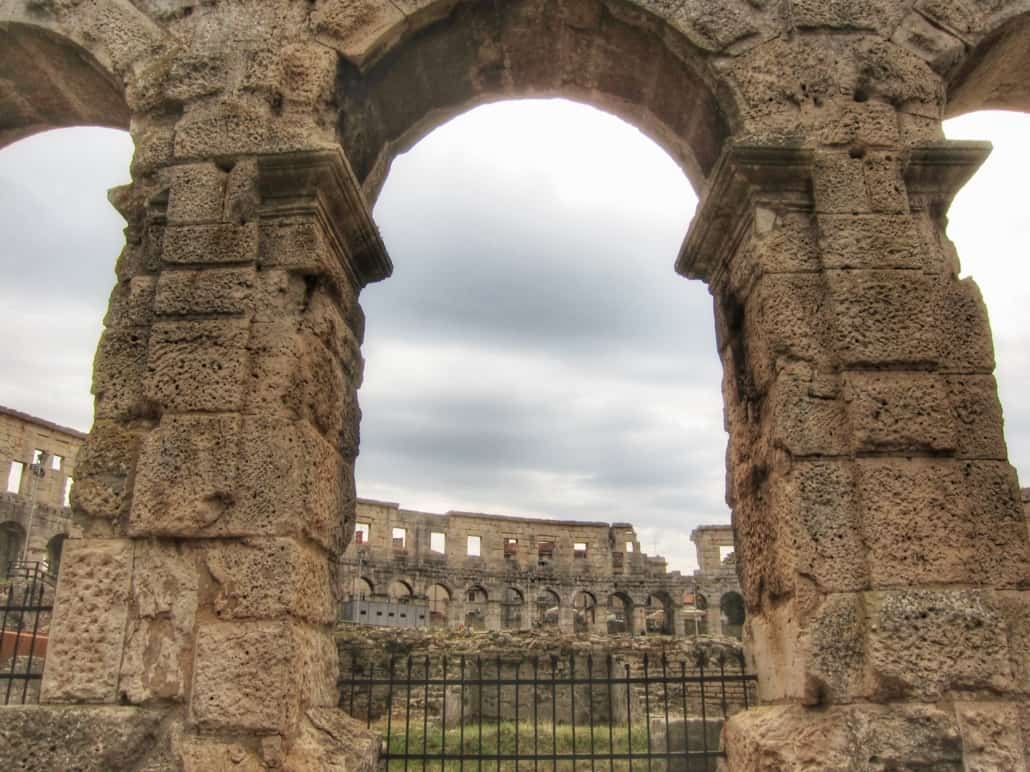
Peeking through one of the arches in the Arena
Features of The Arena
The oval-shaped Arena stands just over 32 metres high, stretching out over an area of about 132 metres wide and 105 metres deep. The central part – where Roman entertainment would have taken place – measures 68 metres by 41 metres. One side of the amphitheatre, the one closest to the Adriatic Sea, has three visible stories (plus a fourth foundation story) whilst the other three sides have two. This is because the Arena is built on a natural slope.
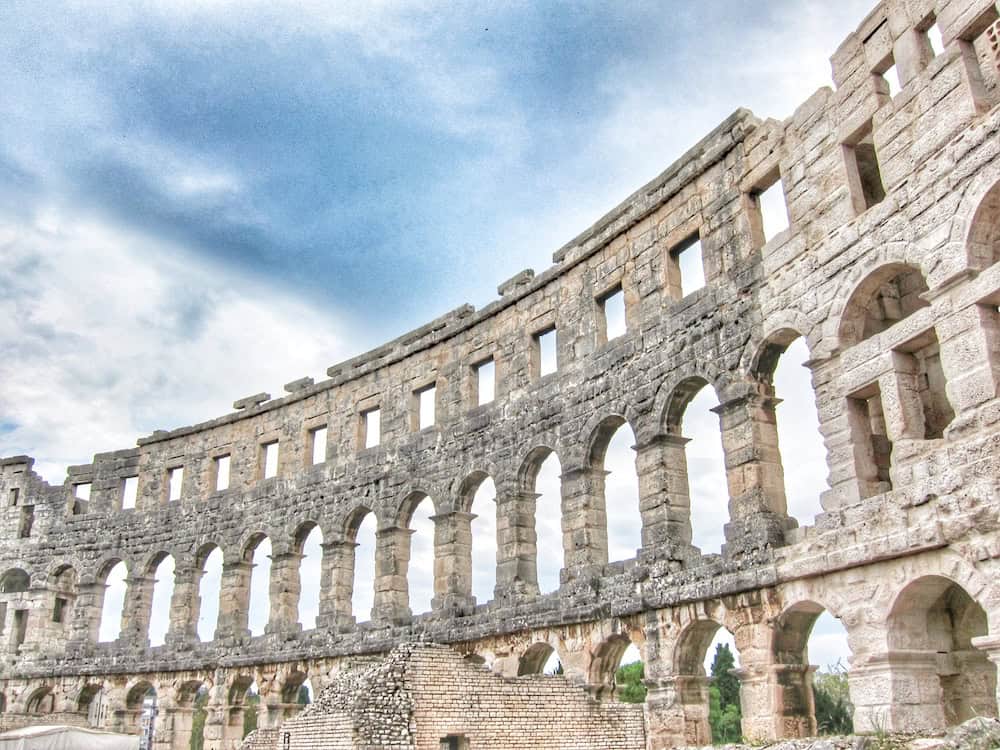
Built in limestone, the two lower stories contain 72 arches whilst the top story is made up of 67 square windows with a cornice feature placed on top. There are four rectangular towers set within the walls which strengthened them; these towers contained water reservoirs.
A view of the exterior walls showing the arches and the square windows of the top story
Below the main Arena floor were constructed a series of chambers for storing animals and passageways to lead them and gladiators up to the Arena.
Perhaps surprisingly, the Arena could have been covered up in the case of bad weather through a series of pulleys and ropes attached to wooden masts that would pull sails over the roof.
Opening Hours and Entrance Price
The Arena is open year-round with extended opening hours – usually until 10pm – in the summer months.
Entry costs €10 for adults and €5 for children.
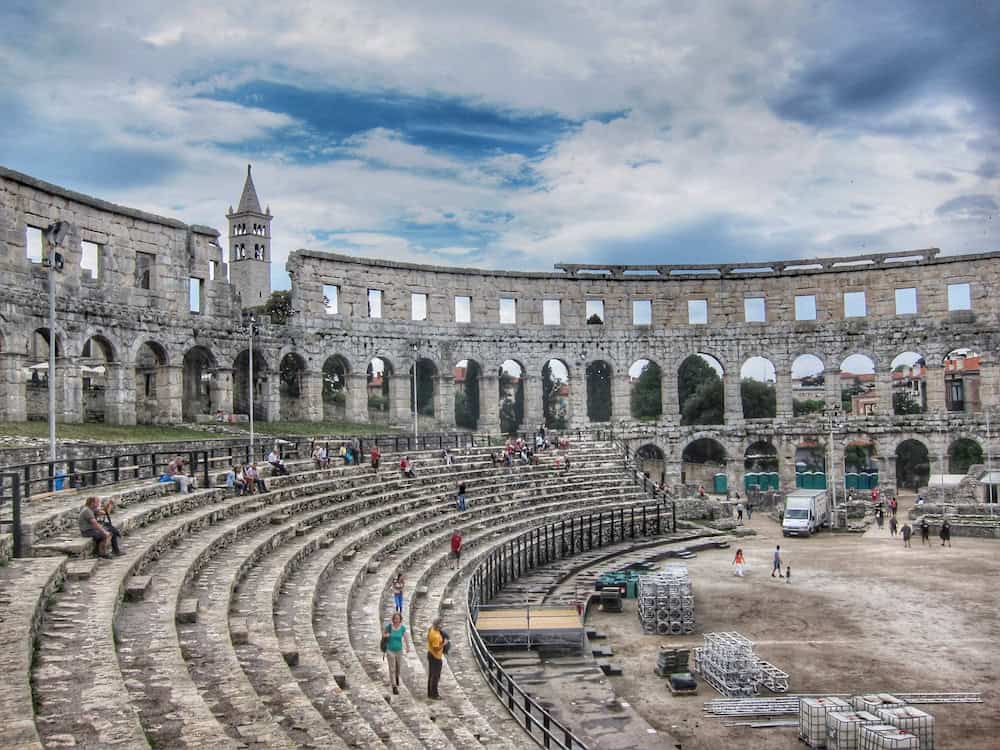
The interior of the Arena
What to See and Do at The Arena
Stroll through the Arena and really get a feel for what it must have been like back in Roman times. Unlike, say, the Colosseum in Rome, you can have an uninterrupted stroll right through the centre of this amphitheatre. At times, it almost feels like quite an intimate venue…but then imagine standing in the centre and being watched by 23,000 people!
Take yourself up to the seating levels where you can and now imagine yourself as a Roman spectator. Entry to the Arena was free back in those days but a seating system based on social class would have existed…so make sure you sit in the “best seats”. Whilst you’re up on this level, do also peer out of the Arena.
The interior of the Arena – you can see the seating as well the setting up of a concert
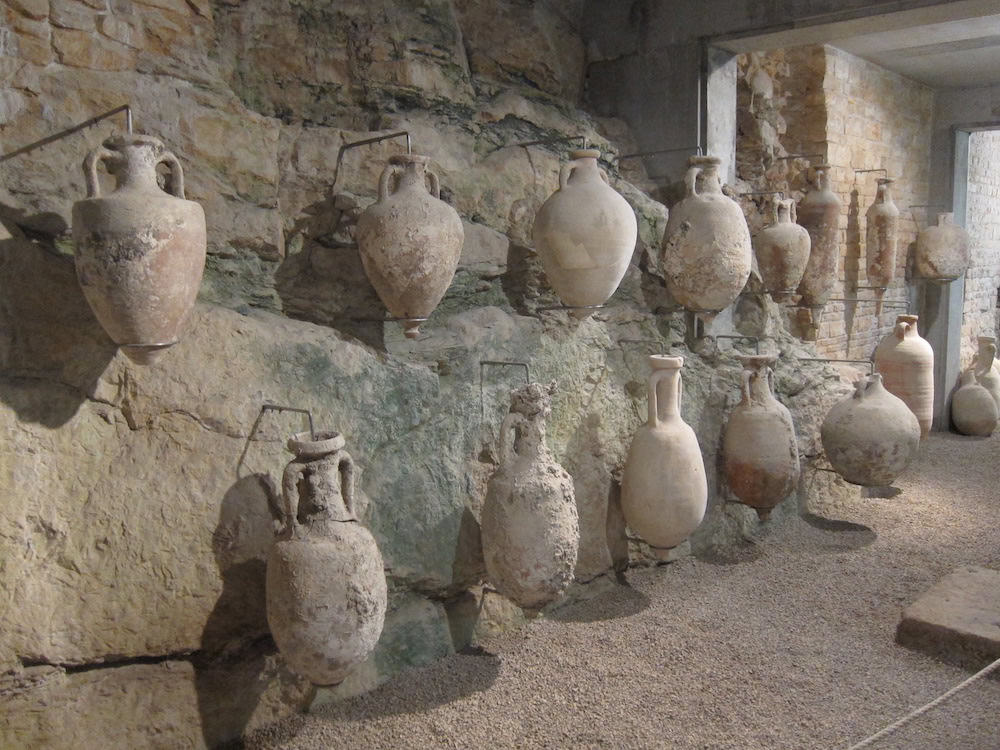
Head down below ground to walk through the passageways and chambers. Here, you will find an exhibition on viticulture and olive oil production in Istria during Roman times with a particular focus on how oil was derived from olives in those times.
There is also a large collection of well-preserved Roman amphorae, which were used for transporting liquids.
Roman amphorae at The Arena
Do be sure to also spend some time walking around the outside of the Arena to fully realise the magnificence of this large, wonderfully preserved Roman structure.
There are no guided tours for the Arena itself once you are inside. You may like instead to join a guided walking tour of Pula – as shown below – which includes entry to the Arena:
These days, the Arena is often used as a concert and entertainment venue in the summer months, and there’s something rather special about enjoying this kind of experience in such a historic venue. Perhaps most famously, the Arena is used as a venue during the Pula Film Festival which takes place every July. In 2024, the 71st edition of the festival will take place meaning it is the oldest film festival in Croatia.
There are also numerous concerts held in the Arena in the summer. For example, in 2024, Dua Lipa, Avril Lavigne, Simple Minds, Lenny Kravitz and Duran Duran will all be performing there. Previous performers over the years have included Sting, Elton John, The Foo Fighters and Luciano Pavarotti. One-off sporting events are also sometimes held here.
Special opening night events of some of Croatia’s music festivals – such as Outlook – have also previously been held here in the past when such festivals were held in the Pula region.
Summer also sees the regular Spectacula Antiqua gladiatorial and Roman reenactments take place. Just the thing to take you back all those many centuries ago!
https://www.visit-croatia.co.uk/wp-content/uploads/2024/04/spotlight-arena-pula-exterior.jpg534800annazhttps://www.visit-croatia.co.uk/wp-content/uploads/2017/09/visit-croatia-logo5.jpgannaz2024-04-29 11:47:002024-04-30 11:48:16Spotlight on: The Arena, Pula
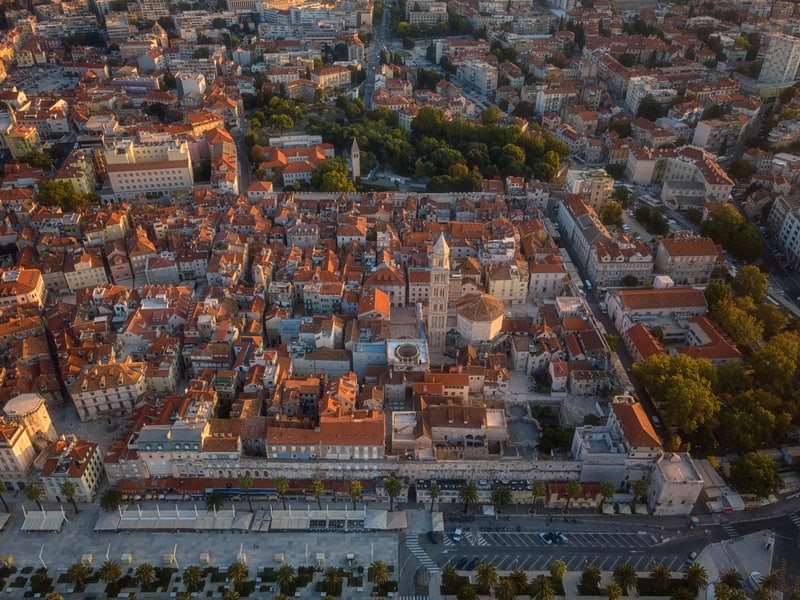
One of the most famed sights in Croatia, the Diocletian’s Palace area in Split is also one of the most historic sights you may visit on your travels. It is an absolute must-see and contains many individually interesting elements to explore. The whole area, right at the very core of the city, is also a thoroughly enjoyable part of Split with numerous cafes, restaurants, bars, shops and more. You’ll be strolling around taking in a whole tonne of history whilst also getting so much of what Split has to offer.
The “Historical Complex of Split with the Palace of Diocletian” was declared a UNESCO World Heritage in 1979. (It was one of Croatia’s first; Dubrovnik’s Old Town and the Plitvice Lakes were also added to the list in the same year.)
About Diocletian’s Palace and History
If you don’t yet know much about Diocletian’s Palace, you might consider Dioletina’s retirement home to be like any typical European palace structure. In your head, you may be considering an extremely large and ornate building, perhaps set in large, highly manicured grounds and full of rather ostentatious furniture.
Diocletian’s Palace is nothing like that! (At least not today; the palace may well have had some of these components all those many centuries ago.)
The palace was built as a retirement home (yes, really) for Roman Emperor Diocletian who was born in Salona (now present-day Solin) sometime between the years 242 to 245. He retired from Emperor life in the year 305 and lived in the palace until his death in 311. Work on constructing the palace is though to have begun in the year 295 with materials from local sources used – particularly white limestone from Brac and bricks made locally. You can see below what the structure would have looked like around the time of its competition – you can see that the palace did indeed stretch all the way out to the sea.
The Palace was built in a rectangular shape of roughly 215 metres by 180 metres. There were towers at each corner of the Palace and octagonal towers framing each entrance into the Palace. The area of the structure was divided into four with two main “streets” within. The southern gate would have been the Emperor’s main entry into the Palace by sea and, indeed, the southern part of the Palace would have contained his residence whilst the northern part would have contained quarters for servants and guards.
After Diocletian’s death, the Palace continued to be used by members of the emperor’s family. It rose in importance again in the 7th century when Salona (Solin), once the capital of Dalmatia and a large (for that time) city was destroyed by an invasion by the Slavs that had by now reached this area. Some of the previous inhabitants of Salona sought shelter and refuge in the large Palace area, and Palace life – now city life – began to resume. In the many years since citizens have continuously lived within what is deemed to be the Palace area and adapted its use multiple times.
Getting There
The Diocletian’s Palace area is just by the Riva, the main harbourfront in Split. It is a short walk from the main bus and train stations and port in the city (which are all adjacent to each other), about 10 minutes.
Should you be travelling from further afield in Split, there are numerous local bus lines that stop near the Palace. You can check out Split’s bus network on the Promet Split website.
What to See and Do at Diocletian’s Palace
You really could get lost whilst wandering the streets of the Palace…but try not to! In all seriousness, the best way of seeing the Palace is to go back and forth through its many little streets taking in all the many sights and experiences. Below are some of the main things to look out for and see.
Gates
As you approach the Palace area, you’ll no doubt enter through to the main part via one of the gates. As we’ve mentioned, the southern gate – the Brass Gate – would have once been the main entrance from the sea and is the smallest of all the gates. Today, this gate allows you entry from the Riva. On the eastern side is the Silver Gate which was reconstructed in 1952 after Dusica Church was destroyed during World War II; the gate had become part of the Church during its construction.
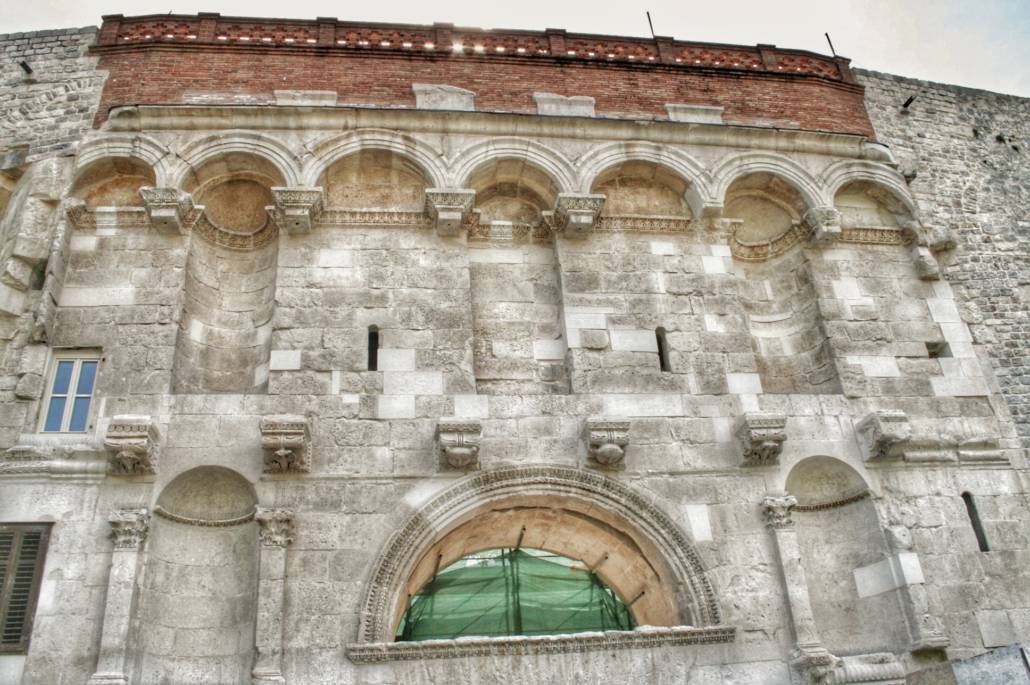
On the northern side, right by the large Grgur Ninski (Gregory of Nin) statue is the Golden Gate (Zlatna vrata) which would have faced the direction of Salona and would have been the main entrance into the Palace.
Golden Gate / Zlatna vrata
On the eastern side is the Iron Gate which is the only gate of the four that has seen continuous use since it was first constructed.
The Cathedral of Saint Domnius and Belltower
The octagonally-shaped Cathedral of St Domnius (Katedrala Svetog Duje in Croatian) is the oldest Catholic cathedral in the world in its original structure, consecrated as it was in the 7th century. The Cathedral contains the 3rd-century mausoleum for Emperor Diocletian whilst the belltower was a later addition, built in the 13th century. Diocletian’s sarcophagus was destroyed in the 5th century
The 57-metre-tall belltower can be climbed for superb views over Split in all directions including out over the twinkling Adriatic Sea.
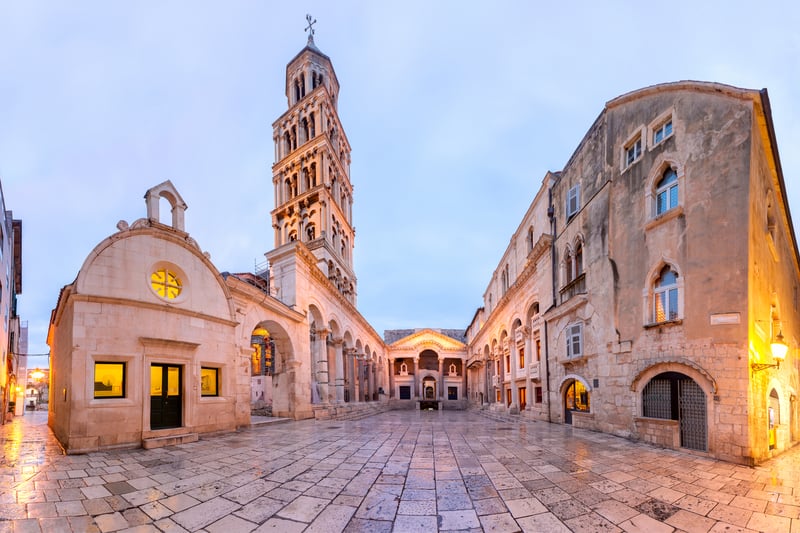
The Peristyle with the Cathedral and its Belltower to the left
Temple of Jupiter
By the entrance of this former temple is another 3,500-year-old Egyptian sphynx, this one being headless. The Temple itself was converted into a Baptistry dedicated to St John the Baptist in the 6th century. The Temple contains sarcophagi with the remains of Ivan of Ravenna and Lovre, both Archbishops of Split in the 11th century. You will also find a bronze statue of St John the Baptist created by famed Croatian sculptor Ivan Mestrovic.
The Peristyle
The Peristyle is a remarkable open-air square which would have been the main square of the Palace even way back when. Consider this as you sip on a relaxing coffee on the stone steps whilst admiring the view. The Peristyle is also home to a 3,500-year-old Egyptian sphynx.
The Vestibule
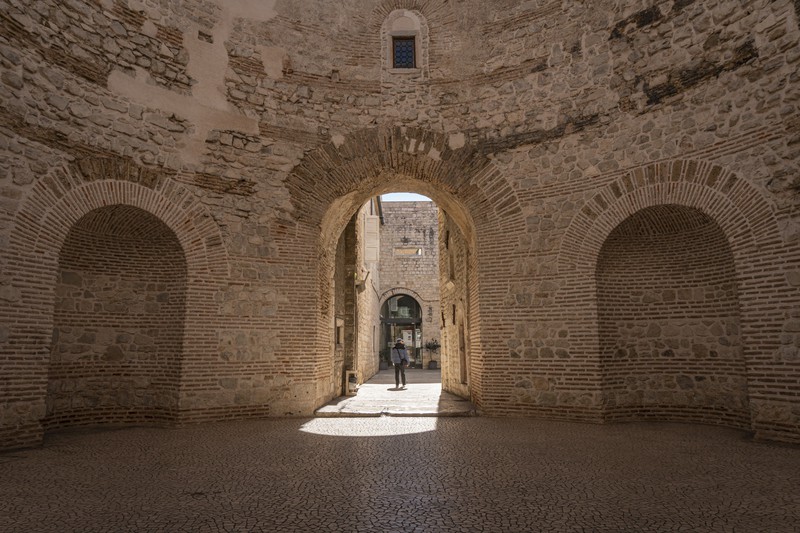
The inside of the vestibule is circular, and you’ll notice the circular open-air top which was once covered by a dome. The vestibule was a hall in the days of the Palace, serving as an entrance to the Palace apartments. These days you come across traditional acapella singers (singing klapa music) who make use of the excellent acoustics in the Vestibule.
Vestibule
Cellars
The cellars were originally used as storage areas when the Palace was first built. The importance of the cellars is because they are so well preserved and provide and excellent idea of what the above-ground portion of the Palace would have been like.
Part of the cellar area can be easily visited as you pass through the Brass Gate from the Riva towards the direction of the Vestibule and the Peristyle. You will find numerous little market stalls selling souvenirs and other trinkets.
Access to the rest of the cellars is ticketed (see below).
Opening Hours and Entrance Price
The main Palace area is free to enter at all times of day and night, year-round, and there is no fee to enter, of course!
Parts of the Palace, however, do have an entrance fee and particular opening times.
All parts of the Cathedral, including the Belltower, require tickets to enter.
Part of the cellars that are ticketed are open 8.30am – 8pm (summer hours, April to October) or 9am to 5pm (winter hours, November to March). Tickets cost €8 for adults and €6 for children aged 7 to 14, seniors (aged 65 and over) and students with ID. Children aged 6 and under can enter for free. You can buy tickets at the ticket booth in the Palace or on the Museum of the City of Split website.
Other Ways of Seeing and Enjoying Diocletian’s Palace
If you’d like to step back in time – virtually – and see for yourself what Diocletian’s Palace would have been like all those many centuries ago, head to the Diocletian’s Dream experience. Don a VR headset and immerse yourself in Split life in the year 305.
There are numerous walking tours of the Diocletian’s Palace area that you can join; led by knowledgeable guides, the tours will really give you an expansive information base from which to learn all about the Emperor and his retirement home. Take a look at some of the tours below:
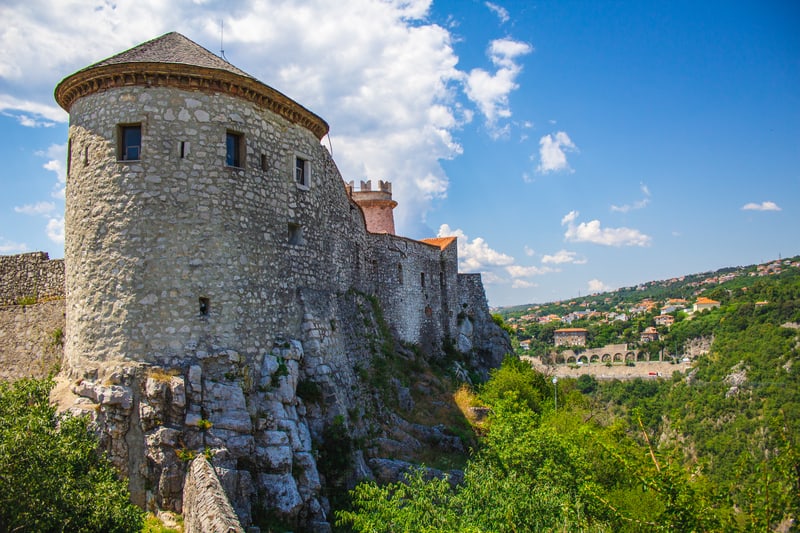
It has to be said that the country of Croatia is blessed with a number of very fine things (islands, a beautiful coastline, a rich history, many a fine sight…to name just a few!). Something that features relatively frequently in the country but perhaps not that well-known to visitors is its castles. One such castle to visit – very easily done so, as it’s just “above” one of Croatia’s main cities – is Trsat Castle. Read on below for information on how to visit the castle and what to see and do there.
Trsat Castle
About Trsat Castle
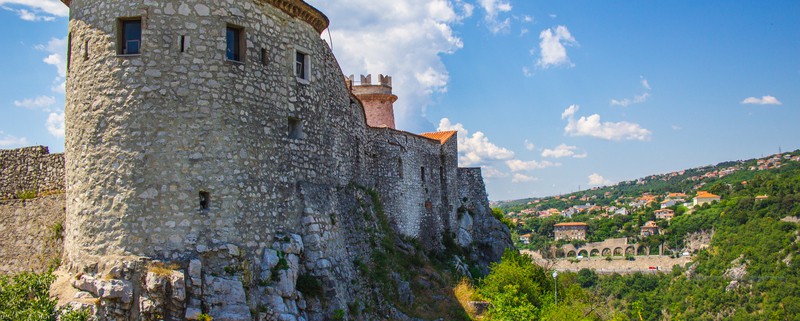
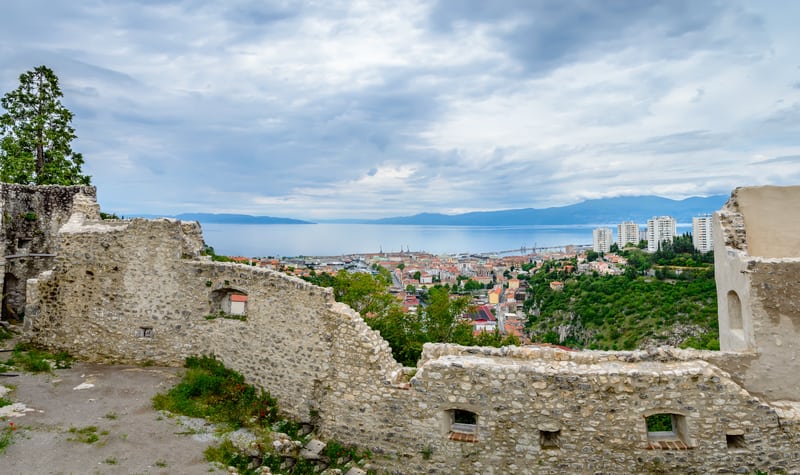
Trsat Castle is located on a hill above Croatia’s third-largest city, the very interesting Rijeka. The castle sits 138 metres above sea level meaning that you’ll enjoy excellent views when visiting, looking out over the city and the Adriatic Sea beyond (even to the island of Krk), and the nearby hills in the other direction.
Trsat Castle is one of the oldest such structures located along the coastline. Situated as it is on a hill, you are right to think that it was built as a defensive building. The current castle was built in the 13th century by the Croatian noble Frankopan family, although it is believed to be sited on a previous Roman hill fort. The castle fell into disrepair during the 17th and 18th centuries when it increasingly was no longer needed as a defensive structure. It was renovated during the 19th century
Getting There
The easiest way of getting to the castle is to take one of the local buses that operate in the city. Rijeka bus line 2 or Rijeka bus line 8 both operate from the centre to Trsat and both options will have a total journey time of around 25 minutes.
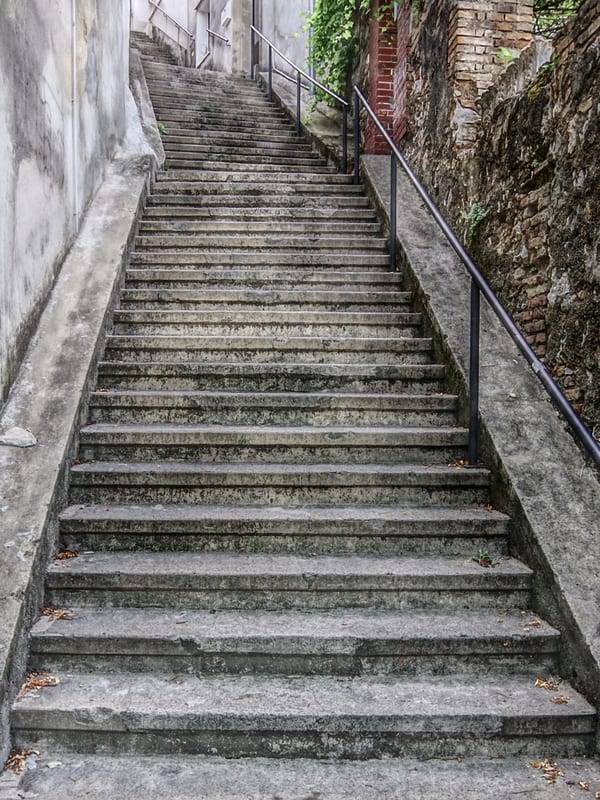
If you like to work up a bit of adrenaline before being rewarded with stunning views, you could also walk to the castle. Take the Petar Kruzic stairs which start just beyond Tito Square where it crosses the River Rijecina. Consisting of 561 stone steps and ascending up to 138 metres high, as we’ve mentioned, it is a bit of an energy-busting climb – but you might also consider part of the Trsat Castle experience.
The Petar Kruzic stairs to Trsat Castle
What to See and Do at Trsat Castle
Whatever way you choose to arrive at the castle, once you’re here, start exploring the remains of the castle’s structure. You’ll get a feel of how impressive this building used to be as you walk around it, and take a look at the information signs which explain the different components of what you can see.
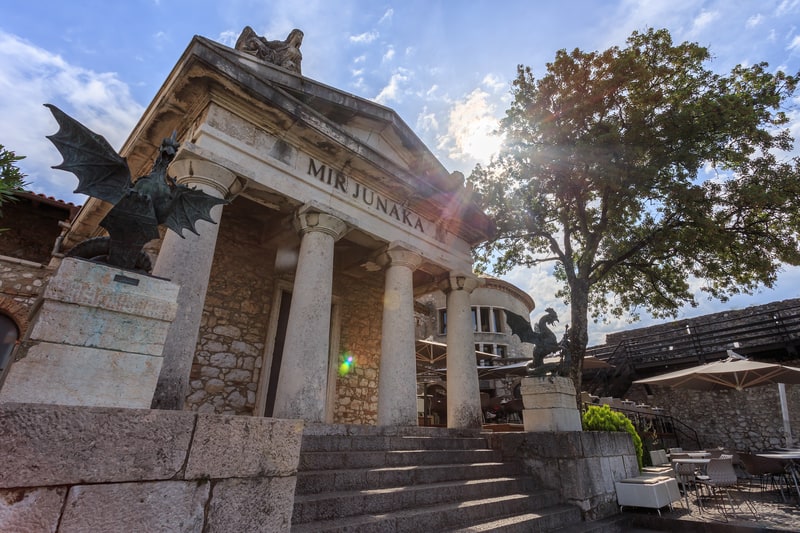
Of particular interest are the towers, some of which can be climbed for an even taller lookout viewpoint. You will also find a mausoleum – the building with MIR JUNAKA on it – which is the resting place of 19th-century military commander Laval Nugent; his family owned the castle up until the end of World War II.
Trsat Castle Mausoleum
The central courtyard of the castle is now home to a cafe bar which is very well placed to offer refreshment with a fantastic lookout point. The castle and the surrounding area is often used these days as a venue for various events.
Opposite is the Trsat Castle Park in which you can enjoy a nice bit of greenery and relaxation before you return back down to the city.
If you’ve climbed up the stairs to the castle, you will have passed by the Church of Our Lady of Trsat. This is one of the main pilgrimage places in Croatia, and the steps actually form part of the pilgrimage route.
View from Trsat Castle
Opening Hours and Entrance Price
t
It is free to enter the castle, which is open year-round.
https://www.visit-croatia.co.uk/wp-content/uploads/2024/02/trsat-castle_1.jpg533800annazhttps://www.visit-croatia.co.uk/wp-content/uploads/2017/09/visit-croatia-logo5.jpgannaz2024-02-21 15:11:102024-02-21 15:11:11Spotlight on: Trsat Castle, Rijeka









.jpg)