Posts

Dubrovnik to Novalja

Travel question: Getting from Dubrovnik to Novalja

Question: Myself and a friend are arriving in Dubrovnik and need to travel to Novalja. Is there any direct transport from Dubrovnik to Novalja? If not, what’s the easiest, shortest and cheapest way to get there? Train? Bus?

Answer: Some of you who are heading to Novalja this summer for one of the many festivals held there may have booked flights to Dubrovnik. It’s not the closest airport to Novalja on the island of Pag (Zadar is; Split is second), but there’s certainly plenty of flights from the UK and Europe to Dubrovnik and you may well have found it cheapest to fly there.

Dubrovnik to Novalja

So, if you’re looking for public transport options from Dubrovnik to Novalja, here’s what we’d recommend…if you’re trying to get between the two as quickly as possible. There is no direct transport from one to the other, so:

Option 1: Dubrovnik to Zadar to Novalja

Travel Dubrovnik to Zadar by bus (8 buses per day, with most in the morning; journey time 6-7 hours) and then Zadar to Novalja by bus (3 buses per day; journey time 2 hours).

Look up timetables on the Zadar Bus Terminal website.

The approximate one-way cost is 280 Kunas (200 Kunas Dubrovnik – Zadar; 80 Kunas Zadar – Novalja).

Option 2: Dubrovnik to Split to Novalja

Travel Dubrovnik to Split by bus (many per day; journey time 4.5 hours) and then Split to Novalja by bus (one per day; journey time 5 hours).

However, the Split – Novalja bus operates in the morning, so you’d most likely have to split this journey up into two days with a night in Split. (No bad thing.)

Look up timetables on the Split Bus Terminal website.

The approximate one-way cost is 340 Kunas (120 Kunas Dubrovnik – Split; 220 Kunas Split – Novalja).

TIP: If you’re keen to secure a seat on the Split – Novalja bus, tickets can be bought online (with a 5% discount!) on the Autotrans website.

Technically you could also do Dubrovnik – Split (4.5 hours); Split – Zadar (lots of buses on this route; 2.5-3 hours; approx. 95 Kunas) and Zadar – Novalja (2 hours) but then that does involve two stops!

Happy festival going!

Croatia Travel Checklist

Croatia Travel Checklist – are you ready?

Are you travelling to Croatia this summer? Here’s our guide to some things you might like to consider before you go!
Croatia Travel Checklist

Do I need a visa for Croatia?

Citizens of EU countries, the U.S., Canada, Australia and New Zealand DON’T need a visa to visit Croatia. There are also many other countries whose citizens don’t need a visa for Croatia – we won’t list them all here, so please do check against the information on Croatian Ministry of Foreign Affairs website.

It is also possible to visit Croatia using a double- or multiple-entry Schengen visa – which is useful if you’re doing a fair amount of travelling around Europe this summer. Again, please check the information on the above website.

What if I do need a visa?!

If you need a visa for Croatia, please contact the Croatian Embassy in the country you’re based in – or the Embassy as advised in this list: Diplomatic Missions and Consular Offices of Croatia.

If you want to obtain a Schengen visa, you would obviously have to do this at the Embassy of a Schengen area country. Normally this would be the country in which you are spending the majority of your time when on your holiday.

What about money – what’s the currency in Croatia?

The currency is the Kuna. Plural in Croatian is Kune, but it’s fine to says Kunas. On signs, the currency is abbreviated to Kn; in foreign exchange places (outside of Croatia) it will be listed as HRK.

The currency in Croatia is not the Euro. Euros are not accepted. Croatia will not be joining the Euro anytime soon.

(Slight disclaimer: Some private accommodation places might accept payment in Euros…but really, work on the basis of the currency being the Kuna!)

See more on our Money in Croatia section.

Should I obtain Kunas before I go?

We know that travellers have many preferences when it comes to foreign currency. Our preference is to travel with debit (cash) cards and withdraw money from ATMs/cash machines as we travel. These are readily available in Croatia (even at airports) and exchange rates are normally very good. Of course, your home bank will charge fees – but these can often be quite low. (Check before you travel!)

Otherwise, there are many places to exchange money – bureau de change and banks – practically everywhere. Simply take along your home currency (Pounds, Euros, Dollars) to Croatia if you’re planning on changing money in the country. Avoid changing money in hotels as exchange rates are normally pretty bad.

You can also obtain Kunas before you go to Croatia if you like – for example, in the UK many high street banks, Travelex.co.uk, the Post Office and M&S Money all sell Kunas these days. However, the exchange rate that you get will be a bit better in Croatia than in your home country.

How much money should I take to Croatia?

For those that do prefer taking cash on holiday, this is the $64,000 question! (Although, please don’t actually take $64,000 along with you.) It’s difficult to answer because – what are your typical spending habits? Do you like to splurge for every meal and on drinks? Or will you mainly be having low-key meals? Will you be signing up for daily organised excursions? Or relying on local buses and ferries to get you to other places?

Below is an idea of some prices in Croatia during peak season. Do note that some locations (e.g. Dubrovnik and Hvar) can be pretty pricey during summer! These are all approximate prices, only to be used as a guide – please do note

  • Relatively simple meal for two (pizza/pasta) with a drink each (beer/soft drink): 150 Kunas
  • Push-the-boat meal for two with a nice bottle of wine: 500 Kunas (or more!)
  • Local beer: 15-20 Kunas
  • Glass of wine: 15-20 Kunas
  • Soft drink: 15 Kunas
  • Bottle of water (at a restaurant/cafe): 10-12 Kunas
  • Coffee: 10-15 Kunas
  • Ice cream: 9/10 Kunas
  • Buses journey – Split to Dubrovnik: 125 Kunas (Obviously, bus prices vary depending on the journey! See Bus Ticket Prices in Croatia)
  • Catamarans – Split to Hvar: 55-70 Kunas (As above!)
  • National park entrance fees e.g. Krka National Park: 110 Kunas (summer price)
  • Excursion e.g. Split to Plitvice Lakes: 500 – 600 Kunas

You can save money by buying your own food/snacks at markets and supermarkets – which are pretty cheap – ideal for a picnic-style lunch; drugstores/pharmacies usually stock a small range of snacks as well.

What cards are accepted in Croatia?

Visa and Mastercard are readily accepted in Croatia. However, you may find that some places – such as smaller, family-run restaurants – don’t accept cards at all, so do always have some cash to hand!

What electrical travel adapters do I need?

Croatia uses the standard European 2-pin electric plug. It’s best to bring one (or a few!) along with you – don’t rely on buying them in Croatia! (Technically, they’re available, but you don’t want to spend all day hunting around for one.) Or, better still, take one and a 4-way plug adapter – so you can charge a few things at once!

Travel Insurance/EHIC

As with travelling anywhere, you really should arrange travel insurance before your visit to Croatia. Shop around for the best deal.

As Croatia is now in the EU, the European Health Insurance Card (EHIC) is recommended for EU citizens as this will help you get state medical healthcare for free/reduced rates. An EHIC card is free – apply for one (or renew one) online.

Phones/Internet

If you’re travelling from the EU, many mobile phone providers now offer rather cheap data and phone plans if you plan on using your phone abroad. For example, UK-operator o2 let you use your phone in other EU countries for £1.99 a day which includes unlimited data (upper restrictions apply); you can making/receive calls for 50p then no more for the first hour, and send texts for just 5p. Contact your own network to find out how much it’ll cost you to use your phone – it may be cheaper than you think. (But it’s always best to double-check!)

Wifi is readily available in Croatia these days – almost all accommodation places offer it (normally for free), as do many cafes/restaurants. You may also find free hotspots in some towns and cities.

Guidebooks on Croatia

Why do you need a guidebook when you have Visit Croatia?!

We’re just kidding, of course, for we also love travelling abroad with a trusty travel guide! (Although Visit Croatia is now fully mobile-optimised!)

Check out our Books on Croatia section to see what’s available.

Accommodation in Croatia

We’ll assume many of you have already sorted out your accommodation for Croatia. If not, head to our Accommodation section!

If you’re planning on leaving until you get to Croatia – wanting to go the ‘private accommodation’ route – that’s fine too. However, because summer is peak season, availability is low – though you should still be able to find a bed for the night somewhere. If you’re not that bothered about accommodation amenities or how basic a place is (although everywhere should be clean and safe – don’t worry about that kind of thing), that’s fine. If you have specific requirements/wants, or wouldn’t be best pleased to stay somewhere basic and with a 80s-style bathroom, then think about booking ahead!

If you ever get stuck looking for accommodation, head to the local tourist office. They should be able to help you find somewhere.

Should I learn some Croatian before I go?

Pretty much everyone that works in the tourist industry – hotel staff, waiters, tourist office works – speaks English, with the younger generation speaking it excellently. (Older waiters, for example, probably speak better German, but they’ll still understand you!)

It wouldn’t hurt to learn a few basic phrases – see our Croatian for Travellers guide and below – but don’t worry too much about learning Croatian!

Basic phrases in Croatian

  • Good morning – Dobro jutro (doh-broh you-trow)
  • Good day – Dobar dan (doh-bar dan)
  • Good evening – Dobra vecer (doh-bra veh-cher)
  • Hi! – Bok! (bok!) Note: quite informal – use one of the above, normally!
  • Goodbye – Dovidenja (doh-vee-jen-ya)
  • Yes – Da
  • No – Ne
  • Thanks – Hvala (Hva-lah)
  • Please – Molim (Mo-leem)
Visiting Croatia in September

Who would have thought it? We’re over halfway through August, which means we are most definitely hurtling towards the end of summer. (Although, personally, I definitely think summer runs until the seasons change in September. But then, I like to be an optimist about the weather.)

Some of you who are perhaps yet to take your summer hols, or are looking for a late summer trip to ease yourself back into autumn ways, may be thinking of visiting Croatia in September. You may be pleased to learn that September is considered the best month to visit amongst those in the know – the weather is still good (yes, you will – most probably – still be able to swim in the sea!), the high season crowds will have departed for home by the end of August, but everything – tourist-related – is still very much open.

Visiting Croatia in September

The island of Vis

However, you probably have a whole list of questions – what’s there to do? Where shall we go? We’re here to help you with these questions and more if you’re considering visiting Croatia in September!

The weather in Croatia in September

First things first. This is something we always get asked – is the weather in Croatia still good in September? Yes, very much so. It may come as no surprise really – as a Mediterranean country, the summer weather continues long into September. The last few years have seen very hot summers in Croatia, and this glorious weather definitely hung around in the ninth month of the year. (In fact, even into early October too!) This year there’s also been a rather hot summer in Croatia with temperatures in so many places reaching the very high 30s celsius. In fact, during July, temperatures for practically the entire country were classified as being “very warm” or “extremely warm” (poor Vis was the only place in Croatia to simply be “warm”), whilst most of the country was considered to be either “dry” or “very dry”.

All in all, we expect the weather in Croatia to be great this September! The Croatian Meteorological Society has plenty of forecasts in English – at the moment, they obviously don’t show much data for September, but take a look at their seven-day forecasts a little closer to the time.

The sea off the coast of Croatia – having had all summer to warm up – will be great, temperature-wise, in September. Yesterday, for example, temperatures reached around 23/24C for many places, with the sea a few degrees colder in the north of the coast.

Disclaimer: Yes, of course, the weather everywhere is starting to turn a little crazy. So don’t hold it against us if conditions in Croatia inexplicably turn winter-y during September. That’s definitely not supposed to happen. And it’s very, very unlikely to happen. But if anything insanely crazy, weather-wise, happens…don’t blame us! 

What’s on in Croatia in September?

Croatia has established itself as something of a prime festival destination in the last few years, with more and more dance festivals being added all the time to each year’s calendar. September is when the festival season winds down, but there’s still a couple of events taking place, both in Istria. The brand-new-for-2013 Unknown is being held in Rovinj from 10th to 14th September, with names like Jessie Ware, The Horrors, Jamie xx and SBTRKT all on the bill. Now in its second year, the electro festival Dimensions will be on in Pula from 5th to 9th September, making use of Fort Punto Christo that’s close to the town. (Dimensions is the “little sister” of Croatia festival favourite Outlook, which is on itself in Pula from 29th August to 2nd September.)

For the less dance music type events, there’s the Split Film Festival on from the 14th to the 21st September. The historical festival Gioistra – now in its seventh year – will be held in Porec from 13th to 15th September, with assorted costumes, revelry, sports, street entertainers and products on sale, all re-enacting 18th century times. The second Korkrya Baroque Festival is an international music festival on the island of Korcula, being held from 7th to 13th September. Zagreb hosts both the general entertainment festival RujanFest (literally, ‘SeptemberFest’) from the 13th to the 22nd September, as well as the 46th edition of the International Puppet Theatre Festival (9th to 14th September).

For those more keen on sports events, Croatia will host the Davis Cup tie against Great Britain in Umag (which means clay!) on the weekend of 13th to 15th September. And yes, Wimbledon champ Andy Murray is expected to play. Tickets can be bought on the ticket portal Eventim.hr.

Be sure to pop into the tourist office of wherever you are to ask for events taking place locally!

Where should I go in Croatia in September?

As we’ve covered so far, the weather will be great in September, so it’s hard not to pick a location on the coast. Dubrovnik should be as busy it always is, and there’s certainly a large number of cruise ships scheduled to dock during that month, bringing thousands of (day trip) passengers at a time. Split has had a great season so far, so it wouldn’t be any surprise to see this place as bustling as it has been. (Seeing as it’s Croatia’s second largest city, it is relatively lively all year round!) Some of the more popular islands, such as Brac and Hvar, and other popular locations on the coast (the Makarska Riviera) are still likely to receive a good number of visitors, even whilst the season starts to wind down.

If you’re after something a little quieter, perhaps consider the most outlying of all the larger Croatian islands – Vis. As a quieter and slightly mystical destination any time of year, we think this place would be divine in September. Other islands to check out include those in the Kvarner bay  such as Krk, Cres, Losinj or Rab, all of which are perhaps not as well known amongst non-Continental European visitors.

Istria is of course one of the most popular destinations in the whole of Croatia, with delights such as Porec, Rovinj and Pula all located here. The county has suffered a slight fall in visitor numbers this year, but will still see good numbers overall. If you’d like to visit, why not consider something like a foodie or activity-based holiday – two things the region does very well! Check out Istria Tourist Board’s guides to gastronomy and sport.

From a logistical point of view, almost all flights from the UK to Croatia still operate in September – and well into October too. The one exception to this is Ryanair’s flights from London Stansted to Rijeka Airport stopping at the end of August. See our Flights to Croatia page for details of all routes to Croatia from the UK.

Do note that in almost all cases, ferry schedules will still be running to summer timetables until the end of September. Certainly, almost all of Jadrolinija‘s local routes remain the same until the end of September, as does their twice-a-week coastal route that runs Rijeka – Split – Stari Grad (Hvar) – Korcula – Mljet – Dubrovnik and vice versa. The exception lies with some of their international sailings (to Italy) that reduce in frequency in September, and again further in October. Venezia Lines‘ sailings between Istria and Venice will only operate from Porec and Rovinj during September.

Or check out Adriagate – they offer last minute discounts on accommodation for destinations all over Croatia!

All in all, if you’re visiting Croatia next month, we hope you enjoy your stay! Why not drop us a line on email, Twitter or Facebook to let us know how it went – we’d love to hear from you!

Rijeka

Travel question: From Zagreb Airport to Rijeka

Good day, we are planning a trip to Croatia & we need to travel from Zagreb to Rijeka to take our cruise. We do not know how to reserve our bus or train & if we need to go to downtown Zagreb or if we could take the bus or the train from the airport. Thanks.

Clock Tower in Rijeka

You are, in fact, in luck. In almost all cases, you’d have to travel to downtown Zagreb to make your way by bus or train to other places in Croatia.

However, it just so happens that there’s a direct bus from Zagreb Airport to Rijeka. This bus departs Zagreb Airport every day at 3.30pm – you can find out a few more details on the Pleso Prijevoz website. You cannot reserve tickets for this bus in advance, and you merely buy them from the driver.

If this bus time isn’t suitable for you, then you would have to travel to downtown Zagreb in order to reach Rijeka. There are transfer buses by the same company (timetable here) and this takes you to the main bus station in Zagreb. Again, buy your tickets for this bus from the driver.

It is better (roughly same price, but definitely faster!) to travel by bus from Zagreb to Rijeka. You can look up timetables on the Zagreb Bus Terminal website. – it won’t yet let you look up times for October, but just look up a date that’s the same day of the week that you wish to travel on. (And then perhaps look it up again nearer the time of your travel.) Almost all – if not all – of these buses operate year-round; journey time is about 2.5-3 hours, depending on which bus you take.

It’s not really possible to buy tickets in advance for bus journeys in Croatia, other than in person by the bus station or sometimes by phone. However, *some* bus companies are starting to offer online booking – Autotrans , one of the main companies in Croatia and who are based in Rijeka – have just started this. They operate a number of the Zagreb – Rijeka services. However, you won’t yet be able to buy tickets for October – again, check back closer to the time of your travels.

In all honesty, especially as you’re travelling out of season, it will be fine for you to simply turn up at Zagreb Bus Terminal and buy tickets for your bus journey to Rijeka there and then!

History of Pula

Travel question: Travelling from Ljubljana to Pula

Hi there, not sure if you’re able to help us at all but my friend and I are coming to Croatia this August for a festival in Pula. We are landing from London in Ljubljana, Slovenia at 19:00 on 27/08/13 and need to get to Pula to our apartment. We want to know if there is a relatively cheap/safe way of us travelling this distance at this time. The apartment owners are aware that we need a late check in but we want to arrive there at a reasonable time. Any information you have would be greatly appreciated. O. H-S

Ljubljana to Pula
The Arena in Pula

Unfortunately, I have to say that you will find it difficult to travel from Ljubljana to Pula at that time of the day (well, evening). There is a direct daily bus from Ljubljana to Pula at that time of year, but it runs at 9.30am. (See the timetable on the FILS website – scroll down for the seasonal, summer line.) I believe a one-way ticket should be about 200 Kunas, or the equivalent in Euros.

The alternatives I would suggest also don’t really work at that time of the day. I would have suggested getting a train from Ljubljana to Rijeka, but the two a day are at 6.35am and 3.10pm. (From Rijeka to Pula there are several buses per day.)

Another possibility would be to take a train to Zagreb (if you did this, it would be best to take a taxi from Ljubljana Airport to Kranj, which is about 15 minutes away, rather than travel to downtown Ljubljana, about 30-45 mins away), and then a bus to Pula.. There are several trains per day from Kranj (or Ljubljana) to Zagreb but again, these all run before your 7pm arrival time.

(If you wanted to look up train timetables, the Die Bahn website is the best place to do this.)

These above options are all relatively cheap and safe (travelling in Croatia/Slovenia is very safe, just use your common sense with personal possessions, of course!) but, obviously, the most important issue is that they don’t get you to Pula the same day! Aside from renting a car (which isn’t an especially cheap option, and not everyone wants to drive) I’m afraid the best thing I would suggest would be to stay in Ljubljana one night and then get the bus direct to Pula the next morning. I’m assuming you’re attending Outlook so the bus will still get you there in time for the opening concert on the 28th. (Not sure if you’ll be able to amend your booking in Pula by a day.)

Zagreb Cathedral

Reader’s email: Experiences on visiting Croatia in December!

A few months ago, we were very happy to receive a lovely follow-up email from a traveller to Croatia (who we assisted in their travel plans via email), which told of their happy experiences whilst enjoying a summer holiday in the country.

Very recently, we were happy to receive another such email from a traveller (that we also assisted, pre-trip, via email) from Latin America who visited a number of towns and cities in Croatia. His comments are well worth reading as he provides a number of very useful tips on the places he visited, whilst it’s also interesting to note his experiences as he visited Croatia in December – and as Croatia is often considered a summer-only destination, it’s great to see an enjoyable visit during this particular month.

Zagreb Cathedral, Croatia

Zagreb’s Cathedral

So, here’s what our happy traveller had to say:

I’m back from my trip to Croatia and it was great in every sense including the weather. We were able to visit Zagreb and stayed at the Dream Hotel  near the airport on our first and last nights. The hotel is quite new and the furniture is custom made for the limited area of the rooms. The service was more than expected with buffet breakfast (I expected toast and coffee!) including fruit, juices and with eggs made to one’s request. The personnel was very helpful and even prepared breakfast at 5 a.m. before driving us to the airport for free as advertised!
We later visited Vukovar where some of my wife’s relatives live. A new museum of a prehistoric culture is being built. It will be inaugurated in 2013, so there’s an additional tourist attraction besides the war-related things. We visited it and it’s located next to the Danube River with an unobtrusive design on the hill.
From Zagreb we flew to Dubrovnik. It’s definitely one of the most beautiful cities I’ve seen, and I have seen quite a few in Europe and America (the continent). We stayed at the Excelsior because of the location on the beach and within walking distance to the Old Town. I followed your advice and drove the airport bus to Pile Gate and then took a taxi saving some kunas. This was offset by the taxi #91 back to the airport gave us some extra turns as what was supposed to cost 30-35K ended up being 45K with little traffic… The hotel is a 5* and the buffet breakfast has an extensive variety as expected. We paid for a room with seaview which was worth it. As you indicated, we didn’t need a tour guide and just wondered around with a map. Since this is the low season, it was great not to have too many tourists around. The food we had at a Konoba to the right of St. Blaise Church was excellent even if the waitress was not too happy doing her job. Walking on the walls was one of the highlights as it gives a different perspective of the town. Even though we stayed only 1 day, we were able to wonder around all of the Old Town and took many pictures. 🙂
From Dubrovnik we flew to Split (via Zagreb). We stayed at the Palace Judita per your recommendation and were fascinated with the hotel and it’s service. It was worth the looong walk with luggage from the bus station. After Dubrovnik, Split doesn’t seem as impressive or beautiful, but was worth visiting. It would be better to visit Split first. Too many graffiti on the walls give a bad impression. It’s rather difficult to determine where the Palace starts and ends and the shops outside the walls are not a nice sight although they do offer bargains. A map was more than enough and no tour is needed even on a 1 day rush visit. At the hotel, Marija, the manager, recommended Konoba Varos, and we were delighted with the good service and seafood which was fresh, tasty and well accompanied with a local wine. This is a restaurant we will remember for a long time!
Back in Zagreb, we visited the old part of the city. It’s too bad that new buildings are built along old ones because the city has very nice neo classical and gothic architecture in some places. The area near the cathedral is well kept and the cathedral is worth visiting even considering we had seen some impressive ones in Spain, particularly Toledo’s.
Lastly, the Croatian language lessons on your web page were most helpful. Although my pronunciation was not too accurate, the words helped to communicate (although many people speak English). I enjoyed trying to use the different words and phrases and most people were helpful. [Note: See Croatian for Travellers]
Thanks so much for your help in making this trip such a nice one and without ugly surprises! We’d like to return to Croatia although it’s expensive to fly from Guatemala.

Thanks very much, dear traveller, for taking the time to email us after your trip and for your kind comments as well! We’re very happy to hear you enjoyed visiting Croatia, and thanks for providing us (and other travellers) with some great tips!

If you’d like any assistance in planning a visit to Croatia (this is a free service – and we don’t try and push any kind of company or service on you!), please do email us at webmaster@visit-croatia.co.uk. We’d be more than happy to help – and would love to hear your experiences of visiting Croatia!
Panorama of Pag, Pag Island, Croatia

Reader’s email: A follow-up to a visit to Croatia!

We here at Visit Croatia field numerous emails every day about visiting Croatia – from places to visit, or suitable holiday destinations for particular travellers (families, older visitors, party-animals), to advice on travelling around (lots of questions about bus travel!), to reaching the country in the first place, to language queries…we’ve pretty much received and answered question about almost everything Croatia-related, over the years! (See the Travel Advice section on this blog for some more recent examples.)

Panorama of Pag city, the largest city on Pag island, Croatia

Pag Town on the island of Pag

Whilst we’re very happy to help everyone that emails in regarding planning their holiday to Croatia, very rarely do we get to hear the outcome of that holiday. Did they like it? What did they see? What did they like best? How much did they explore? It all honestly, it’s perfectly understandable – and I wouldn’t expect people to write to me telling me about everything they did!  I assume, however, that most people did enjoy their holiday, and hope that they have shared their experiences with friends and family and persuaded some of them to visit Croatia in the future.

This year, however, I’ve been conversing with a traveller who was looking for a quiet place on the Croatian coast for a twelve-day holiday for this month (August). He’d looked through the Visit Croatia site, and suggested that somewhere near Zadar, Sibenik or Split would be suitable for him. I gave him a few suggestions and after he did some additional research, he settled on the island of Pag – though fully intending to do some additional exploring in the nearby area.

The traveller also kindly promised that he’d let me know how it all went – and this week, I got a very lovely email! He wrote:

My holiday is over and I am back from Croatia. I am sorry for this because it was really very nice holiday. But this is the life, as we know, everything finishes.

I have really spent wonderful and great time in Croatia, on the otok Pag (and not only). We have visited many places. Of course we have explored all the island Pag – not only Pag, Novalja, Povljana, Metajna, but also almost all small villages like Vlasici, Kosljun, Simuni, Mandre, Lun and others. Besides this we have visited the towns of Zadar, Sibenik, Split and many small villages like Nin (very nice place), Sukosan, Filip i Jakov, Biograd na moru. Every place was wonderful. We have also made three excursions by boat – 1. around all the island Pag, 2. Kornati National park (we have seen many islands) and 3. islands Olib and Silba. Really excellent, splendid, magnificent and great places. Although we have seen only little part of Croatia I could say that it is very nice country.

Of course we ate Paski sir (delicious), roasted piggy and other specialities which we liked so much.

In two words it was very nice holiday and I am very sorry that the time passed so quickly.

I thank you very much once more because it was also your merit with your help and your advices.

Thank you very much for the follow-up email, dear traveller, and it’s wonderful to hear that you had such a nice time. We hope you have the opportunity to visit Croatia again!

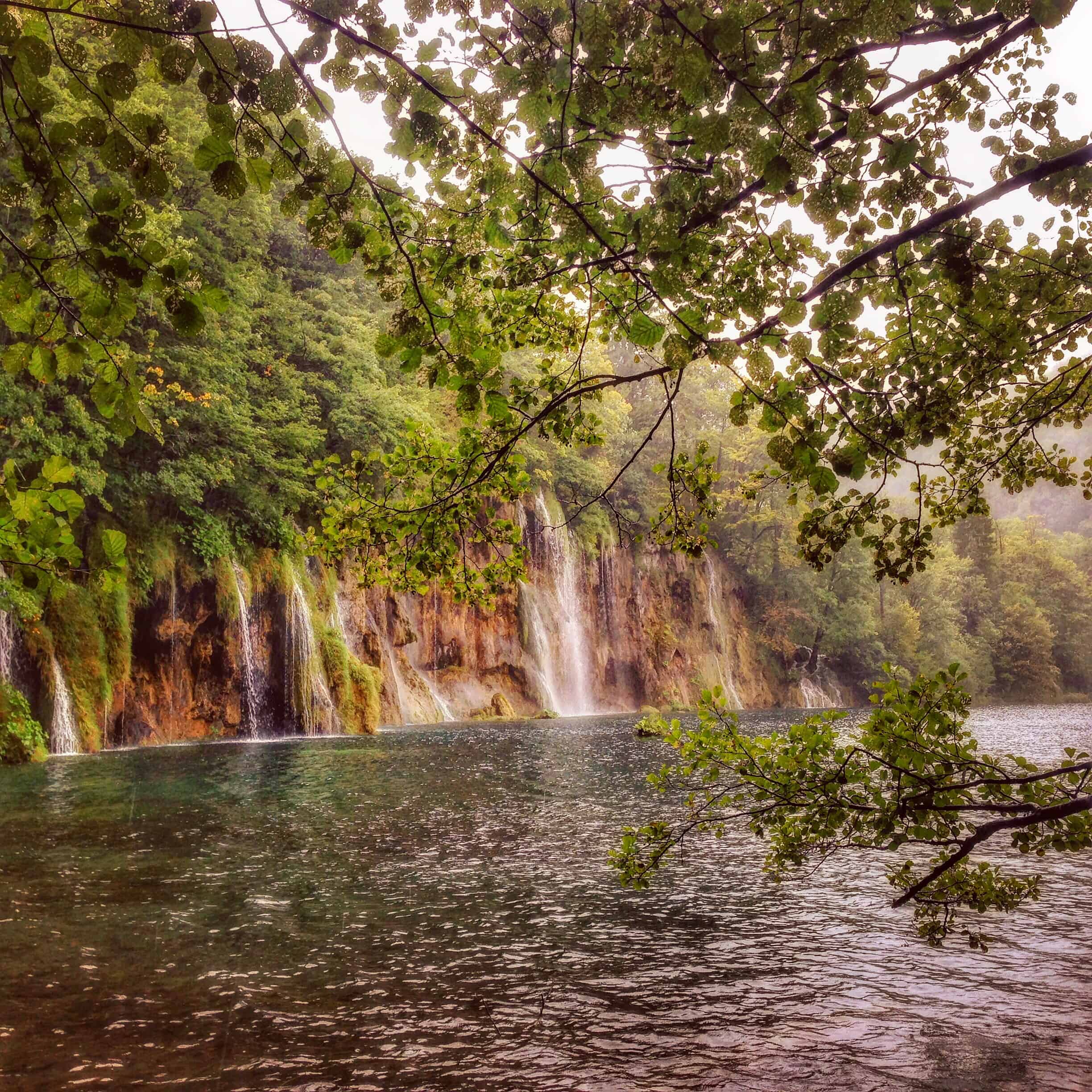
Plitvice Lakes Photos - Greenery

Travel question: from Zadar to the Plitvice Lakes National Park by public transport

We want to travel by bus or train from Zadar to Plitvice Lakes. We will arrive on in Zadar by plane – which bus should we have and where is the boarding point? Can we take the train? G.A.

Firstly, the easy answer, there is no train from Zadar to the Plitvice Lakes.

Zadar to Plitvice Lakes

Plitvice Lakes National Park

To travel from Zadar Airport to Plitvice, first you need to transfer from the airport to the main bus station in Zadar. You can see a timetable for this journey on the Zadar Airport website.

From Zadar bus station, here is the timetable for buses to Plitvice Lakes (taken from the Zadar Bus Terminal website. (All routes run daily, although may be subject to change – at least, that’s the disclaimer on the bus station website!)

Dep. 8.30 Arr. 10.25
Company: Prijevoz Knezevic
Line: Zadar – Udbina – Plitvice Lakes

Dep. 9.00 Arr. 11.00
Company: Autotransport Sibenik
Line: Split – Zagreb

Dep. 12.00 Arr. 14.15
Company: Croatia Bus
Line: Split – Zagreb

Dep. 14.30 Arr. 16.45
Company: Croatia Bus
Line: Vir – Zagreb

Dep. 15.10 Arr. 17.50
Company: AP Varazdin
Line: Split – Varazdin

Dep. 6pm Arr. 19.55
Company: Prijevoz Knezevic
Line: Zadar – Udbina – Plitvice Lakes

Dep. 23.00 Arr. 01.50
Company: Imotski – Panturist
Line: Imotski – Osijek

You can also look up timetables on the websites of some of the bus companies that are listed on our Travelling Around – By Bus page.

Travel advice: Holiday resorts in Croatia with beaches suitable for young children

Hallo, I have an unusual request – please recommend beaches for a small baby (2 years).

I would like to  sandy beaches  or small pebbles beaches from gently sloping to the sea that is shallow. I would also like to have restaurants, bars, shops, swimming pools. Two years ago I was in Zaton Holiday Resort and I’m looking something like this in Istria, Kvarner or Dalmatia – north or central.

I am grateful for the help. A.G.

The first thing to say is that Croatia is not that well known for its sandy beaches. By far the majority of beaches are of the pebble variety. However, I understand that for some people (especially those with young children!), sandy beaches are important.

Of course, if you don’t mind pebble beaches than you will have a lot more choice – as I said, the vast majority of beaches in Croatia are pebble-y. I would say that many would also be gently sloping with quite a bit of shallow water – it would be quite rare to have anything that would be quite deep quite suddenly.

Based on the place you mentioned you stayed in before (Zaton Holiday Resort), you might want to take a look at CampingIN Park Umag in Istria, which is very suitable for families with its various facilities (including pool) and features both Mobile Homes and Premium Homes.

Alternatively, you could also consider Camping Park Soline (again, with mobile homes) that is in Biograd na moru, North Dalmatia. It is close to both a pebble and a sandy beach.

The Solaris Camping Beach Resort near Sibenik, also in North Dalmatia is again very family-friendly, although perhaps the pebble beach area is quite small – but the resort does say the beach area is child friendly.

If you’d prefer to be a bit further south – between Split and Makarska – then you could consider Kamp Galeb. This is located in Omis, which is about 25-30km south (along the coast) of Split. The Omis Riviera is one of the places in Croatia that does have sandy beaches.

Kamp Galeb itself is located alongside a sandy beach, and its mobile homes are situated directly on the beach.

In fact, the camp itself says that the beach is very suitable for families with small children.

Again, the camp has a range of facilities – a few shops (bakery, also supermarket close by), a restaurant, a playground for children and an aqua park.

All of the above resorts have been included on the Croatian Camping Union’s best camping resorts list.

Travel question: How to travel from Tisno to Split

I need information about hiring a car in Tisno, one way, and dropping off in Split? My boyfriend and I need to get to Split one way or another and i’ve heard the bus is a nightmare and takes 5 hours? Is this true? Please let me know if you have any ideas as to how we can do this. Many thanks. K.D.

I’m afraid it would be very unlikely that you would be able to rent a car in Tisno and drop it off in Split – Tisno is too small a place to have proper car rental companies, and any local agencies that would possibly provide car hire would only provide it for you to explore the local area (and bring the car back to them!), in the same way you could hire a bike or scooter for a few hours.

The scheduled bus from Tisno to Split should take around the two hour mark, not five. I’m not necessarily sure why the bus would be considered a nightmare – possible reasons might be that, as it’s the height of summer, traffic may be slow along the coastal road with lots of other holidaymakers who’ve come down to Croatia by car clogging things up. However, if you were to rent a car, you wouldn’t be able to escape this!

Even if the roads were slow, I would say that your bus shouldn’t be that delayed…possibly by one extra hour (so, a three hour journey in total). Obviously, things depend on the day of the week (weekends would be busier), time of day etc.

Other reasons might be that the bus might be very full, so there’s not enough seats and you have to stand. In some cases, the bus might be even so full that they wouldn’t let you on, and you might have to wait for the next one.

However, saying all this, there are a number of buses per day on this route. You can look up timetables at the Split Bus Terminal website. Select Tisno R as the starting point (not Tisno M).

When you’re actually in Tisno, I would confirm locally to make sure you know where the bus stop is. You could also enquire about purchasing your tickets, say, a day or two in advance, but as it’s a small place you might not be able to.

If you get stuck (for whatever reason – I don’t think you will, but good to keep these things in mind) I would consider taking a taxi (or local bus, if you can find the information when there) to another local town and get a bus from there. For example, Pirovac is close to Tisno (6 miles/15 mins) and there are more buses from there to Split.

Another alternative would be to take a local bus from Tisno to Sibenik (about half an hour away), which is the nearest large town. Then from here, there shouldn’t be any issues getting a bus to Split. Not only are there even more buses from here to Split (about 36 a day), but some routes start in Sibenik, so you wouldn’t have any issues about not being able to get on a bus because it’s too full.