Zadar is the main city in Northern Dalmatia with over
76,000 inhabitants. Most famous for its Old Town, set in a peninsula that is completely pedestrianised, the town has numerous Roman and other wonderful sights.
Getting to Zadar
Zadar has its own airport, which is 8km from the town. Buses from the airport to the main bus terminal in Zadar run in conjunction with flight arrivals; see the how to reach us page on the Zadar airport website for bus times.
(Just to help you understand - I know I found it a little puzzling at first - the right hand column shows bus departure times from the airport. So, for example, the Ryanair flight from London Stansted which arrives at 8.35pm on a Monday has a bus that will leave Zadar Airport at 9.30pm.)
History of Zadar
With evidence of a settlement in the area from as far back as the 9th century BC, it developed well under the control of the Romans when they conquered the region in the 2nd century BC - the layout of town, its city walls and gates, and important buildings were all constructed during this period.
From the end of the 9th century, Zadar fell under some sort of control of Croat rulers from the interior, where a Croatian state had emerged. This period saw a migration of Croat citizens to Zadar and the town became reasonably successful in trade. Its emergence also saw Venice see it as a threat, meaning that Zadar was attacked - and liberated - numerous times, before it was finally sold off to Venice by the Hungarian King
Ladislas of Naples in 1409.
Under Venetian rule, Zadar was subjected to attacks from the Ottomans, so city defences were fortified as the building of new walls commenced in the 16th century. Although economically the town stagnated somewhat - Zadar was only allowed to export to Venice - it grew culturally with a number of poets and writers emerging during this time.
Following the fall of Venice, and after a brief eight year rule under the French, Austria conquered Dalmatia in 1813 and established Zadar as the administrative centre of Dalmatia. The town underwent an age of Italianisation with Italian becoming the main language. This period also saw an upsurge in some Slavic nationalisation in the town.
After World War I, Zadar was occupied by the Italian army in 1918 and then officially given - together with the islands of Lastovo and Palagruza - to Italy by the Treaty of Rapallo in 1920. This time, a period of forced Italianisation was put in place with some of the population of Zadar moved to places in Yugoslavia, and Italian citizens moved in. After World War II, the town was given to Yugoslavia in 1947 (although had been liberated by partizans in 1944).
After Croatia declared independence in 1991, Zadar suffered considerably during the ensuing four year war. The town was periodically shelled and was in fact cut off from Zagreb (with the only link being via the island of Pag) as the surrounding area was occupied by rebel forces. Much of the area around Zadar was liberated in January 1993, although some attacks on the town continued until the end of the war in 1995.
Sightseeing in Zadar
Zadar Old Town is located on the tip of a narrow
peninsula. Most of the town is surrounded by city walls, with
towers and the two city gates being of interest. It is a stunning place to visit!
The Mainland Gate (Kopnena
vrata), to the east of the Old Town, was built
in 1543 and has the city coat of arms engraved on it. Its use was as the main entrance to the Old Town from the...mainland, unsurprisingly!
Close to
this is the Captain's Tower (Kapetanova kula), dating from the 13th century, part of the city's defences. A much more recent terrace has been built, meaning you can climb up the tower to see the great view. In the same square - Trg pet bunara are five wells (pet bunara means five wells in Croatia), that were built in 1574 and used to function as the water supply for the city.
The other gate is the Port Gate (Lucka vrata) to the
north, built in 1573.
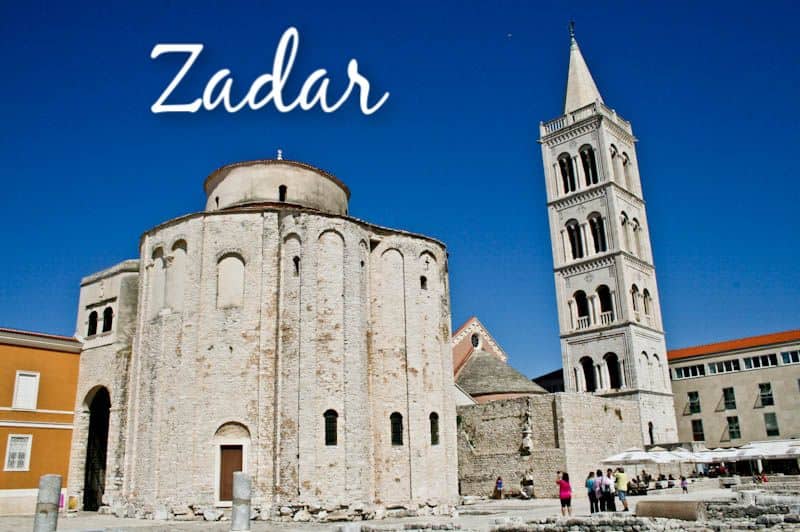
In the centre of the Old Town is the St Donatus Church (Crkva Sveti
Donata) which was built at the beginning of the 9th century
- using some stone from the Forum (see below) - and stands at 27m high. In a city of 30 churches, this one stopped being used as a church in the late 18th century, but is still used today as an excellent concert venue and is something of a Zadar icon.
Nearby is the Church of St. Mary (Crkva Sveta Marija) as well
as the Cathedral of St. Anastasia (Katedrala Sveta Stosija) from the 13th century. The Forum in Zeleni Trg used to be 95m by 45m in size, believed to have been built between 1st century BC and 3rd century AD. Today, very little of it remains apart from the paving stones and some walls, as well as as 14m column to which, up untl 1840, the town's offenders were chained to suffer public humiliation. The Zeleni Trg, however, is still Zadar's bustling central square. Accommodation in Zadar
Please see our Accommodation in Zadar page.
General Info
The area code is 023.
The Tourist Office is at Ilije Smiljanica 5, 23000
Zadar, Tel: 023 212 222, Fax: 023 211 781, Email:
tz-zadar@zd.tel.hr
For more information on Zadar, check out the Zadar Tourist Office website, the Official
Website of the Zadar Riviera, Zadar Online or Kalelarga.com.
See our Map of Zadar. |