
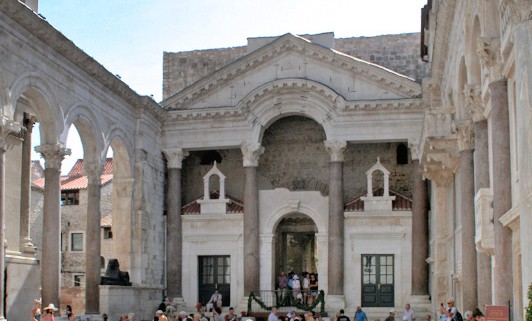
The early days of the history of Split revolve around a Greek settlement founded in the area between the 3rd and 4th centuries. Its most famous historical development, however, came in 295 AD. Roman emperor Diocletian ordered a residence to be built there for his retirement. The location was chosen as it was close to the large Roman settlement of Salona. (Salona is present-day Solin, which is about 5km from Split).
Split in the Roman Empire
It took ten years to build this magnificent palace and Diocletian lived there until he died in 313 AD. After his death, many Roman rulers continued to use it as a retreat. However, by the latter part of the 6th century, the palace had fallen into disrepair.
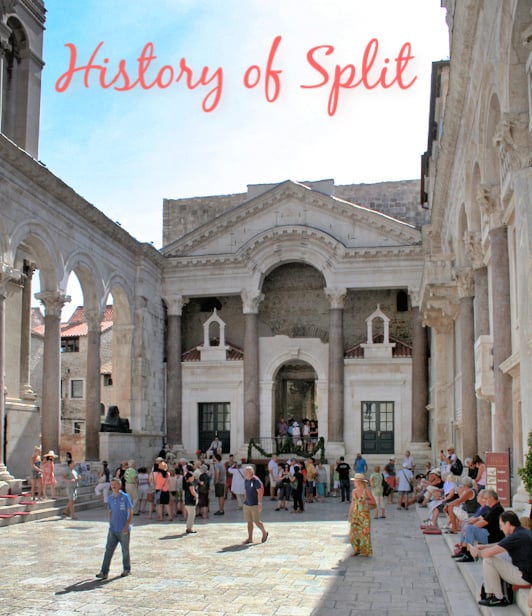
After the 7th century, when the Roman colony of Salona was abandoned, many of its inhabitants sought sanctuary behind the palace’s high walls. Their descendants continued to live there over the centuries.
History of Split up to and under Venetian Rule
During the 11th century and beyond, the city of Split grew considerably in the areas around the palace. Split enjoyed a good degree of autonomy between the 12th and 14th centuries before it was conquered by the Venetians in 1420.
After the fall of Venetian rule in 1797, Split was ruled by the Austrians, and briefly by the French.
20th Century Split
In the 20th century after the dissolution of the Austro-Hungarian Empire, Split became part of the Kingdom of Serbs, Croats and Slovenes that was established in 1918. Much of its development occurred after 1920. In that year, Zadar, Dalmatia’s official capital, became an Italian enclave. Split took its place as the main city in the region.
In 1941, the city was occupied by the Italians. A very strong resistance movement soon evolved with the city first being liberated in 1943 after the capitulation of Italy. Although then occupied by Germany, in October 1944 Split was finally liberated again when the first people’s government of Croatia was formed.
As part of Yugoslavia after World War II, Split experienced substantial growth. Government investment in the city saw factories built for a number of different industries. In particular, shipbuilding was an important part of the city; Yugoslavia became one of the top countries in the world in that field. Split also became an important port.
Split did not suffer much damage during the war that broke out in 1991, despite the Yugoslav Navy and the Yugoslav Army’s coastal district being based there.
Since Croatia’s independence, Split suffered as its once-strong industry entered into decline. However, it has recovered in recent years and is today a bustling city and – pleasingly – increasingly a popular place for holidaymakers to visit.
More info
There’s an excellent write-up about the history of Split by Croatia expert Marcus Tanner on the History Extra site: The history of Split: Croatia’s splendid Roman palace city.