
|  |
This article featured in the 25th anniversary issue of Personal Computer World, which came out in April 2003.
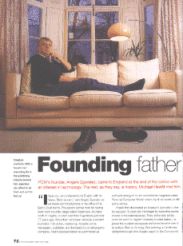
PCW’s founder, Angelo Zgorelec, came to England at the end of the sixties with an interest in technology. Michael Hewitt met him.
“I hope you can understand my English with its heavy, Slavic accent,” said Angelo Zgorelec as we made our introductions in the office of his Earl’s Court home. The accent comes from his having been born in a small town called Koprivnica, 60 miles north of Zagreb, in what was then Yugoslavia, just over 57 years ago. Since then he’s been variously a student journalist, fruit-picker, washer-up, hospital porter, newsagent, publisher, and the head of a small property company. And in between times he summoned up sufficient energy to found some techie magazine called Personal Computer World, which, by all accounts, is still going strong.
Angelo first discovered an interest in journalism when he was just 15 years old. He began by supplying sports stories to the national press. Then, in the mid-sixties when he went to Zagreb University to read history, he joined the student newspaper and soon became one of its editors. But not for long. One evening, a functionary visited him to ask why Angelo wasn’t in the Communist Party. In the Yugoslavia of the sixties, trying to be a journalist without carrying a Party card was a faux pas as massive as trying to be a chief constable without joining the Masons. So the aforementioned functionary gave him a choice: join – or else. “I didn’t like being told to believe in something in which I didn’t,” said Angelo. “So I refused and was dismissed from the newspaper. I’d been getting increasingly fed up with all the restrictions on life in Yugoslavia, anyway, so this was the last straw for me. Then I suddenly found out that the university was offering students the chance to go abroad, fruit-picking in England – I jumped at it.”
With just £4 in his pocket, Angelo arrived in the UK and set to picking plums. He soon graduated to washing dishes and then hospital portering. He also kept up the journalism, writing reports on “swinging London” as a freelance for the Croatian press. Then came his big break, businesswise, when he managed to convince a distribution company called The Seymour Press to allow him to sell The International Herald Tribune and assorted other US publications via street pitches and other small-scale retail outlets. With the money made here, and in other ducking-and-diving routines, he was soon able to afford to buy a small newsagent’s shop.
At this point, a thought came to him: instead of simply selling someone else’s publications, why not set up one of his own? After all, he now had enough money. But on what subject? He had always had an interest in technology of all sorts (solar power and satellite communications, for instance) so Angelo knew it was going to be technology related.
“Then one day I saw a front-page article in the Wall Street Journal describing how computers were about to revolutionise the world. I found it fascinating. So much so that I cut it out and kept it in my pocket. Round about the same time, the first computer shop in London, The Computer Workshop, opened on Ifield Road. They had a computer in their window. I forget exactly what it was, but every evening I used to go there just to stand outside and look at it. I thought it was absolutely amazing.”
Between drools, it didn’t take Angelo long to decide that his proposed magazine was going to be about computers. But would there be a market for it? Although Practical Electronics regularly devoted six pages to what passed for computers in those days, there was no computer magazine per se in the UK, unless you counted the US import, Byte. This was probably because computers were still largely a minority, hobbyists’ area, like model aircraft. Most people put their own together from off-the-shelf components. If you were prepared to shell out upwards of £2,000 for, say, an Intel 8080 processor, 16Kb of memory, a keyboard, and a cassette tape recorder for storage, you could end up with something that was pretty good for playing a game of hangman. It therefore required something of a leap of faith to believe that one day these things would become standard items of consumer electronics equipment. But Angelo’s faith leapt, nonetheless.
“I found out that Byte magazine was holding a computer show in New York and so I decided to fly over there and take a look – at the time, Laker Airways was starting to sell flights for £65. I reckoned that if computing looked likely to take off in America, then it could take off here, too. So I went to New York and turned up at the exhibition. There was a two-hour queue to get in. I essentially said to myself: ‘I don’t need to see anything else. If people are prepared to queue for two hours, this is going to be huge’.”
Back in the UK, Seymour Press offered to distribute the magazine, although they tried to convince him to stick to some subject with more of a future, such as CB radio. But Angelo was adamant. He then asked one of his friends, a beat poet and “permanent student”, Meyer Solomon, if he’d like to edit it. Meyer didn’t have anything else on, so he agreed. And the next question was: what were they going to call the publication?
“It was always going to be … something … ‘World’, but it was the first word that took a lot of thought. Eventually, there were two choices; Micro Computer World or Personal Computer World. In the end, I settled on the latter.” But at the time, the idea of a “personal” computer was almost as woolly as that of a “personal” concrete mixer.
Angelo assembled the first edition of Personal Computer World in the Troubadour Cafe in London’s Old Brompton Road which, coincidentally, was where Bob Dylan made his UK debut. Its appearance was timed to coincide with the launch of Britain’s own Microcomputer, the Nascom 1, a colour picture of which appeared on the cover at the time. This must have helped. When PCW hit the streets in February 1978, it was an immediate sell-out. All of the 30,000 print run was snapped up, and the magazine soon recouped its £12,000 start-up costs. “It’s much better than anyone expected it would be,” said journalist, Guy Kewney, upon being presented with a copy – “Which is one of the nicest compliments I’ve ever received,” said Angelo.
PCW went monthly from the second edition and hasn’t really looked back. Angelo himself was publisher for 16 issues, and then went into partnership with Felix Dennis. Eventually, the title was sold to VNU Publications for £2.5 million. Angelo’s share helped him pay for his house and much else, besides. So, does he still keep his hand in? “Although I use computers all the time, I’m not really up to speed on the development side of things any more. I’m astounded at the progress that’s been made over the past 20 years, of course. I love the internet, for example, and the fact that every day I can discover something new. But in the future, I’ll watch from the sidelines. Besides, at my age, it’s time to slow down a little.”
Sadly, Personal Computer World ceased publication in 2009. You can read more about the magazine here.