

The Plitvice Lakes National Park, Croatia’s most popular tourist attraction, was granted UNESCO World Heritage status in 1979. Located roughly halfway between capital city, Zagreb, and Zadar on the coast, the lakes are a definite must-see in Croatia. (As confirmed by the many emails we’ve received!)
The beauty of the National Park lies in its sixteen lakes, interconnected by a series of waterfalls, and set in deep woodland populated by deer, bears, wolves, boars and rare bird species. The National Park covers a total area of 300 square kilometres, whilst the lakes join together over a distance of eight kilometres.
There’s also quite an altitude difference – the highest point is at 1,280m, the lowest at 380m – although the total height difference between the lakes themselves is only 135m. (Veliki Slap, the largest waterfall, is 62 metres tall.)
If you’re undecided about whether or not to visit Plitvice Lakes, take a look at any photo album of the Park and that will surely sway you! The official Plitvice Lakes website has a fantastic virtual tour that features some truly stunning scenes.
Or, for another preview, check out our Plitvice Lakes Photos!

Explorer Club offers a “Plitvice Lakes Escape” at the Lika Retreat eco-village which is home to lodges (housing 2 to 8 people) offering comfortable, family-friendly accommodation, plus outdoor grills, gazebos and an onsite swimming pool. The Retreat is a perfect base year-round, whether you’re visiting during peak summer, colourful autumn or a snowy winter month; Explorer Club will arrange activities (hiking, biking, kayaking) national park visits and other excursions for you and your group. The Plitvice Lakes Escape also includes three traditional dinners that embrace the flavours typical of this part of Croatia. Grocery delivery and airport transfers are included!
Getting to the Plitvice Lakes National Park
See our page on Getting to the Plitvice Lakes National Park for details on how to get there by public transport or organised excursion.
If you’re driving to the Park, there is a car park at both entrances. For a standard-sized car, parking costs €1.50 per hour in March, April, May, October and November and €2 from June to September. Outside of these months, parking is free.

Visiting the Plitvice Lakes National Park
The Park is open daily all year round, with longer opening hours during summer (usually 7am to 8pm). The entrance fee acts as a contribution to the Park’s upkeep and protection. For adults, it is €10 from January to March and in November and December; €23 during April, May and October; and €40 for June to September.
If you visit after 4pm in June, July, August and September, tickets are discounted – they cost €25.
Children aged 7 to 18 have cheaper tickets (€4 in off-season, €6 in mid-season and €15 in peak season – or €9 after 4pm), whilst children under the age of seven go free. Students also get discounted entry, and groups of 15 or more (whether adults, students or children) can also get discounts.
2-day tickets for the Park can also be purchased, which are worth it if you really want to make the most of what Plitvice has to offer. These cost €15 in off-season, €39 in low season and €60 in peak season.
4-hour guided tours in English, German, French, Spanish, Italian or Croatian can also be pre-booked for a minimum of 15 people at an additional cost.
There are two entrances to the Park – excitingly titled Entrance 1 for the lower lakes and Entrance 2 for the higher lakes. Entrance 2 (and therefore some of the park) is normally closed in winter (November to April). Always take a look at the official Plitvice Lakes website before you visit for advice on what is or isn’t open/accessible.
Full details of ticket prices can be found on the Price List page of the Plitvice Lakes National Park website.
You can purchase tickets for the Plitvice Lakes National Park in advance online or at the ticket booths at the entrances. During the busy summer period, it is recommended to purchase tickets in advance so you don’t wait for ages in a queue!
Sightseeing in the Plitvice Lakes National Park
See our special page on Exploring the Plitvice Lakes National Park.
The best time of year to visit
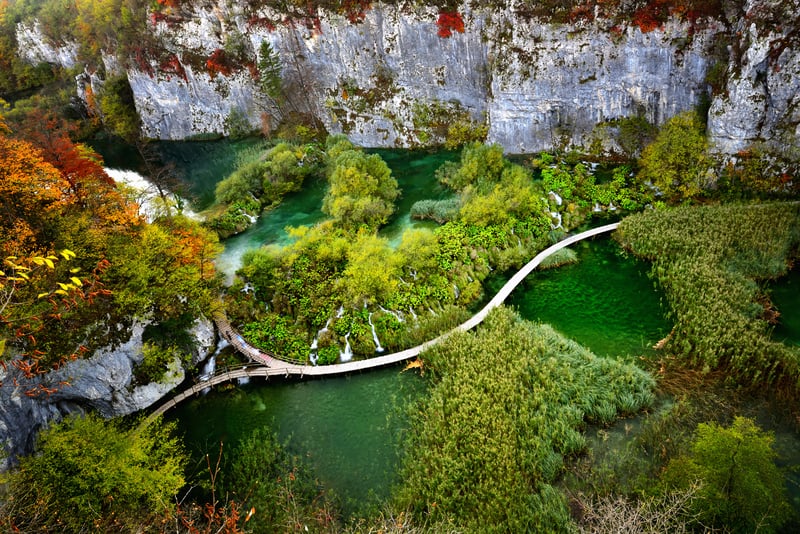
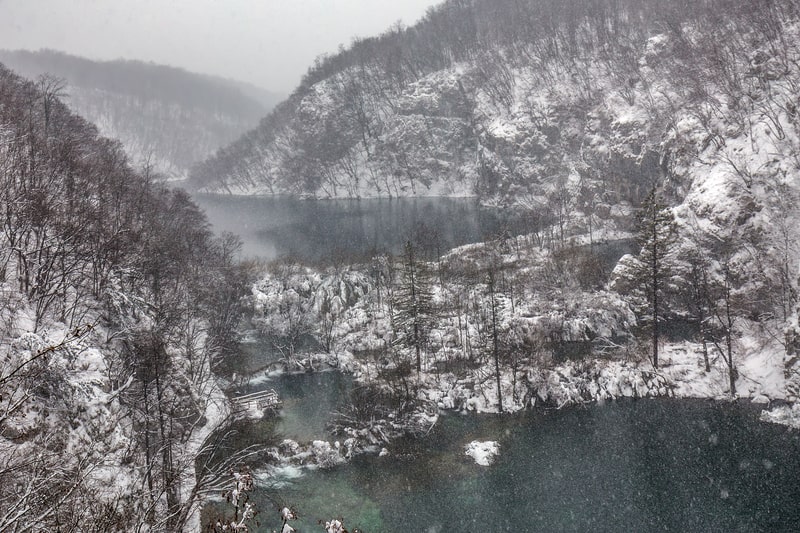
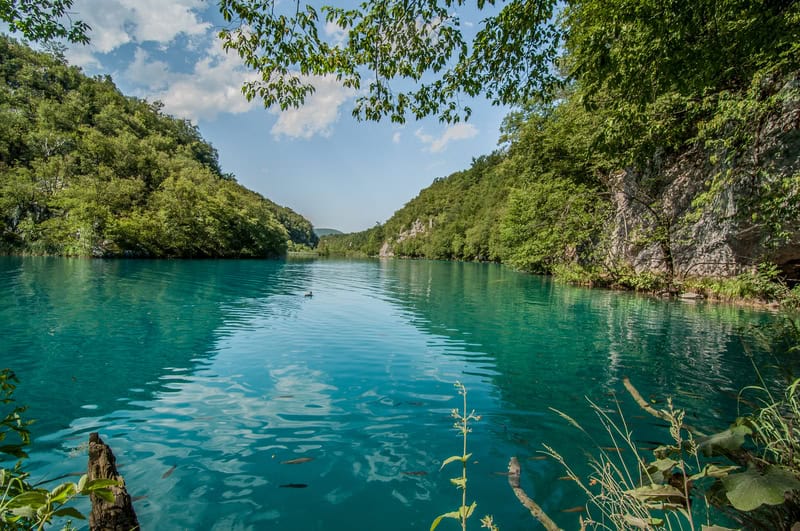
Plitvice Lakes isn’t just for summer. It’s a stunning place to visit any time of year as the different seasons see the Park take on different hues, whether that’s lush greenery in spring/summer, rich colours in autumn, or magical scenes in the snow and ice in winter. Even if conditions are rainy, the park can still be wonderful to explore as the water takes on a dramatic effect – sometimes bubbling up underneath your feet on the wooden pathways!
Understandably, Plitvice can get very busy during the summer and the pathways can be quite crowded. We’d ideally recommend a spring/late summer visit when the weather is still good, the park is open for relatively long hours, but there should be fewer people.
Do note that Entrance 2 (higher lakes) normally closes in winter. There’s still plenty to explore from Entrance 1! In fact – I can advise you exactly on what there is to see. Read up my special post on Visit Croatia Review: Plitvice Lakes in Winter.
Accommodation in the Plitvice Lakes
It is possible to stay right next to the Park at one of its hotels (which are all clustered quite closely together by Entrance 2), although not all are operational at the present time. The one hotel that is the 3-star Hotel Jezero, which offers 205 rooms and is open year-round.
The Park’s campsite is Camp Korana, which contains bungalows or space for 500 camping units and is located about 7km from Entrance 1. Another campsite, Camp Borje, is 15km away from Entrance 2. These two campsites are only open from April to October.
Other hotels in the wider region include the Lakeside Hotel Plitvice, the Hotel Palcich Plitvice, the Hotel Degenija, the 16 Lakes Hotel and the Lyra Hotel Plitvice, all of which are 4-star.
There is also a very wide selection of private accommodation (rooms, apartments in guesthouses and similar) in the region. These include some options very close to the park entrances, but also plenty of choice in a number of the towns and villages (such as Slunj) on the way to the Park.
If you don’t have your own car, make sure you choose accommodation that’s within walking distance of the Park. (Or perhaps arrange transfer options with the accommodation owners.)
Take a look at hotel and apartment accommodation in the Plitvice region using the map below:
Do also see our Accommodation in the Plitvice Lakes page for a detailed listing of all of the above options.
More information
Please see the official Plitvice Lakes National Park website.
If you’re visiting the Lakes, do also visit the nearby Barac Caves – an amazing underground natural phenomenon – which is only 20km away.